

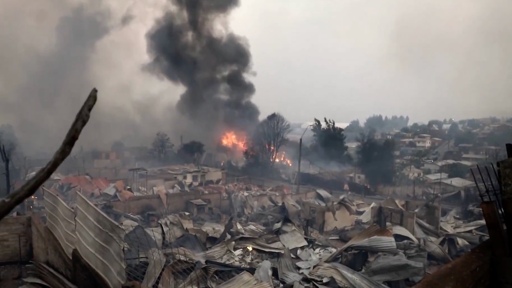
Devastating fires in Chile continue to ravage the south of the country. The magnitude of the damage compelled the center-left government of Gabriel Boric to declare a “state of catastrophe” in several regions of the country, including Ñuble, Bío Bío, and La Araucanía.
According to the National Forestry Corporation (CONAF), there are 10 fire hotspots where firefighters and other state agencies are working intensively. However, according to CONAF director Rodrigo Illesca, there are 48 active fires in the country.
The fires began on January 17. So far, more than 280 fires have been recorded, of which about 139 have been brought under control. According to authorities, more than 20 people have died, and tens of thousands have been forced to evacuate their homes immediately. The Ministry of Public Works reported that more than 2,000 tons of debris have been removed from the disaster areas.
President Boric has stated that he will provide immediate financial aid to those affected: “Once again, from the Biobío Region, we continue to work alongside local authorities to coordinate the various vouchers, food supplies, and emergency housing that are reaching our compatriots. Aid that has arrived from different parts of Chile is being distributed from the collection center in Talcahuano. Together, organized and working side by side, we will move forward!”
According to various media outlets, the flames have destroyed a vast area of more than 64,000 hectares, although several experts suggest that the actual amount of forest destroyed will likely increase as the fire remains uncontrolled.
In addition, Chile’s Legal Medical Service (SML) has reported that the death toll has risen to 21 people. On January 24, the SML handed over the remains of four victims to their families after recovering them from the aftermath of the fire.
“As a result of this work, we have now been able to identify all of the deceased in Biobío, except for the one found during today’s operation,” Marcela Cartagena, regional prosecutor for Biobío, told the press.
For now, it appears that weather conditions have slowed the spread of the fires. In addition, the director of CONAF stated that the efficient response of the authorities has slowed the spread of the fire. Air support and the deployment of large brigades in the territory have been essential.
However, Illesca has reported that, starting on January 27, weather conditions are expected to cause the fires to intensify, especially in the Maule area and in parts of the southern mountain range near La Araucanía.
The support of firefighters from other countries has been essential in the work to mitigate the fires: 195 from Mexico, 31 from Uruguay, 15 from Argentina, 10 from Spain, among others. The firefighters’ work will continue for at least two weeks or more until most of the fires are under control.
Why have the fires in Chile been so devastating?
Many people are wondering about the intensity of the 2026 fires. In Chile, fires often occur in certain areas throughout the year, but the current fires have attracted attention due to their aggressiveness and rapid spread.
Several scientists say that they are not only due to the extreme summer heat, drought, and wind, but also because people have altered nature in such a way that fires spread more quickly.
To this must be added, scientists say, the specific effects of climate change, which has caused a lethal mix that can even be seen in satellite photographs, revealing the magnitude of the disaster.
“We are experiencing a particularly critical situation that is far beyond the usual averages normally seen in forest fire seasons … This year in particular, we are almost tripling the amount of area affected, but not the number of fires,” which so far is “within normal ranges, even below average,” Miguel Castillo, director of the Forest Fire Laboratory at the University of Chile, told the Los Angeles Times.
Furthermore, it is important to note that Chile is facing a long drought, which, according to several experts, has lasted for several years, creating the perfect conditions for fires to spread out of control.
Thus, global climate change is once again wreaking havoc, for which humanity is still unprepared. According to experts, if immediate action is not taken to curb climate change, fires such as those in the global South will continue in the coming years and could be even more devastating.
The post More than 20 dead and 50,000 evacuated due to fires in Chile appeared first on Peoples Dispatch.
From Peoples Dispatch via This RSS Feed.