

On Monday evening, Gregory Bovino was demoted from his role as “commander at large” of Border Patrol. The Washington Post’s editorial board called it “a tacit admission that [Trump] understands that his administration’s deportation strategy has gone too far.” At the same time, Minneapolis mayor Jacob Frey announced that some federal agents would leave the next day and that he would continue to push for a full withdrawal.
Firing a mid- or high-level official is a well-known tactic that governments use to dissipate discontent. It is an attempt to partially deflect responsibility and save face in the context of insurmountable criticism, but it also acknowledges that the previous course of action cannot continue. In this case, Trump took a hit. The brutal occupation by ICE and the lawless terrorizing of immigrants, protesters, and legal observers — this cannot continue.
The pressure on Trump increased significantly after a second public execution by federal agents on Saturday. Sports stars and Hollywood actors amplified the discontent. Even members of the Republican Party voiced their dissatisfaction or even defected from the party altogether. But make no mistake: all these developments in the “superstructure” are a result of the popular resistance in Minneapolis.
Minneapolis forced the Trump administration’s hand. This is a partial victory for the movement against state terror and against Trump’s assault on immigrants, working-class communities, and the Left. It is a victory for which Minnesotans paid a high price: the lives of Renée Good and Alex Pretti, in addition to the lives of those who died in detention centers and the many injuries and traumas that community members endured. But it is important to claim this small victory. It gives us all strength to keep fighting, and it provides us lessons to prepare the resistance in other cities. Here are three keys.
1. Self-Organization (or, ICE fucked with the Wrong City)
ICE landed in Minneapolis looking to terrorize working-class communities (primarily, though not exclusively, immigrants and people of color) and to make an example of a city that dared to stand up and fight in 2020. The George Floyd uprising, including the burning of a Minneapolis Police Department precinct, was a chapter of class struggle that put Minneapolis in Trump’s crosshairs.
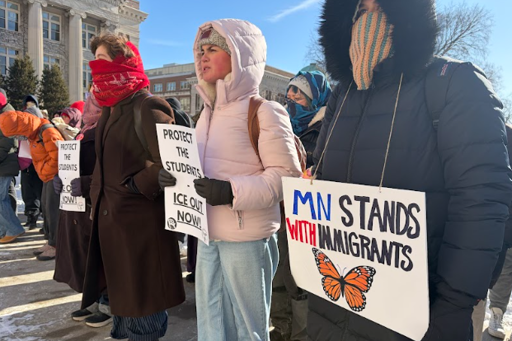
But what ICE found was a city ready to fight back. Two thousand agents (later increased to 3,000) roamed the city, kidnapping people, breaking into homes without warrants, and brutalizing anyone who would stand in their way or simply record their activities. Yet they faced an organized community, with a high level of working-class solidarity, that did not back down.
Despite the terror and the violence, thousands of individuals joined rapid-response groups, took to the streets to protest, sounded whistles, and recorded agents with their phones. A massive network of self-organized, overwhelmingly working-class people delivered food to families who could not safely leave their homes; collected and dropped off groceries in key hubs and at people’s homes; escorted people at risk of deportation; and more.
2. Working-Class Power
ICE agents found themselves outnumbered. They encountered an organized populace that resisted, followed their moves, and made their operations harder and their lives miserable. Despite the murder of Renée Good — and partly because of it — people continued to resist the occupation, protecting their neighbors and keeping ICE in check. As many members of ICE watch groups observed, the violence they encountered from ICE agents was a clear signal that their activity bothered them; it made their work harder.
The massive day of action on January 23 was an unprecedented show of strength. Despite the tepid role of most union leaders, many of whom endorsed the call but did not organize a real strike, the city was paralyzed. The 50,000 to 100,000 demonstrators in Minneapolis, joined by many thousands in other cities, sent a clear message of unity and strength against repression. At the massive mobilization, the crowd was full of people wearing union pins, Teamsters sweatshirts, and many other union items. Six Starbucks locations — two of which weren’t even unionized — were shut down after workers walked out. After the mass day of action in Minneapolis, the idea that organized labor must play a decisive role in resisting Trump only increased, as widespread calls were made for a national general strike, and some unions, like National Nurses United, joined the call to abolish ICE.
3. Perseverance and the Will to Resist
I can only imagine how small and powerless ICE agents must have felt. They were on the losing side. But a white-supremacist military force with wannabe Nazis at its helm thinks they can overcome any resistance by sheer force. They came out the next day like a raging bull, ready to take on anyone who stood in their way. Yet they again found an organized community unwilling to back down.
The chain of events could have been different. People could have stayed home in the face of life-threatening encounters. Had this been the case, ICE could have continued to roam the streets freely as a military force in an occupied territory. But this is not what happened. People continued to turn out. This courage, this heroism embodied in Alex Pretti, martyred by state repression, is what kept Minneapolis united, alive, and strong. It is this courage and heroism that forced Trump’s hand.
For Alex Pretti, for Renée Nicole Good, for Gerardo Lunas Campos, and for the many who lost their lives that we still don’t know about, we must continue this fight until we abolish ICE. We must build on the historic day of action and organize a national general strike for these demands and more: all federal agents out of Minneapolis now, prosecute all agents involved in the murders in Minneapolis, no more deportations. Union leaders are not going to do it by their own initiative. As rank-and-file union members, we need to build pressure from below so that they have no alternative but to mobilize unions’ resources and call the strike so that members can join en masse.
A period of awakening can follow this intense episode of class struggle. Masses of working-class people may suddenly realize the power of unity and struggle, and the need to build their own political party. Amid such grim prospects, this counter-tendency could permanently change the course of politics in the United States.
The post How Minneapolis Defeated Bovino appeared first on Left Voice.
From Left Voice via This RSS Feed.