


By David Swanson, World BEYOND War, January 27, 2026
Secession first he would put down
Wholly and forever,
And afterwards from Britain’s crown
He Canada would sever.
Yankee Doodle, keep it up,
Yankee Doodle dandy.
Mind the music and the step
and with the girls be handy!
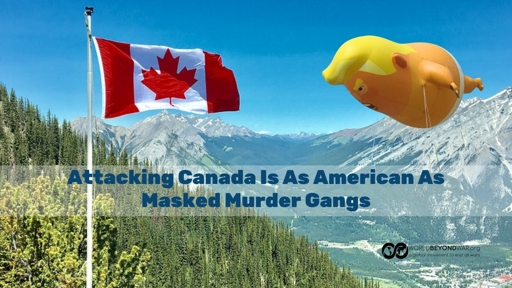
Grab em by the CN Tower! The U.S. and Canada may be preparing for war with each other, even while selling each other weapons, jointly building insane “Golden Dome” schemes, and so on. It’s all a big joke, of course. And it’s very Trumpian and off script. But that doesn’t mean it isn’t part of a longstanding tradition.
Six-years after the British landing at Jamestown, Virginia, with the settlers struggling to survive and hardly managing to get their own local genocide underway, these new Virginians hired mercenaries to attack Acadia and drive the French out of what they considered their continent. It didn’t work, but what war ever does? The Virginia-based U.S. military still thinks as the Jamestown settlers thought, centuries of cultural progress having passed it by.
The colonies that would become the United States decided to take over Canada in 1690 (and failed, again). They got the British to help them in 1711 (and failed, yet again). General Braddock and Colonel Washington tried again in 1755 (and still failed). But they did perpetrate a great deal of ethnic cleansing, driving out not just the Acadians but also the indigenous Indians.
In 1758, the British and U.S. stole a Canadian fort, renamed it Pittsburgh, and no doubt immediately made plans to build a giant stadium across the river dedicated to the glorification of ketchup. Two years later, the British took over everything.
In 1775, George Washington sent troops led by Benedict Arnold to attack Canada yet again, talking about “liberating” Canada and demanding gratitude. Before long, of course, the soon-to-be U.S. would be fighting the British. The great and glorious Constitutional Convention in Philadelphia then drafted a Constitution that added Canada as that age’s equivalent of the 51st state (the 14th state). Some editing was done.
Benjamin Franklin asked the British to hand Canada over during negotiations for the Treaty of Paris in 1783. Britain did so, to a significant degree, handing over land that did not belong to it or to Canada or to the Unites States, the land that would become Michigan, Wisconsin, Illinois, Ohio, and Indiana. People who live there may or may not know that they used to be Canada. It may or may not occur to them that they, too, could have had healthcare, education, and transportation.
In 1812, the U.S. and British transformed skirmishes, maritime offenses, and trade disagreements into a full-blown, utterly useless and destructive war, the main accomplishment of which, other than death and misery, seems to have been getting Washington, D.C., burned. Honest charges could be laid against the British. And, unlike many U.S. wars, this one was authorized by, and in fact promoted primarily by, the Congress, as opposed to the president. But it was the United States, not Britain, that declared war, and one goal of many war supporters was not especially defensive — the conquest of Canada!
Congressman Samuel Taggart (F., Mass.), in protest of a closed-door debate, published a speech in the Alexandria Gazette on June 24, 1812, in which he remarked:
“The conquest of Canada has been represented to be so easy as to be little more than a party of pleasure. We have, it has been said, nothing to do but to march an army into the country and display the standard of the United States, and the Canadians will immediately flock to it and place themselves under our protection. They have been represented as ripe for revolt, panting for emancipation from a tyrannical Government, and longing to enjoy the sweets of liberty under the fostering hand of the United States.” *
Taggart went on to present reasons why such a result was by no means to be expected, and of course he was right. But being right is of little value when war fever takes hold. Vice President Dick Cheney, on March 16, 2003, made a similar claim about Iraqis, despite himself having pointed out its error on television nine years earlier when he had explained why the United States had not invaded Baghdad during the Gulf War.
After the war of 1812, it was off the the West, and eventually all the way to taking Washington and Oregon from Britain and Alaska from Russia, and bribing politicians for the Reciprocity Treaty of 1854. There were new attacks on Canada in the 1860s and 70s. When Canada was established as a nation, the U.S. Congress condemned it. In 1930, the U.S. drew up a plan to attack Canada using chemical weapons. In 1935 it got another “free trade” agreement, after which many more have of course followed. Respect and decency never quite did, though. Whether LBJ actually grabbed Lester Pearson and accused him of having “pissed on his rug” by mildly questioning ever so slightly the U.S. genocide in Vietnam, I don’t know, but the tale is accepted wisdom, as is the relationship is depicts between the two countries.
If Canada steps too far out of line, there are those in the U.S. government who will expect it to be made part of the contiguous United States stretching from Cuba to Greenland.
* See: Samuel Taggart, “With Good Advice Make War,” in We Who Dared to Say No to War: American Antiwar Writing from 1812 to Now, edited by Murray Polner and Thomas Woods Jr., Basic Books, 2008, p. 15.
The post Attacking Canada Is As American As Masked Murder Gangs appeared first on World BEYOND War.
From World BEYOND War via This RSS Feed.