


James Mendelsohn and Edward Cantor are two of three Israel supporters who made dangerous smears against left-winger James Wilson. The third, Pete Newbon — a serial Israel troll who also attacked Jewish left-winger Michael Rosen — died by suicide before the conclusion of Wilson’s case and has been falsely lionised by the Israel lobby.
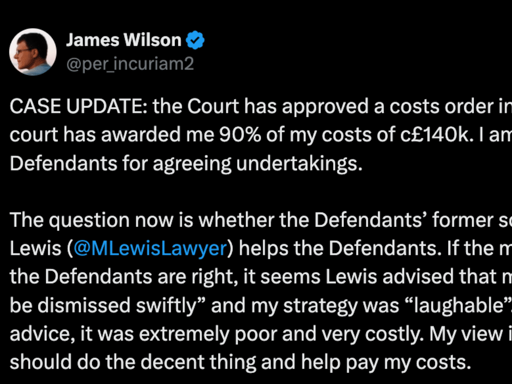
The survivors were ordered to pay almost £140,000 in costs to their victim, on top of an award of £30,000 in damages made after James Wilson won his libel trial against them. The smear put Wilson and his family in fear of physical harm – and the pair’s conduct of their defence, advised by pro-Israel lawyer Mark Lewis, smeared Wilson even further.
Since the end of the case, Wilson – also trained as a lawyer – has written a series of analyses of the conduct of various parties trying to defeat him. These include notorious pro-Israel lawyer Mark Lewis, at the centre of a string of aggressive legal actions – and an attempt to ‘cancel’ comedian Reginald D Hunter.
Lewis advised the late Newbon – and was fired by Newbon’s widow, Rachel Hewitt. Hewitt later wrote that her late husband had been:
secretly pursuing multiple court cases entirely unbeknownst to me, risking my and my children’s financial security and home.
In December 2025, Wilson laid out “some of the evidence” that Lewis:
made dishonest statements to the Solicitors Regulation Authority (SRA) in response to a report I made. By dishonest I mean that Mr Lewis knew his statements to the SRA were untrue or misleading, or he was reckless as to whether they were untrue or misleading. I set out some of the evidence and analyse it below.
In his latest report, based on further documents released to him following his successful court case against Cantor and Mendelsohn, Wilson sets out evidence relating to another high-profile legal figure: the well-known Gavin Millar KC. The revelations are explosive. They speak volumes about the motivations of the Israel lobby in choosing the victims of their various forms of hounding.

Image from Gavin Millar’s Matrix Chambers profile.
Wilson writes:
This episode looks at one specific document which is a typed record of a conference in February 2023 with Gavin Millar KC…
…Having lost the applications to strike out my claims, Mr Millar was instructed to advise on an appeal. On 16 February 2023, there was a conference to discuss the appeal. I do not know if the conference was in person or online. At the conference were: Mr Millar; Ms Grossman (the defendants’ barrister who acted for them at the strike out hearing); Mr Lewis (who then acted for Mr Cantor and started to act for Mr Mendelsohn five days later); and Megan Tolkien (Mr Lewis’ assistant at Patron Law).
Neither Mr Mendelsohn nor Mr Cantor were at the conference. I do not know the reasons why, but it is common and important for clients to attend conferences with their barrister(s). … In addition to not attending the conference and never speaking to Ms Grossman or Mr Millar, Mr Lewis’ advice about attending the strike out hearing in an email of 11 January 2023 to Mr Cantor was “I certainly would not travel to the hearing”. If you are ever involved in litigation, but never get to speak to your barrister and your solicitor advises you not to attend a hearing, then alarm bells should be ringing.
Wilson’s analysis goes into some depth, but even from a cursory reading certain parts jump out. In one instance — taken from notes made by Lewis’s assistant — Lewis discusses with Millar his motives for pursuing the case:
I turn now to Ms Tolkien’s note of the conference. The note is a summary of what was said and not a transcript or verbatim account. The conference lasted from 14:00 to 15:08 and if you were to read out what is in the note, it would not take 68 minutes. … I have no reason to think that Ms Tolkien’s note is inaccurate.
Mr Millar advised against an appeal, but what is more interesting is what the exchanges between the lawyers reveal. I provide a series of extracts below with some analysis and opinions.
The conference started with:
Gavin Millar: Looking at appeal, what do we get out of it?
Mark Lewis: get some money out of him [me]. If good appeal, do so anyway.
Mr Lewis’ apparent fixation with getting money from and bankrupting me is a recurring issue. Later on in the conference Mr Lewis said the most desirable outcome was me paying the lawyers £100,000. Any money that Mr Lewis might have got from me was for himself and Patron Law for their fees. His clients would have got none of it.
Wilson then covers instances of Lewis withholding “crucial” evidence from the court before trying to have Wilson’s case struck out. And the fact that Lewis appears not to have mentioned it to Millar either, who was receiving a substantial payment from Lewis’s clients for Millar’s advice:
While a discussion about the crucial evidence might have been omitted from the note, the most likely explanation is surely that Mr Lewis and Ms Grossman did not tell Mr Millar about the evidence and that is why it was not discussed?
If I am right about this, then something very weird has gone on. The defendants were paying – it cost them £1,680 – for the advice of Mr Millar, one of the foremost defamation lawyers in the country, but it seems their lawyers did not give Mr Millar crucial evidence so he could give informed advice on a key issue in the litigation.
My suspicion is that the crucial evidence was not given to Mr Millar because he might have advised “You cannot appeal the decision where you have evidence that suggests publication by Mr Cantor to over 500 people”.
Perhaps Mr Millar might also have said “Frankly, I cannot believe you ran what you knew was a misleading case on limited publication to try to get Wilson’s claim struck out”.
Then there is discussion of Lewis’s “incompetence and unprofessional conduct”, until Wilson gets to a comment by Millar. It might even surprise those familiar with the cases he’s taken on during his long career.
What is striking about Mr Lewis’ ‘made-up world’ is that none of the issues he identifies really relate to the best interests of his client Mr Cantor. While Mr Cantor risked losing his home in the litigation – and it will be as devastating for him as it would have been for Dr Newbon – Mr Lewis was focussed on his own interests or what interested him: getting money from me, bankrupting me, the complaints to the SRA, bullying me, blaming me for Dr Newbon’s death, etc, etc. Mr Cantor’s interests do not get a look in.
Mr Millar’s response to Mr Lewis was:
Gavin Millar: Corbynite as well, another reason to bring him [Wilson] down.
Wilson finds this comment, and the whole apparent focus of the discussion on Lewis’s interests and not those of his clients, “disturbing” and “troubling”:
So, if Ms Tolkien’s notes are accurate, it is disturbing that: (a) there is talk about getting money out of me, bankrupting me, and bringing me down because I am a Corbynite; but (b) there is no talk at all about the interests of the defendants – in whose best interests the lawyers were required to act – or what the consequences might be for them. The defendants lost at trial and I did not have to pay their lawyers anything. I was not made bankrupt. I was not brought down. What is going to happen, though, is that Mr Mendelsohn will go bankrupt and Mr Cantor will lose the home in which he and his family live, which is what Dr Newbon faced before he tragically died by suicide. Again, the defendants found the litigation traumatic. I think it is fair to say that their lawyers should have thought and talked more about these things, rather than their weird fantasies about bringing me down.
The final exchange I want to analyse is this:
Mark Lewis: if D1 [Mr Mendelsohn] is liable for publication by D2 [Dr Newbon] and D2 cannot be liable for that publication because of his death can D1 still be liable?
Gavin Millar: yes, joint and severally liable.
This is seriously troubling. Mr Millar gives Mr Lewis clear and unequivocal advice that Mr Mendelsohn could still be liable for Dr Newbon’s publication even though Dr Newbon had died. When it came to trial ten months later, Mr Lewis secretly drafted – despite the conflict between him and them – the defendants’ closing submissions. One of Mr Lewis’ submissions was “D1 [Mr Mendelsohn] published only to D2 [Dr Newbon]. The libel claims against D2 was abated by his death. D1 cannot be liable for D2’s actions in circumstances where the law is clear that D2 cannot be liable for those actions”. The judge rejected Mr Lewis’ submission because it was – as Mr Millar had clearly advised Mr Lewis – wrong as a matter of law.
So: Mr Lewis had been correctly told by Mr Millar, a KC and one of the foremost defamation lawyers in the country, that Dr Newbon’s death was no obstacle to Mr Mendelsohn being liable for Dr Newbon’s actions. Despite this, Mr Lewis secretly drafted the defendant’s submissions on the basis that Dr Newbon’s death did prevent Mr Mendelsohn being so liable. Mr Mendelsohn genuinely believed I could not succeed at trial because he could not be liable for Dr Newbon’s conduct. Mr Lewis’ incompetence here is staggering.
What an insight into the Israel lobby’s lawfare industry — and Wilson goes on to list even more.
Featured image via X/the Canary
By Skwawkbox
From Canary via This RSS Feed.