

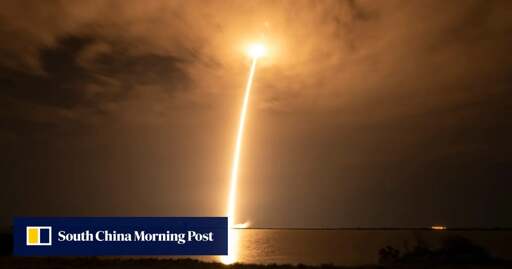
A team of researchers in China has claimed that a recent near-miss between a Chinese satellite and one of SpaceX’s Starlink devices was behind the US company’s decision to move more than 4,000 of its satellites into lower orbit. The two satellites passed within about 200 metres (656 feet) of each other on December 10, shortly after a launch from northwestern China, according to a social media post last month by Michael Nicolls, SpaceX’s vice-president of engineering. Three weeks later, in…
Fun fact: With the exponentially growing number of satellites, the time between evasive maneuvers needed to avoid collisions is dropping. This is called the CRASH clock.
In 2018, an evasive maneuver was needed every 164 days.
At the end of 2025, it was every 5 days.
And that time window is getting shorter.
If the CRASH clock gets shorter than the duration of a solar storm (which makes it temporarily impossible to issue evasive commands to satellites), there won’t be enough time to recover control before a collision cascade happens.
https://arxiv.org/abs/2512.09643Solar storms that were strong enough to disrupt satellites for 3 days happened in 2003, 2024 and 2025.
