

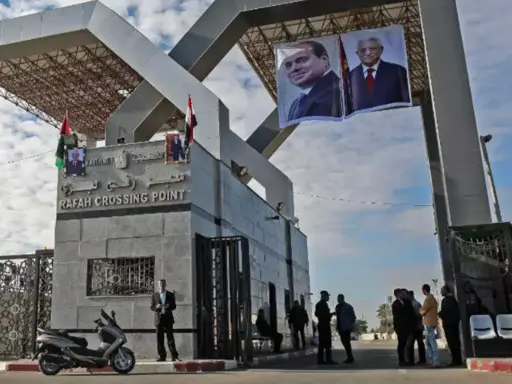

The residents of Gaza are anxiously awaiting the reopening of the Rafah border crossing. Egypt closed the crossing after Israel seized control and launched an offensive against the southern city in May 2024. If implemented, this would end the ban on Palestinians leaving Rafah.
Quid Pro Quo
This isn’t exactly a surprise announcement. The earliest reports emerged yesterday, alongside confirmation that Israel had retrieved the body of the last remaining Israeli captive, former police officer Ran Gvili. Israel agreed to restore border access on the condition of recovering Gvili’s remains — for pedestrians only. Furthermore, the office added that, Hamas, must “locate and return all deceased hostages” as a demand.
The crossing, a lifeline for thousands, has become a stark symbol of the isolation and siege imposed on two million people in Gaza. For two and a half years, Gazans have been cut off from the outside world. They are denied the right to travel and also denied the right to seek medical treatment for life-altering injuries inflicted by Israel’s occupying army. Others, including cancer patients and those with kidney failure, are trapped inside Gaza. Consequently, they are deprived of their freedom of movement.
On Sunday, Israeli Prime Minister Benjamin Netanyahu’s office reported that the opening would be partial and governed by “full Israeli inspection mechanisms.” The announcement followed an Israeli cabinet meeting. The Rafah crossing was undoubtedly top of the agenda in that meeting.
The UAE-owned outlet, Sky News Arabia, reported that in recent days opposition from Israel’s far-right to reinstating border access has grown louder.
Israeli National Security Minister Ben-Gvir — the man pushing for a discriminatory capital punishment policy against Palestinians — has called the potential reopening “a mistake.” Orit Strook, also a member of Israel’s far-right and minister for illegal settlements, warned against handing Gaza over to the Palestinian Authority (PA). The PA governs the Occupied Palestinian Territories (OPT).
Partial Reopening, Partial Gains
Armed Palestinian resistance factions, including Hamas, have welcomed the opening of the Rafah crossing, on both the Palestinian and Egyptian sides. Access, they said, is a fundamental human right that cannot be used as political leverage.
Hamas stressed that it has offered all possible guarantees and has been flexible in its dealings with regional and international efforts to lobby for reopening. It criticised the Israeli official narrative, which absolves itself of responsibility by blaming “terrorism.”
According to medical estimates, approximately 60,000 individuals in Gaza need urgent medical treatment. This figure includes 20,000 critical cases requiring evacuation.
Political Bargaining
Despite assurances from the occupying authority, the opening remains partial and has not yet occurred. Israel is widely known for leveraging the Rafah crossing as a strategic asset to taunt and cajole ordinary Palestinians.
For the people of Gaza, assurances from the occupying power inspire little confidence. Many fear more of the same. Namely, that Israel’s use of the crossing as a bargaining chip occurs without committing to the entry for aid.
Moreover, it’s unclear whether border access will be limited to people “exiting.” Egypt has insisted on bidirectional access and stressed that any reopening must be fully coordinated with Cairo.
The finer details
According to the center-left Israeli news outlet Haaretz, Israel appealed to the US to deploy private security companies along the crossing in place of Palestinian personnel.
Other outlets, such as Al Jazeera, reported that European observers would be deployed.
Will they differentiate between students, people with disabilities, and those requiring medical attention? For some, passing through the crossing isn’t a holiday choice but a matter of life and death. Will the rigid administrative system — which supplants the previous one — recognise the humanitarian obligation to allow people through? For now, people remain hopeful, but their optimism is tempered with caution — and rightly so.
Featured image via AFP
By Alaa Shamali
From Canary via This RSS Feed.