

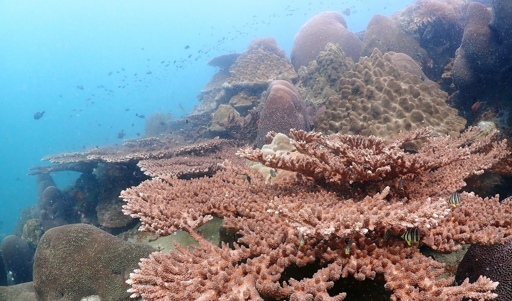
Marine scientists compiling the most holistic “snapshot” of Thailand’s coral reefs to date have uncovered evidence of a long-suspected reality: Thailand’s coral reefs are losing structural complexity. Home to more than 300 species of reef-building corals, Thailand’s reefs have been hit repeatedly by mass coral bleaching triggered by extreme marine heat waves. The stress of these events has likely prompted shifts in the species that make up coral communities, with knock-on effects across entire marine ecosystems, experts say. The new study, based on underwater surveys carried out between 2022 and early 2024, just before the effects of the fourth global coral bleaching event were widely reported in Thailand, documents fringing reefs and offshore pinnacles across eight provinces on the Gulf of Thailand and Andaman Sea coasts. The 2024 bleaching event will have inevitably taken an as-yet-unquantified toll on the region’s reefs, the authors note. “Having this map of what corals are represented across the region gives us a starting point for conservation,” said Rahul Mehrotra, research director at the Aow Thai Marine Ecology Center (ATMEC) and a co-author of the study. “We hope that this baseline will [motivate] more nuanced assessments.” While nationwide studies have previously attempted to assess coral health at long-term monitoring sites in Thai waters, the majority of evaluations have been “highly localised and sporadic in nature,” the study says. The new coast-to-coast data represent a fresh baseline against which reef managers, researchers and policymakers can measure future change, Mehrotra said. A diversity of coral growth forms…This article was originally published on Mongabay
From Conservation news via This RSS Feed.