

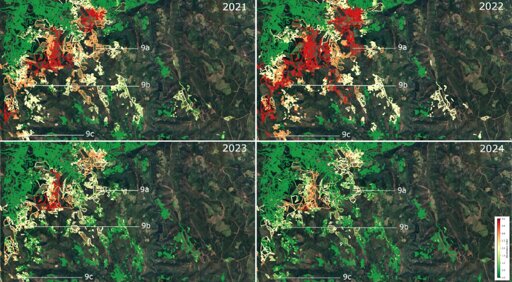
Researchers at the Regional Service for Agri-Food Research and Development (SERIDA) have developed a new large-scale remote sensing model that will enable comprehensive, high-resolution monitoring of fossorial water vole populations in areas where they cause agricultural damage. The system combines data collected in the field with satellite-derived information, facilitating detailed and continuous control of the appearance and spread of these rodents across extensive agricultural areas.
From Biology News - Evolution, Cell theory, Gene theory, Microbiology, Biotechnology via This RSS Feed.
You must log in or # to comment.