

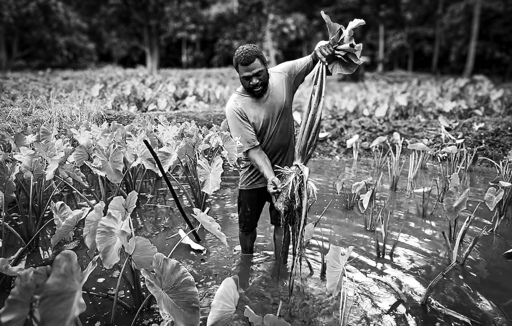
The packed-earth trail winds through the dense and tangled forest of Vanuatu, the ocean crashing just meters to our right. Richard Rojo’s feet don’t mind the stones and stumps, and he carries a bush knife and a repurposed rice sack. It’s a path well-trodden for Rojo, who’s lived here in the village of Tasmate on Vanuatu’s remote west coast of Espiritu Santo Island as a subsistence farmer and fisher all his 40-ish years. I walk-jog to keep up with him as he talks to me over his shoulder, idly whacking at an occasional vine with his knife. We’ve been traveling together a few days now in his open boat up and down this coast, on a reporting trip with the Sunset Santo Environmental Network (SSEN) team so I can see for myself the way villages here are threatened by climate change. We walk for about 10 minutes as I pepper Rojo with questions. We pass towering trees covered with epiphytic plants and wade across a river before popping out into a clearing the size of a few soccer pitches. Coconut palms edge the far side and, in front of us, earthen berms enclose a shallow rectangular pool maybe 5 by 50 meters (roughly 16 by 164 feet). Inside are rows and rows of chest-high plants with heart-shaped leaves: Colocasia esculenta, or water taro. Rojo sets down his knife and bag and wades into the pool. “I will go replace some that are dying like this one,” he says, finding his…This article was originally published on Mongabay
From Conservation news via This RSS Feed.