

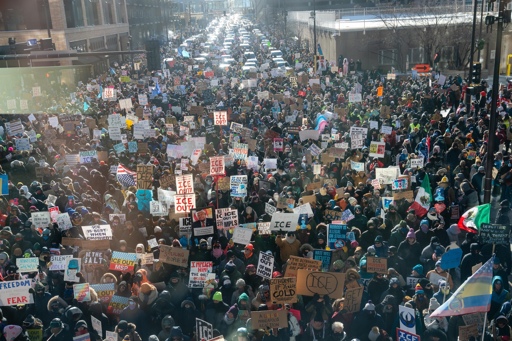
Minnesotans have been fighting to kick ICE out of the Twin Cities for over a month, since the Trump administration authorized “Operation Metro Surge,” unleashing thousands of federal agents onto the streets in a sweeping, indiscriminate attack on immigrants and their communities. The people of Minneapolis and St. Paul immediately jumped into action — drawing on the experiences of Los Angeles and Chicago — organizing within their neighborhoods to form patrols that identify and follow ICE agents, memorizing their rights and those of their immigrant neighbors, and delivering groceries to people too afraid to leave their houses in case ICE snatches them on their way to school or church.
This has become part of daily life for hundreds of people across the city, from activists who learned the brutality of state repression firsthand during Black Lives Matter in 2020 to people who are being politicized for the first time as a result of the second Trump administration’s assault on immigrants and so-called “sanctuary cities.”
Meanwhile, ICE’s tactics have escalated — targeting Black and Brown people regardless of their immigration status, dressing in plain clothes, using children as bait to abduct their parents, and using deadly force against those who protest or try to document their atrocities.
But even as ICE and federal agents tear through the city with increasing brutality — acting with the explicit sanction of the Trump administration — Minnesotans from every walk of life have adapted again and again to protect their neighbors, coworkers, classmates, and loved ones and to demand justice for those who have already been taken by ICE. Teachers are walking their students to and from school to prevent them from being followed by ICE; people show up every day to protest outside the building where ICE agents are deployed; they picket for hours outside hotels housing ICE agents with noisemakers and even a full band to keep the agents from sleeping; workers at local businesses have turned their workplaces into distribution centers for supplies; the networks to warn of ICE sightings have become even more well-organized and expanded, ready to organize and send people to the scene of ICE activity in minutes, in the full knowledge that they are risking their lives to do so.
Yet ICE has not left the streets — and agents have only become more emboldened. In response to the protests against the murder of Renee Nicole Good in broad daylight, the Trump administration has not sought to de-escalate the situation. Instead it recruited and deployed hundreds more federal agents to the city, calling protesters “domestic terrorists.” The administration has defended complete immunity for ICE agents, including the one who murdered Good. Trump officials even continue to spread lies after ICU nurse Alex Pretti’s murder, calling federal agents “victims.”
So Minneapolis decided to escalate. Local religious leaders, NGOs, and influential unions called for a city-wide economic shutdown to stop business as usual. In just a week, dozens of unions and social and political organizations endorsed the call. And Minnesotans responded in force.
No Work, No School, No Shopping
On January 23 over 700 workplaces shut down across the area. Signs hung in windows of businesses all over the city:
We’re closed in solidarity with our neighbors.
We welcome everyone except ICE.
ICE out of Minneapolis
January 23 — No work, no school, no shopping.
Meanwhile, the neon signs of major chains like Whole Foods and Target lit empty streets and shuttered shops, showing exactly whose side they’re on.
Over 50,000 people marched through the heart of the city in sub-zero temperatures to demand not just the end of ICE’s siege in their city, but for the abolition of ICE altogether. Children of immigrants marched to protect their parents and families. Indigenous communities marched together. Students and teachers whose plans to walk out were postponed by weather-related school closures flocked to the streets in defense of their students and classmates. Echoing the sentiment of the massive “No Kings” marches over the last several months, protesters railed against Trump, the Republican Party, and the political establishment — denouncing the Epstein scandal, attacks on healthcare, and the administration’s trampling of democratic rights.
But in an unfamiliar experience for the U.S. working class, tens of thousands of people across all different sectors refused to go to work on Friday. Some called in sick, others organized directly with their coworkers to stop work and mobilize. In one CWA local, 86 percent of workers refused to work on Friday. Starbucks workers across six stores — four unionized and two not — walked off the job, forcing their stores to close. Other unionized workers — transit workers, teachers, airport workers, nurses, and service workers — dotted the crowd, union pins attached to their winter jackets and union logos on the scarves shielding their skin from the cold.
Whether they came with unions or not, workers showed up to defend their coworkers and communities. The historic action has linked workers in new ways, giving life to the words “An attack on one is an attack on us all.”
Speaking on the importance of Friday’s shutdown, many of the people we interviewed said that “money talks.” What speaks louder, however, is the unity of the working class in stopping business as usual because, we are the ones who make everything run. The workers who organized and participated in the shutdown on January 23 are emblematic of a growing feeling among the working class in the United States that our position as workers is a powerful place from which to organize — to unite, plan, and fight back by withholding our labor. Rather than giving in to the cycle of demoralization that comes from days of protest that result in nothing but empty promises from Democratic Party politicians, Minnesotans are digging their heels in. That’s why the call in Minneapolis was taken up in several cities across the country, from New York to Los Angeles.
From Outrage to Organization
Less than a day after tens of thousands took to the streets and participated in an economic shutdown, federal immigration police responded to the massive repudiation of their presence in Minneapolis by shooting another community member — just seventeen days after ICE shot Renee Nicole Good in her car.
Within 30 minutes after the brutal footage of Pretti’s murder circulated on social media feeds and group chats, community members were showing up on the scene. With the knowledge that only comes from weeks of organizing against ICE in freezing temperatures, protesters showed up with their car trunks full of hand warmers and emergency blankets for the cold, masks and goggles for the tear gas and flashbangs, and whistles to alert fellow protesters of ICE activity. Neighbors stood outside their houses as armored vehicles with federal reinforcements barreled down their streets, inviting protesters inside to get warm or drink a glass of water to wash the tear gas down.
DHS’s lies about Pretti still ringing in their ears, hundreds of people faced off against federal agents who attempted to close off the blocks surrounding the scene of the shooting, trying to prevent people from gathering to mourn their neighbor. Protesters converged on Nicollet Avenue and 26th Street with the goal of pushing federal agents out of the site of Pretti’s murder.
Meanwhile, the Minneapolis police stood by, directing traffic as protesters were beaten by federal agents. Calling for peace and order miles away from the scene of the protest, Chief of the Police Brian O’Hara said that MPD would not be sent as reinforcements for federal agents. Far from condemning ICE’s presence in the Twin Cities, however, he made it clear that nearly five years after the massive uprising against police brutality that shook Minneapolis and the world, MPD fears the resurrection of that movement more than anything. There has been an uneasy peace in the Minneapolis between the community and the police since 2020, but no one has forgotten that only years ago it was the police and National Guard who were throwing tear gas into their faces.
Protesters confronted armed agents for hours, dodging hundreds of tear gas canisters and flashbangs, building barricades out of dumpsters and trash that were immediately struck down by agents shooting rubber bullets directly at the crowd. A local diner opened its doors to serve as a spontaneous medic station to treat those suffering the effects of the tear gas and rubber bullets. ICE advanced down the block, and protesters repeatedly pushed them back after the clouds of gas dispersed.
Soon an armored vehicle attempted to break the frontline; a lone voice was projected to the crowd: “this is the FBI. We demand you disperse immediately.” But protesters held the line and ultimately the vehicle turned around and left. The other agents soon followed.
Protesters rushed in to reclaim the block where Pretti was murdered. They set up a memorial on the spot where he was shot, just as they did for Renee Good weeks before and just a couple blocks away. Community members faced off against deadly ICE agents to take back a street that many of them cross each day. On Saturday they fought for their right to mourn their neighbor, an act of defiance in the face of the Trump administration’s attempt to cover up what millions of people across the world have seen on their phones.
The people of Minneapolis are fed up with ICE’s presence in their communities. After the uprising of 2020, they will not allow armed forces to control their city and terrorize their communities with impunity. They’re tired of wondering which of their neighbors is going to be kidnapped next or murdered in the street. And if you ask anyone who has been in the streets over the last two days, Minnesotans know that no one is coming to save them. This is their fight and they are willing to do whatever it takes to kick ICE out for good and abolish the institution entirely. With that realization has and must come new ways of organizing.
Shut It Down Until ICE Is Out for Good
Friday’s economic shutdown was a taste of what could be achieved if the people of Minnesota unite across their cities, in all the places they are, to stop business as usual in an all-out rejection of ICE and Trump’s immigration policies, and to get justice for all those murdered by the state. And if Friday showed what’s possible, then Saturday’s shooting shows that there is no time to lose in drawing more people into the fight.
Trump is not backing down. His administration has little room to maneuver as his poll numbers drop and the call to abolish ICE reverberates out from Minneapolis across the country, with over half of Americans saying they support that demand. Meanwhile, the administration and DHS — from Kristi Noem to Greg Bovino — continue to spread lies about what is happening in Minneapolis in order to cling to some amount of ICE’s (and Trump’s) legitimacy among their base. In that sense, Minneapolis is on the front line of the fight against Trump. Forcing a retreat there means strengthening the entire movement against Trump’s authoritarian policies in the United States and abroad.
“General strike” is the phrase on everyone’s lips. University of Minnesota student unions have already called for a second shutdown on January 30. A general strike is nothing less than shutting down the operations of the entire city: no school, no public transportation, no production, no profits for the ruling class. This will require the initiative and participation of the entire city, uniting all their different efforts over the last weeks toward this single purpose.
Neighborhood networks that have been running grocery deliveries to families too afraid to leave the house and conducting patrols to alert people to ICE activity have shown an incredible level of organization. These efforts must unite with the workers organizations, social organizations, and political organizations that mobilized en masse on Friday. These networks can be activated to build for this new phase of the struggle — holding community assemblies to organize next steps and provide a way for community members, workers, and students to discuss the steps forward together and how to organize toward a real general strike that paralyzes the city.
Imagine what would have been possible if, instead of simply endorsing the call, unions and union leaders went all out to enable their members to strike: calling it what it is, walking off the job and stopping operations until their demands are met, and marching in massive contingents to confront ICE and ensure that not another single member of their community is taken away. This would give strength to the thousands of unorganized workers to strike as well and unite with their class siblings in the streets, even shutting down the big corporations who so far have been able to keep their doors open.
Unleashing the power of the working class to fight indefinitely until our demands are met requires workers — organized and unorganized alike — to confront “no strike” clauses and anti-labor laws head on. Forcing ICE out will mean breaking the passivity of union leaders and Democratic politicians who hope that statements and critiques will be enough to channel the Minnesotans’ anger into protests that do not confront these repressive forces and the administration head on. From their workplaces, schools, and neighborhoods, Minnesotans — not the Democratic Party, not the National Guard — are going to be the ones to decide the next steps of the struggle, as they have been all along.
Minnesota can’t do this alone. Friday wasn’t just a day of protest in the Twin Cities. People across the country have mobilized in solidarity with Minneapolis — in outrage over those murdered by ICE, but also because they know that if ICE isn’t stopped now, they will — and already are — coming to other cities across the country to do the very same thing. Minneapolis’s efforts must be supported by active solidarity across the country, with affiliate unions organizing their own walkouts, strikes, and pickets to support the efforts of workers in the midwest. The national AFL-CIO denounced the events in Minneapolis and endorsed the action on January 23 — now it’s time to put words into real action and organize their members in every local to support Minneapolis and the right to stand up to the Trump administration’s attacks, which will be used to attack the working class in the future.
What happens next in Minneapolis will reverberate across the country and across the world. Kicking ICE out of the city for good represents nothing less than forcing a retreat for the Trump administration and its war on immigrants and the entire working class.
The post Outrage and Organization in Minneapolis: Chronicle from a Historic Uprising appeared first on Left Voice.
From Left Voice via This RSS Feed.