

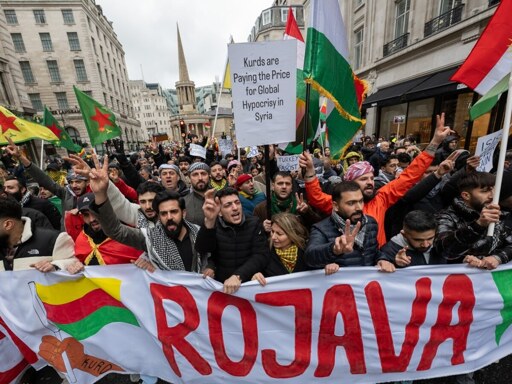

On 25 January over 50,000 people marched through London from the BBC to 10 Downing Street. An umbrella organisation called “United Kurds” under the leadership of the Kurdish Assembly of Great Britain organised the protest.
They were protesting against the so-called Syrian Transitional Government (STG), in concert with Turkish-backed jihadist militias, who are currently killing civilians and attacking areas of the Autonomous Administration of North and Eastern Syria.
Kurds and allies march across the UK
This protest is part of a national week of action, coinciding with similar demonstrations happening in London, Manchester, Bristol, Leeds, Norwich, and several other cities around the UK and Europe, where tens of thousands are expected to participate in solidarity.
Scores of civilians have been killed, including many children, with footage emerging of desecration of bodies (particularly women), including the cutting off of women’s hair and body parts. At least 4 children have died in Kobani, a city currently under siege. Over 150,000 people have been displaced in Aleppo since the start of the conflict. A genocide echoing that of the 2014 Yezidi genocide is imminent.
The demands of the demonstrations are for the government to:
- (1) Apply immediate political pressure to stop the attacks against civilians and urgently call for a ceasefire at the international level.
- (2) Terminate all political, military, and logistical ties connecting the UK to groups affiliated with Al-Qaeda, ISIS, or the Syrian Transitional Government.
- (3) Take a clear position against the threat of ISIS – the release of ISIS members and policies that enable them to reorganise.
- (4) Provide urgent shelter, healthcare, food, and psychosocial support to the tens of thousands of people who have been displaced.
- (5) Implement independent international monitoring mechanism for war crimes in Rojava, ensuring that those responsible are held accountable.
Rojava
Over the past few weeks, the Syrian Democratic Forces, which include the YPG and YPJ, have defended the territory of North and East Syria, commonly known as ‘Rojava’ and famous around the world for its political project of peaceful coexistence known as Democratic Confederalism. The area is facing an existential threat as STG forces and their allied jihadist militias have launched a large-scale invasion.
The STG, under the leadership of Ahmed Al-Sharaa, has demonstrated a blatant disregard for democratic ideals and diversity. Since its emergence in Damascus last year, the government, dominated by members of the al-Qaeda offshoot, Hay’at Tahrir al-Sham, has targeted minoritised religious and ethnic groups across Syria and has demonstrated horrific violence, particularly towards women.
In stark contrast, North and East Syria has fostered a multicultural and democratic system grounded in women’s rights, ecological sustainability, and grassroots power. This revolutionary movement is now facing an existential crisis due to ongoing STG attacks, conducted in collaboration with Turkish-backed jihadist militias and supported by Turkish Army drones.
Ishak Milani co-chair of the Kurdish Assembly of Great Britain said:
There is a rapidly deteriorating humanitarian and security crisis unfolding in Rojava and the city of Kobani in North-East Syria. Kurdish civilians – who stood on the front line against ISIS and sacrificed thousands of lives to protect not only their own communities but also the security of Europe and Britain – are once again facing devastating violence, displacement, and siege.
In recent days, extremist forces linked to ISIS and other jihadist factions have regrouped and escalated attacks across Kurdish-administered areas, with credible reports confirming that over a thousand ISIS-linked militants have been released back into the conflict, fuelling instability and terror.
Kobani – the global symbol of resistance against ISIS and the city that once prevented terror from spreading across the region and into Europe – is now under siege once again, threatened by abandonment and renewed aggression.
This is not only a Kurdish tragedy; it is a direct threat to regional stability and international security, and it represents a profound moral failure if the world remains silent. The UK must act now before another humanitarian catastrophe is allowed to unfold.
Despite a ceasefire declared on 18 January, STG forces are actively advancing and encircling Kobani, which is currently without electricity or water supplies. This is a site of an iconic stand against the ISIS caliphate in 2015. The community of Kobani, along with the fight for a just and free society in North and East Syria, must be heard.
Featured image via Guy Smallman
By The Canary
From Canary via This RSS Feed.