


A secret team inside the Department for Work and Pensions (DWP) is seeding stories in the mainstream media to fuel the bullshit narrative around rampant benefit fraud.
It was always obvious that the DWP was tipping off and collaborating with client journalists to spread this pernicious benefit fraud propaganda. Now however, information the Canary obtained via Freedom of Information (FOI) request has for the first time exposed the significant focus and resources the department is placing on planting these cases in the press.
Notably, its dedicated guidance document details how the DWP considers “publicity” as “one of the most valuable outcomes” of its fraud investigations. What’s more, it has revealed – in the DWP’s own damning words – its calculated rationale behind doing so. And predictably, the document makes clear that buttressing its callous welfare cuts is a core part of this.
DWP planting benefit fraud stories in the press
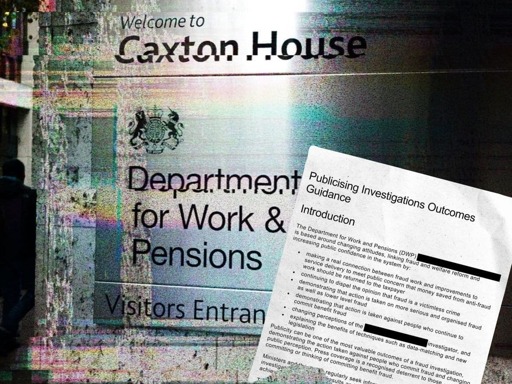
The internal guidance document – titled Publicising Investigation Outcomes – details the DWP’s publicity process around supposed benefit fraud.
From the outset, it’s obvious that the department intends to weaponise this media coverage. In its opening sentence, it states (emphasis ours):
The Department for Work and Pensions (DWP) [redacted] is based around changing attitudes, linking fraud and welfare reform and increasing public confidence in the system
In short, through the press, it’s positioning fraud cases as a pretext for benefit cuts. Of course, where it talks about “changing attitudes” and “public confidence in the system”, this is likely what it’s really about too.
The next part of the document only reinforces this. It goes on to lay out how planting these cases in the media supposedly helps it to meet these aims. Notably, it states that it does this by:
- making a real connection between fraud work and improvements to service delivery to meet public concern that money saved from anti-fraud work should be returned to the taxpayer
- continuing to dispel the opinion that fraud is a victimless crime
- demonstrating that action is taken on more serious and organised fraud as well as lower level fraud
- demonstrating that action is taken against people who continue to commit benefit fraud
- changing perceptions of the [redacted] investigator, and explaining the benefits of techniques such as data-matching and new legislation
Those first two justifications arguably operate hand in hand. The rhetoric around it not being a “victimless crime” and money-saving for the taxpayer is rife in the media-political discourse. Establishment politicians and the press routinely pit the ‘hard-working taxpayer’ against poor and disabled people.
Funnily enough, they routinely conveniently forget to mention that huge amounts of fraud is based on the DWP’s assumptions, and ergo, not actual fraud. In other cases, it’s criminalising claimants’ making honest mistakes as they attempt to navigate a labyrinthine benefit system.
Moreover, as the Canary has repeatedly highlighted, the DWP likes to project its crackdown persona in going after organised crime. However, it seems to be pouring significant and arguably, hugely disproportionate resources (see: frequent Covert Surveillance Officer (CSO) job postings) into what it’s terming “lower level fraud”. That’s the chronically ill and disabled people it likes to go after for ‘not being disabled’, or ‘as disabled’ as they’ve claimed.
Omitting these facts, the idea that poor and disabled people are fraudsters sticks in the public consciousness. And of course, this is to the DWP’s advantage.
Manufacturing consent for dystopian surveillance
Then, we’re assuming that the redacted ‘investigator’ in the document is probably referring to the DWP’s fraud investigators, and perhaps CSOs too. But, the public isn’t allowed to know what staff role(s) it’s trying to subliminally steer us into supporting through its lapdog media.
In reality, that benignly-termed data-matching also often refers to discriminatory algorithms that heavily scrutinise claimants. Ultimately, the juxtaposition with fraud investigators is likely just as deliberate here.
Reading between the lines, what it means is this: it seeks to change “perceptions” around the DWP’s dystopian-scale surveillance structures. In short, it wants the public apathetic about the tools of its creeping fascism. And it wants them on side as it seeks to expand this via welfare cut and benefit snooping legislation.
The opening statement also appears to point to the fact there’s a specific DWP team responsible for spreading this benefit fraud PR to the client media. Naturally, the DWP has blocked out its title.
Invasive news coverage for who? The DWP gets to decide
The document then goes on to explain how it does all this. Most significantly, it highlights its ‘Media Notice (MN)’ process, through which it aims to:
obtain the best local and national media coverage possible for the valuable work done across [redacted] and to act as more of a deterrent on a local level.
It says that the following types of benefit fraud stories would fit its criteria for a “National MN action”. These are the cases it feeds to the national press:
- interesting cases. For example, cases likely to be newsworthy or involving a large scale raid with numerous arrests
embarrassing to the Department, such as, offences committed by an employee
the suspect:
• is a well-known person or related to a well-known person
• has a unusual or professional occupation
• has a history of benefit fraud
• is/was employed by a Government Department. For example, the Local Authority or police
• is/was employed in a position of trust
• has used the benefits from the offence for an unusual purpose, such as funding a lavish lifestyle
• an employer colluding in the fraud.
In theory, the criteria should preclude the DWP publicising details of fraud investigations into its so-called “low level fraud” cases. It hasn’t seemed to stop the DWP plastering the private lives of disabled claimants it goes after all over the pages of the rightwing rags.
However, in practice, the press is all-too eager to slander and stereotype for clicks. Naturally, the DWP appears quite content to collaborate in doing just that.
Plastering the personal lives of disabled people across press pages
The guide also states next that:
Any other investigation can still receive some local media activity.
Simply put, doxing the details of poor and disabled people’s personal lives is pretty much fair game to the DWP, period.
Ultimately, the press peddling the idea that benefit fraud is rife has the DWP’s desired effect. A YouGov poll from November 2024 found that just 9% of the British public believe:
that all or almost all users of the benefits system are genuinely in need, with this widening to just half of the public (49%) who believe that at least the majority of people on benefits are deserving of help.
In other words, half the UK public think most people claiming benefits, don’t deserve them. The Canary’s Rachel Charlton-Dailey’s recent encounter with a taxi driver who thought benefit fraud was 20-30%, when it’s actually less than 1%, epitomises this level of widespread public misconception.
And of course, it just paves the way for politicians to push for welfare cuts.
Heavy redactions
The Canary acquired the heavily redacted guidance material after a protracted battle with the DWP. Initially, it had refused to disclose its document to us detailing its work feeding stories to the mainstream media. We originally submitted an FOI for this at the end of August. The DWP claimed that doing so would “compromise the effectiveness” of its “response to fraud”. Following this, it set out that disclosure would:
allow threat actors to understand how our Investigation teams operate and therefore support threat actors with evading our counter fraud work which would not be in the public interest. There is also a risk that releasing such documents could allow threat actors to convincingly pretend to be Investigations officers in order to commit crime against customers/the public.
The Canary challenged the DWP applying it to the document in its entirety. After chasing multiple times, the DWP finally came back on 29 December. It acknowledged that it was wrong to refuse the document outright. As such, the department provided a copy – although still appears to have liberally applied redactions in questionable instances.
For example, it has completely blocked out a section titled Distribution of Media Notices. It’s arguably hard to see how the public knowing how it feeds stories to the media allows “threat actors” to use that information to ‘game the system’, as the DWP went to pains to suggest.
Scapegoating claimants: a pretext for cuts and surveillance
Nevertheless, the document is incontrovertible evidence that the DWP is behind many of these fraud stories that the corporate press dutifully laps up to scapegoat claimants. In its FOI response, the DWP also told the Canary that the guidance was:
in the process of being updated.
So it looks like the department is dedicating even further resources to developing its processes for embedding this myth.
Needless to say, the mainstream press’s ceaseless deluge of vilifying benefit fraud propaganda is definitely no accident. It’s a media shitstorm of the DWP – and this government’s – own making.
Feature image via the Canary
From Canary via This RSS Feed.