

Article Summary
• The Skagit Valley is the center of a thriving regional grain economy, fueled by local wheat production, a mill, the research center Breadlab, and bakeries.
• A key driver behind the valley’s success is the Skagit Port Commission, which supported the Breadlab, underwrote a millstone-research trip to Scandinavia, and built a granary for Skagit farmers.
• The port also invested $1.2 million in Cairnsprings Mill, a social purpose corporation that now mills more than 7 million pounds of flour annually, supporting local farmers and bakers.
• The public-private partnership represents a model that could inspire other regions seeking to strengthen local food systems.
Compared to the high plains of Kansas or the rolling fields of eastern Montana, Skagit County, Washington, is something of a backwater when it comes to wheat production. Yet over the past 15 years, the Skagit Valley has emerged as a national hot spot for innovations in grain breeding, artisan-scale milling, and experimental baking.
This broad alluvial plain, graced by the chiseled peaks of the North Cascades to the east and the forested humps of the San Juan Islands to the west, is home to the Breadlab, which develops highly nutritious, climate-adapted varieties of wheat, rye, and other grains. One of the nation’s two King Arthur Baking Schools shares space with the lab. Cairnsprings Mills, a favored flour purveyor for bakeries across the Pacific Northwest, is around the corner, and at the nearby Breadfarm bakery, the line of people waiting for baguettes, cookies, and massive miche loaves on summer weekends stretches around the side of building.
“We thought if we could get specialty wheat to grow here, you could get more per bushel. It turns out to be true.”
The seeds of the Skagit’s flourishing grain economy were planted at a time when the community faced a turning point. During most of the 20th century, peas had been a major cash crop here. In December 2009, Twin City Foods, the last remaining pea processor in northwestern Washington, announced it would close.
The sudden news shocked area farmers and left them hustling to fill some 6,000 acres with another crop that would fit into their rotation schedule.
Local elected leaders hustled, too. Many had watched with growing unease as Seattle’s sprawl paved over prime agricultural land to the south. Unless Skagit came up with a plan to produce more high-value crops, they feared that it, too, could lose its agricultural character.
“We were trying to figure out what was next for the valley,” said Patsy Martin, who served as the Port of Skagit’s executive director for 14 years before retiring in 2021. “How do we help these smaller farmers make enough money? How do you help farmers be price makers, not price takers?”
The Port of Skagit Plants the Seeds
A port commission may seem like an unlikely public agency to spearhead an agricultural initiative, but among their various responsibilities, Washington’s 75 port districts are tasked with assisting local economic development. In Skagit County, that could mean aerospace, logging, or agriculture. Its port officials lean into agriculture.
In the last 15 years, the port has invested more than $7.5 million in local food and farming enterprises. The port helped launch Viva Farms, a celebrated farmer training outfit; a canning company called Gielow Pickles; and a slaughterhouse and butcher, NW Local Meats, that mostly serves farmers on the San Juan Islands. Port investments in value-added agriculture have helped create some 200 jobs in the county.
The port also decided to revive grain production in the area. A century ago, the valley’s oat production had helped feed Seattle’s horses, but by the late 20th century, grain production had taken a back seat to more high-value crops.

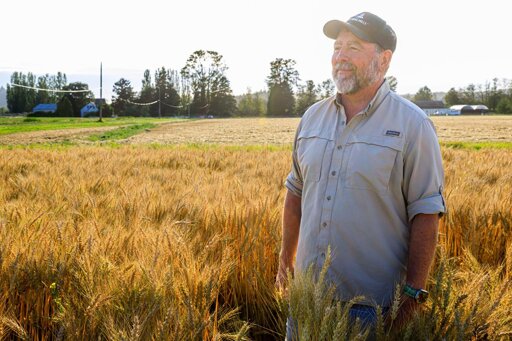
Keith Morter of Keith Morter Farms harvests wheat in Ione, Oregon. (Photo credit: Andrew Snyder)
“When we got to thinking about what could be done differently about the land, a couple of different ideas emerged—and one of them was growing specialty wheat,” said Kevin Ware, a local doctor who has served on the Port Commission for more than 20 years.
“We thought if we could get specialty wheat to grow here, you could get more per bushel,” Ware said. “It turns out to be true.”
The Road to a Local Grain Economy
Last December, rain and headline-making floods hammered the Skagit Valley, but days later, the sky was clear, conjuring a rainbow above a cabbage field. “We call this ‘the Magic Skagit,’” said Dave Hedlin, a 70-something third-generation farmer.
Part of the magic is the valley’s soils, among the most fertile and productive in the nation, enriched for millennia by silt exfoliated by wind and rain from the flanks of the nearby mountains. Part of the magic is the temperate climate, unusual for such a northerly location, which allows growers to produce more than 80 crops. Magical too is the winter arrival of thousands of snow geese, tundra swans, and trumpeter swans that descend on the valley to glean the fields. On clear days, the white lines of flocks in the distance can be mistaken for ripples of snow in the foothills.
Finally, part of the Skagit’s magic is people, Hedlin continued. “Even though we compete every day as farmers, somehow, when it’s time to fund agricultural research [for grains] … we all managed to wrap up our sleeves and work together and figure out a way to get it done.”
Hedlin runs a diversified farm of 500 acres bordering the Salish Sea, with about half certified organic or regenerative organic. Like many Skagit farmers, Hedlin was growing grain decades ago, “for fun and occasionally for profit.” Skagit County is the nation’s top producer of tulips and daffodils and a major potato producer—crops that can be hard on the soil. For as long as anyone could remember, farmers had planted cereal every third or fourth year as a rotation crop to help cycle nutrients, restore organic matter, and break disease patterns.
In a good year, Skagit farmers sold the grain into the commodity system, where it was most likely shipped to Asia because the valley’s soft white wheat made a perfect flour for noodles. In a decent year, the grain might be processed into animal feed. But many years, farmers just plowed it under because prices were so low it wasn’t worth harvesting. There had to be a better way.
Breeding Better Grain and Building a Mill
Enter Stephen Jones, a wheat breeder from the Washington State University extension service. Jones, now retired, was eager to develop wheat varieties that would be more productive in the fields and nutritious to eat. With WSU support, plus seed money from Clif Bar, King Arthur, and Patagonia, Jones launched the Breadlab in 2008.
“When Steve came, he flipped the switch and said, ‘You don’t need to lose money on wheat every year. You can make money,” said Kevin Murphy, a longtime wheat breeder who became the lab’s executive director in 2024. Key to the switch was developing wheat strains that could outperform traditional varieties in both the fields and bakers’ kitchens. “Our little tagline is ‘breeders that bake.’”
After Breadlab was up and running, a crucial piece for a local grain economy was still missing: a grain mill. Kevin Morse, who spent 10 years directing The Nature Conservancy’s programs to help Skagit farmers adopt conservation practices, raised his hand to make it happen. “I saw grains as an opportunity, because it’s one of the last commodities to go craft,” Morse said.

Cairnspring Mills co-founder and CEO Kevin Morse pictured at Cairnspring Mills in Burlington, Washington. (Photo credit: Sara Marie D’Eugenio)
Morse had relationships with Pacific Northwest investors who were experienced in the food industry and weren’t looking for a quick payout. But some kind of public investment was still necessary.
“Go back 11 or 12 years when we started having these conversations and imagine somebody walking into an investor’s office or an equity fund saying, ‘We’re going to build a craft flour mill,’” Morse said. “Most people weren’t going to buy in.”
The Port Steps In
Having already helped to launch the Breadlab by providing it with office space and cheap rent, the port became a crucial partner in launching what would become Cairnsprings Mill. The Port Commission underwrote a trip Morse took to Scandinavia to research milling stones for processing whole grains. In Denmark, Morse discovered composite millstones—made from flint and emery—that would be perfect for processing whole grains. Although Morse still had to raise the operating capital, the port invested $1.2 million to build the mill, with an agreement to lease the infrastructure back to Cairnsprings until the company, a registered social purpose corporation, could pay it off. The port also built and began operating a 10-silo granary for Skagit farmers.
“It took a village,” Morse said. “A public-private partnership was the way we were going to get it off the ground.” In January 2017, the mill processed its first commercial-scale batch of flour from wheat grown in Western Washington.
The Many Dividends of Local Grain
Last year, Cairnsprings ran shifts nearly around the clock and milled 7.5 million pounds of flour. That may not be much in the grand scheme of things—it’s about what a huge industrial mill produces in a day—but Cairnsprings pays between $9 and $10 a bushel for wheat that meets its quality standards. In the commodity system, high-quality wheat will fetch about $6.50 a bushel. “We’re actually helping farmers stay in business,” Morse said.
The farmers seem happy.
“It’s really exciting, especially on the organic side, to able to grow a grain that’s kind of bulletproof,” Dave Hedlin said. “Always before, we would take Eastern Washington varieties of grains and try a bunch of them out, and whichever one was survivable, we’d grow that.”
In comparison, Breadlab varieties are bred for western Washington, and farmers can select for desired traits. “It’s just really fun,” Hedlin said.
The bakers are psyched.
“It’s really delicious,” said Mel Darbyshire, head baker at Grand Central Bakery and Café, a Seattle and Portland chain that prioritizes regional and sustainably grown ingredients. The bakery uses Cairnsprings’ Trailerblazer and Edison flours, which the bakers especially like for pizza and focaccia. “It’s got germ and bran in there, and with that you get flavor,” Darbyshire said. “You get more of those nutty notes.”
At the Port of Skagit, officials are also pleased with their return on investment. Cairnsprings is on track to pay off its 20-year lease on the mill equipment, and taxpayers will make a healthy 6 percent profit on the deal. But Port Commissioner Ware sees a larger ROI for the community as a whole, in terms of “improvement to the community, more agricultural jobs, more people keeping their farms, less being converted to non-agricultural purposes,” she said. “Did we win? Yeah.”
“We’re doing this because we believe rebuilding local food systems is the best way to make us more healthy, prosperous, and resilient.”
Every agricultural community is unique, with its own set of attributes, advantages, and challenges. But everyone involved with the Skagit wheat economy is confident that other agricultural areas could similarly use public dollars as a springboard for private enterprise.
“There are other small places that have pieces of it that I think can replicate, whether it’s grains or some other crops that work particularly well in their climate and soils,” said former Port executive director Patsy Martin.
Next Stop: Oregon
Cairnsprings is already working on a repeat. Last fall, the company broke ground on a second, much larger mill outside Pendelton, Oregon. The new mill, which will be closer to the state’s major wheat-growing region east of the Cascades, is located on the lands of the Umatilla Indian Reservation. In an echo of the role played earlier by the Port of Skagit, the Confederated Tribes of the Umatilla are providing a significant portion of the capital. The tribe is now an equity partner in Cairnsprings.
The new mill will have 12 times the capacity of the original mill in Skagit. Cairnsprings will be able to offer fair prices to more farmers, sell to many more bakeries, feed more people hungry for whole grain flours. A millstone, it turns out, can be the cornerstone of creating a grain economy that works for farmers sick of being paid so little and eaters who want more than flours stripped to mere starch and gluten.
“Part of our vision for the future is that this inspires others to do this in their communities too,” Morse said. “We’re doing this because we believe rebuilding local food systems is the best way to make us more healthy, prosperous, and resilient. We hope this is the model that sticks and becomes the norm, instead of an outlier.”
The post How Artisan Grains Helped Skagit County Rebuild Its Economy appeared first on Civil Eats.
From Civil Eats via This RSS Feed.