

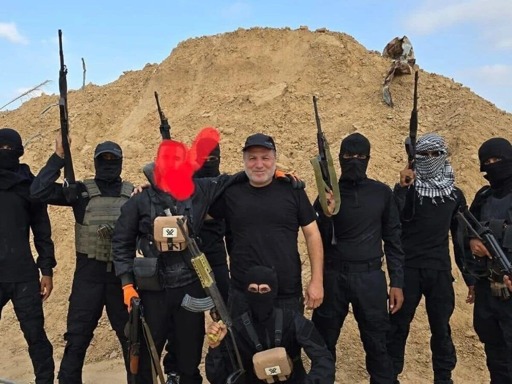

The Wall Street Journal has revealed what appears to be a hidden layer of Israel’s war on Gaza: an undeclared reliance on local armed militias acting as “field agents” to carry out tasks the Israeli army cannot openly perform under the ceasefire.
According to the newspaper, this is not a temporary arrangement. It is an alternative security architecture, managed from behind the scenes and implemented through Palestinian proxies rejected by their own communities. These groups operate in areas under Israeli control, but conduct operations inside zones supposedly off-limits to Israeli forces. The difference is largely cosmetic. Local gunmen act under intelligence cover, supported by drones and logistics, while Israel’s direct involvement remains obscured.
Israeli militias in Gaza
The façade collapsed when Hussam al-Astal—described by the Journal as a militia leader—boasted of assassinating a Khan Younis police official inside the Al-Mawasi area. In a phone interview, al-Astal called the killing “a solution to a problem” and threatened to murder anyone who replaced the victim.
In a video recording, he appeared brandishing an assault rifle, sending a clear message: access to targets is possible, and violence will continue.
Hamas quickly described these militias as “tools of the occupation” and warned that “the price of betrayal is high.” This view reflects broader sentiment in Gaza, where such groups are widely seen as illegitimate entities operating under Israeli protection.
Although al-Astal denies receiving direct military support—aside from food—testimony from Israeli military sources suggests close coordination. A former Gaza Division operations officer admitted: “We monitor them, we help with information, and if Hamas gets close, we intervene.”
The implication is clear. Israel makes the decisions, others execute them
The Wall Street Journal concludes that this system is not accidental, but a tactical response to ceasefire restrictions. When regular forces are constrained, irregular proxies are deployed. This allows Israel to operate in prohibited areas without the cost of direct exposure.
The report also details other militias, including so-called “popular forces,” used in complex operations such as luring Hamas fighters from tunnels in Rafah. Some killings were filmed and posted on social media. One Israeli reserve soldier described escorting “aid” convoys to a Rafah militia: food, water, cigarettes, and sealed boxes delivered by the Shin Bet. These details expose how proxy war economies are sustained.
The newspaper’s assessment is bleak. These militias have failed to gain legitimacy. Their unpopularity, involvement in looting and crime, and Hamas’s ability to reassert control keep them confined to temporary utility.
For Gaza’s residents, they are not a “third force.” They are an extension of the occupation with a local face—one that adds another layer of violence without delivering stability.
Featured image via the Canary
By Alaa Shamali
From Canary via This RSS Feed.