

On 3 January 2026, 32 Cubans — from a 26-year-old lieutenant to a 67-year-old veteran — lost their lives defending Venezuelan President Nicolás Maduro against the US military operation in Caracas. In this essay, Marxlenin Pérez Valdés celebrates their heroism and resistance.
Author: Marxlenin Pérez Valdés
Marxlenin Pérez Valdés is Doctor of Philosophical Sciences and Professor of Marxism and a Cuban communicator.
On 3 January 2026, the peoples of Latin America were wounded once again, in their own “Zone of Peace”. As a result of the United States’ military operation against Venezuela’s sovereignty and the kidnapping of President Nicolás Maduro and his wife Cilia Flores, the number of human casualties — still not precisely reported — is estimated at around 80. They include Venezuelans and Cubans, military personnel and civilians alike. It is still unknown whether or how many casualties were suffered by the invading US forces, the perpetrator of the crime.
According to testimonies from survivors, the US Armed Forces and their “Delta Force” did not emerge unscathed from the incident. But their government does not wish to acknowledge their casualties. To do so would be to shatter the mythical image of invincibility that they have so carefully cultivated for years.
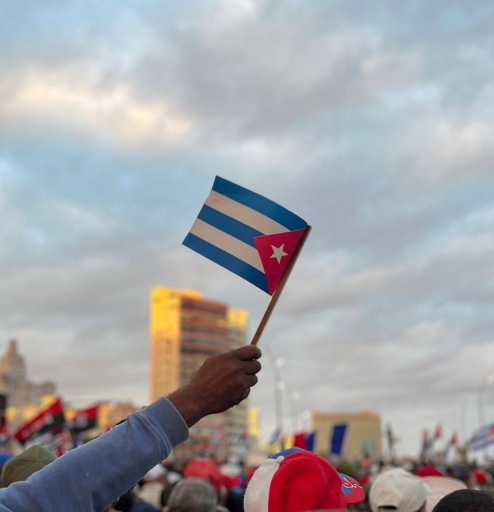
Over centuries, Cuba has taken shape through struggles grounded in ideals of independence, justice, and anti-imperialism — principles that shape our national subjectivity. For that reason, tens of thousands of Cubans went to the building of the Ministry of the Revolutionary Armed Forces of Cuba (MINFAR) on 15 January to pay tribute when President Maduro’s defenders returned lifeless to their homeland. And for that same reason, on 16 January, more than one million Cubans marched across the length and breadth of the island in defense of our sovereignty.
Today, we know more about the 32 compatriots who fell in combat fulfilling their duty. We know their names, their professional and personal trajectories, their merits, their previous missions, and their convictions. We have seen their photographs and heard or read anecdotes from family members and friends about who they were. The people call them by their names. The homeland remembers them with pride.
We know that the youngest was 26 years old and the oldest 67. Reading the testimony of the mother of Lieutenant Fernando, the youngest of the Cuban combatants, brings about an incomparable desolation. It is impossible not to cry with her when she speaks of her only son, murdered in Caracas:
“We communicated every day. We spoke on 2 January, around nine at night… When I found out… I had sent him a message and he didn’t reply, but I held onto hope that he was okay. Later, seeing the hours go by… when I saw the people dressed in green arrive at the house… there was no need for anyone to say a word.”[1]
We also know that, in addition to being someone’s sons, grandsons, brothers, and friends here, many of those killed were fathers. Captain Adrián, who died along with 11 combatants when the US bombed the houses in which they were sleeping, had spoken with his family just four hours before the horrific event. He was only 34 years old. He leaves behind a three-year-old daughter who will never be able to kiss him again, and a wife left desolate by the loss of her beloved companion. Her words are heart-wrenching:
“It was a deadly bomb. Then, bursts of gunfire from planes, as if to exterminate everything, they told me. Nothing was left there.”[2]
We know how they were killed from other Cubans, who mobilised immediately in response to the aggression and survived the US military attack. Through them, it is possible to reconstruct the hell that those who fought back had to confront. Yohandris Varona carried the bodies of his comrades with his own hands. He said:
“We fought there against the planes that were strafing us. Even though our weaponry was lighter, we never stopped fighting; we faced them… If a helicopter comes right over you, the only thing left to do is shoot at it and defend yourself. That’s how it was. We kept firing until the very last moment.”
“Our comrades are a glory for all of Cuba… I saw them all fall and I carried every one of them. There was no help from anyone for that, but not a single body was left in the field. We preserved them in one of our own bedrooms. I cannot explain the pain. But at least no one was left behind in Venezuela. They are here, in our Homeland.”[3]
The day after our 32 murdered brothers returned to Cuba, President Miguel Díaz-Canel delivered a forceful speech at the Tribuna Antiimperialista in Havana. The speech gave the Cuban people a better sense of the battle that was fought in Caracas. He spoke about the determination of those who swore to defend President Nicolás Maduro. In these final moments, First Colonel Humberto Alfonso Roca
[1] Source: Juventud Rebelde.
[2] Source: El Artemiseñ**o.
[3] Source: Periódico Adelante.
Sánchez was recorded as saying: “Only over my dead body will anyone be able to take or assassinate the President”. He gave an account of the fight that confirmed what we had always suspected — that the brave Cubans tangibly blunted the enemy’s strength.
“One of them, Lieutenant Colonel Jorge Márquez, was the one who hit a helicopter and who knows how many of its crew. He did it by firing his anti-aircraft weapon, despite being wounded and bleeding profusely from a leg. Courage is the word everyone uses to describe the confrontation with the aggressors. And they name First Colonel Lázaro Evangelio Rodríguez Rodríguez, who led the attempt to rescue the first fallen, until one of the enemy drones struck him: ‘I’m wounded. Long live Cuba!’ were his last words.”[1]
What fortitude our heroes possessed! They carried in their determination the entire history of resistance and rebelliousness that forms the foundation of our Caribbean nation. On this matter, the Cuban Minister of the Interior said:
“On Cuban soil, there will never be room for cowardice and betrayal… The enemy speaks euphorically of high-precision operations, of elite troops, of supremacy. We speak of faces, of families… We speak of girls and boys who will have to grow up without the embrace of those who offered their lives thinking precisely of them… They are a lesson for those who hesitate and a warning for those who threaten.”[2]
The affront of 3 January 2026 was not the first attack by US imperialism against Venezuela, Cuba, or Latin America more broadly. It was not the first assault against our region, against its sovereign peoples, or against the planet as a whole. The extensive record of invasions and aggressions by the United States against its enemies is public and notorious. The list of grievances is immense.
That historical memory — of imperialist violence and resistance to it — also needs to be mobilised in this battle of nations for their independence and dignity. Pity those who choose to turn their heads the other way to avoid seeing the truth, whether out of opportunism, political convenience, or because they believe cowardice is a guarantee of salvation. History will not absolve them. On the contrary, they will be buried as accomplices to the crime.
Honor and glory to the 32 Cuban heroes fallen in combat!
[1] Taken from the speech by the President of Cuba, Miguel Díaz-Canel Bermúdez. Source: Website of the Presidency and Government of Cuba.
[2] Remarks by the Minister of the Interior of Cuba, Army Corps General Lázaro Alberto Álvarez Casas. Source: Granma newspaper.
From Sovereign Media via This RSS Feed.