

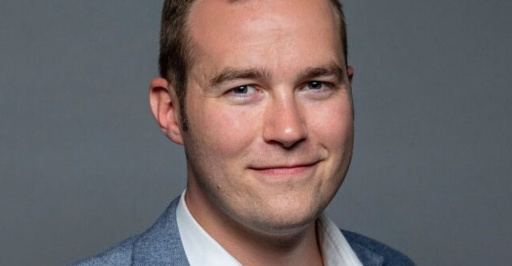
Janine Jackson interviewed the Newspaper Guild–CWA’s Jon Schleuss about the Pittsburgh Post-Gazette shutdown for the January 16, 2026, episode of CounterSpin*. This is a lightly edited transcript.*
https://media.blubrry.com/counterspin/content.blubrry.com/counterspin/CounterSpin260116Schleuss.mp3
Poynter (10/20/25)
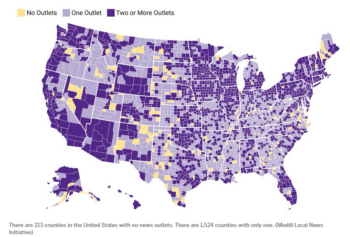
Janine Jackson: We are growing used to seeing newspapers shut down; some 3,500 local papers have closed in this country since 2005. Not all were as storied or long-lasting as the Pittsburgh Post-Gazette, running under that banner since 1927, with roots going back as far as 1786. The owners plan to shutter it in May.
Although print papers face some similar pressures, not all close for the same reason. And the story behind the Post-Gazette‘s end is particularly frustrating.
We’re joined now by phone by Jon Schleuss, president of the Newspaper Guild–CWA. Welcome to CounterSpin, Jon Schleuss.
Jon Schleuss: Thanks so much for having me.
JJ: When local newspapers close down, though many people will mourn the loss, there’s an air of inevitability. Like, well, revenue models change… I mean, yeah, there’s profit-driven consolidation, but really, it’s just sort of like, “Times change.”
But with the Post-Gazette, let’s not lose it all in the mists of memory: This closure could have been avoided at multiple moments, right? What is the history here?
News Guild–CWA (11/10/25)
JS: Yeah, you’re absolutely right. And I think it’s a real challenge for the industry since the internet came along, right? Newspapers put everything up on the internet for free, when they had charged a subscription, right, or a cost at a newsstand to purchase a newspaper. And then they sold advertising, and a big portion of the revenue came from advertising.
So the dynamics have been changing, and every newspaper company really needs to be innovative and thinking about how they’re going to augment the way that they do the job of journalism, so that everyone hears it, right? Move to different media and platforms, and really try to change with the times.
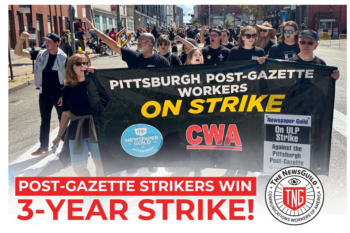
At the Post-Gazette, we have a situation where the company announced their closure after losing a years-long legal battle with us, the union that represents the largest number of journalists in North America. And we filed these charges and these complaints, and even had a three-year-long strike. over the company’s violation of federal law.
And the original costs for their violations of federal law were really minuscule. We weren’t even talking, like, raises for people. We’re talking about the healthcare that they bargained, and the company agreed to, that they pulled away and destroyed about five-and-a-half years ago. The costs were really probably tens of thousands of dollars a year, for the healthcare premiums that the company had to pay. And instead of paying that, they spent millions of dollars hiring outside lawyers to fight journalists in Pittsburgh.
And so, yeah, they could have settled at any point. And, instead, it really seems like they’re just trying to take their ball and go home.
Bloomberg Law (1/7/26)
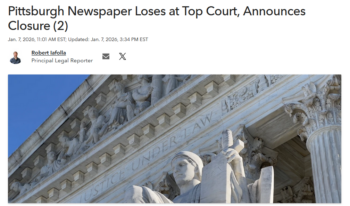
And this is a family that is millionaires. They make a lot of money in the rest of the company, by owning TV and radio stations. They also have cable and internet operations in Mississippi and Ohio. So they make a lot of money. And this is a decision to really try to fight the union, and really sore-losing after they lost at the Supreme Court.
JJ: We don’t think of this Supreme Court as wildly pro-labor. So this must have been something that even this court would say, “Well, no, you can’t do this.”
JS: That’s the thing that’s so wild about this case, right? We had a decision by Justice Alito, of all people, who refused the company’s request to issue a stay on an injunction. And that injunction merely says that the company has to restore the healthcare provisions that they took away five-and-a-half years ago. And that injunction was given to us by the Third Circuit Court of Appeals.
And so it’s a really big victory, I think, for labor. And it’s pretty, I think, amazing that Justice Alito refused to issue a stay and said, “No, you know what, you guys, you gotta follow the law.”
And the owners of the Post-Gazette, too, I should mention, are very avid Trump supporters. And they even hired a lawyer that clerked for the Supreme Court.
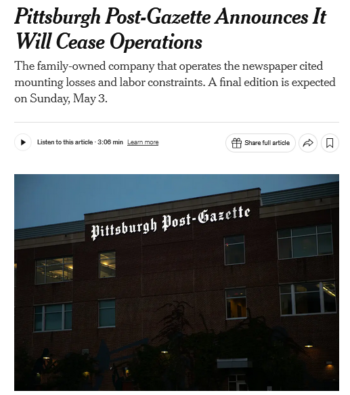
New York Times (1/7/26)
JJ: You know, the New York Times on January 7 had a not-terrible report, as things go. But as we know, many people just read the head and the subhead. And what you learned there was, and I’ll just quote it, that “The family-owned company that operates the paper cited mounting losses and labor constraints.”
Now, labor constraints—turns out, you’re saying, “pay the healthcare that you contracted for,” you know—but “labor constraints” is kind of a hardy perennial in media language.
But “family-owned” is also doing some lifting there. And I think it’s important what you just noted, that when you say “family-owned,” well, that’s not a faceless corporation that’s just making money decisions. I think it’s important to complicate this idea that this was: a family started up a company, and then labor “constrained” them, and then they were in a position of “losing,” and who would want them to lose? I feel like that presentation complicates things unnecessarily for people.
JS: Yeah, you know, it’s hard, as journalists, I’ll give our members at the New York Times some slack too, right, because it’s hard to fit all the details in. But you’re absolutely right. When we’re talking “family-owned,” we’re talking about a family that owned a private jet, right, and uses that private jet to fly their dogs to their vacation house in Maine. We’re talking about a family that owns a mansion in a very swanky part of Pittsburgh. And when we’re talking about the labor strike, we’re talking about dozens of journalists who went on strike, and didn’t get a paycheck for more than three years to do their ethical duty to hold power to account.
So you’re right, there’s a lot of context in there: You have some scrappy journalists who had already given up wage increases across the board for two decades, and given that up to try to have a shared sacrifice. And the family is millionaires, they have a lot of money and resources, and instead of just settling a fight that could have been for tens of thousands of dollars, they’ve escalated it, and lost in the last five-and-a-half years.
Extra! (2/12)
JJ: Those of us who lament local newspaper closures don’t have a rose-colored memory, like there’s some perfect time that we’re trying to get back to. Newspapers have had issues since there have been newspapers. But we also know a community’s need for solid, local reporting doesn’t disappear as revenue methods or modalities change. Social media is great, it can be void-filling. It’s just not a substitute for a reporter who lives in your town, who knows your town, who’s talking to local politicians and reporting local policy.
And I know that this is work that the Guild-CWA does around the country. How do you see people trying to talk about what comes next? Who’s in these conversations? Because we aren’t just talking about saving the Post–Gazette, we’re talking about serving communities that need local news.
JS: Yeah, you’re absolutely right. You know, journalists are very curious types of workers, right? Because we don’t get in this field for the glamour. People will think of journalists as being high-paid, and maybe on TV, but the vast majority of America’s journalists can barely even eke out enough money to put food on the table. I’ve got members in parts of the country who have to go to food banks to survive, and they have a full-time job, but then they have to get another secondary job to support their income.
So journalists get into it because they have an ethical drive to seek truth and report it, to tell those stories, to be in city council meetings, to go to high school sports games, to go wherever the story takes them. and bring that back to readers, right? So this is a huge loss, to lose hundreds of jobs in Pittsburgh.
We’re really focused on the future. We’ve got our members in Pittsburgh working to maybe secure foundational support, to see if someone else would swoop in and potentially buy this storied newspaper. And we’re also looking at our legal options here, because this is more retaliation and more union-busting from a company, and a family, that can afford to keep a publication running. So we’re looking at all options on the table, and working towards them to save news for the folks in Pittsburgh.
JJ: Finally, while I have you, we’re pulling resources and livelihoods and platforms from working journalists, and at the same time, we’re seeing the absolutely crucial nature, in Minneapolis and Gaza, around the world, of the work of reporting. You know, if your job didn’t have any value, it’s hard to see why someone would try and shoot you for doing it. And I just wonder if you have any thoughts about these connections between telling communities they no longer have a local news resource, and then telling reporters it’s dangerous to do your job. We’re in a dangerous moment, but reporting is a response to that.

Jon Schleuss: “If you can reduce the amount of news, and the free flow of information, you can reduce democratic rights.”
JS: Yeah, and people really are hungry for it. They’re hungry for news. People are really interested in it, now more than ever. And we’ve had our own members, in Chicago, in Southern California, who, while covering ICE protests, have been shot, directly shot by rubber bullets and tear gas while they were clearly identified as journalists, with lanyards around their neck, with reporter’s notebooks, with camera equipment.
And so the current government, the Trump administration, is actively trying to undermine and intimidate. I mean, we just had the FBI raid a reporter’s home at the Washington Post. It’s all an effort to chill, because if you can reduce the amount of news, and the free flow of information, you can reduce democratic rights and undermine the very founding nature of our country, which is why we put, right at the top of our Constitution, that a free press is essential to sustain a democracy.
So that’s what we’re fighting for and we’re fighting for that, and journalists are going to continue to do the work because, again, we’re just built differently. Like, we have to get the story out. And we’re trying to do it safely, but we’re going to continue to do that work as long as we’re allowed to, and as long as we’re able to.
JJ: And I think it’s important for people to understand that it’s not just about individuals putting on a hat with a press card. We need the structures and the resources that support that work in a sustained way.
JS: Yep. That’s right.
JJ: All right, then. We’ve been speaking with Jon Schleuss. He’s president of the Newspaper Guild–CWA. Thank you so much, Jon Schleuss, for joining us this week on CounterSpin.
JS: Aw, thanks so much for having me.
From FAIR via This RSS Feed.