

This article by Ruth Dávila originally appeared in the January 22, 2026 edition of Revista Contralínea. The views expressed in this article are the authors’* own and do not necessarily reflect those ofMexico Solidarity Mediaor theMexico Solidarity Project.*
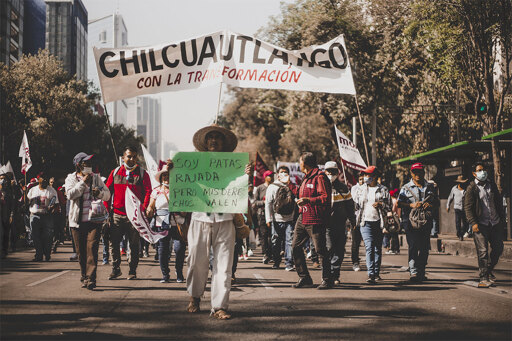
In the era of the Fourth Transformation (4T), the political project of the Morena movement, classist and racist expressions predominate. Words like “chairos,” “nacos,” “prietos,” “indios pata rajada,” and others are some of the expressions that make up the vocabulary of those who feel aggrieved by the rise to power of those who represent those “others” who, in their imagination, are associated with poverty, Indigenous people, and dark skin.
When in 2006, former president Andrés Manuel López Obrador (AMLO) first ran for president, which was awarded to the PAN member Felipe Calderón (2006-2012), we witnessed the construction of a campaign that labeled AMLO as a danger to Mexico, and that described the supporters of the “obradorista” movement as “pelados”, “gatos”, “nacos” and “chairos”.
This occurred during the early rise of social media, the television duopoly, and the presence of organizations like the Communication Council, Voice of Business. The arrival of memes was also used to cruelly express: “Why do they call AMLO Whiskas? Because nine out of ten cats prefer him.” [Gato, cat, is a derogatory term denoting a domestic worker – editor]
This construction of otherness is frequently idealistic; that is, in the terms of the Slovenian philosopher Slavoj Žižek, it is an idealization of the “other,” of the different. In his Reflections on Violence (2007), Žižek revisited the era of fascism to illustrate how a caricatured image of Jews was constructed: prominent noses, avarice, usury, and so on. Similarly, in the period leading up to the Rwandan genocide, the significant role played by the media in disseminating hate speech against the Tutsis, who were also stereotyped, is well-documented. This resulted in a large-scale interethnic war between Hutus and Tutsis characterized by extreme violence and cruelty toward the latter.
It is evident that hate speech and expressions that exalt negative characteristics of the opposing group consequently materialize expressions of violence that transgress human rights.
With these examples, I aim to highlight that the discursive construction of “others” is frequently laden with prejudice. This otherness is constructed in order to place that “other” in the position that, according to the dominant group, corresponds to them; the result is usually exclusion and discrimination.

Parasite (2019), dir. Bong Joon-ho
Regarding the smell of these “others” as a way of indicating their class position, it clearly alludes to their poverty or skin color; likewise, the ideological-political stance stems from a need to construct an “us vs. them” dichotomy. An example of this is seen in the South Korean film Parasite (2019), where both social classes (poor and rich) share a sense of identity, belonging, and delimitation of physical and symbolic space.
A central element of the film is the constant allusion to the smell emanating from the members of the Kim family, who belong to the lower class; for the Park family, the former smell like the underground and poverty. And what do the “others” smell like? Those who don’t belong to “our group,” those we see as inferior. It might seem like a bad joke or something anecdotal, but these expressions alluding to the smell of those “others” who are inferior because of their class or race are, as the brilliant film by South Korean director Bong Joon-ho shows, expressions of aporophobia (rejection of poor people), classism, and hygienism.
A few days ago, a sign on the door of the Faculty Lounge—the place we go for coffee or tea—at the Center for Economic Research and Teaching (CIDE), my workplace, apologized for the inconvenience caused by the painting of the area. The sign read: “We apologize for the inconvenience and the smell, but the Faculty Lounge is being repainted. Thank you for your understanding.” After the first sentence, someone anonymously added, in blue marker and printed letters: “[Sorry for the inconvenience and] the smell of leftist rhetoric,” a clear expression of classism.
We cannot dismiss this as a mere anecdote or the behavior of someone unable to control their anger or impulses. In a world where dehumanization, exclusion, persecution of people based on their ethnicity, racism, and classism are exponentially increasing, these practices are not isolated incidents; they are symptoms.
Ruth Dávila is an Associate Professor in the Division of Multidisciplinary Studies at CIDE, the Center for Economic Research and Teaching.
-

Classism & Racism in the Era of the Fourth Transformation
January 23, 2026January 23, 2026
In a world where dehumanization, exclusion, persecution of people based on their ethnicity, racism, and classism are exponentially increasing, these practices are not isolated incidents; they are symptoms.
-

People’s Mañanera January 23
January 23, 2026January 23, 2026
President Sheinbaum’s daily press conference, with comments on Interoceanic trail derailment report, collaboration with US, extortion, declining homicides in Veracruz, and Veracruz infrastructure investment.
-

Sheinbaum: Wage Policies & Social Programs Broke Decades of Neoliberal Neglect
January 23, 2026January 23, 2026
During a tour of Puebla, Mexico’s President cited these changes as reversing the historical backwardness faced by the popular sectors.
The post Classism & Racism in the Era of the Fourth Transformation appeared first on Mexico Solidarity Media.
From Mexico Solidarity Media via This RSS Feed.