

This editorial by Pedro Mellado Rodríguez originally appeared in the January 23, 2026 edition of Sin Embargo. The views expressed in this article are the authors’* own and do not necessarily reflect those ofMexico Solidarity Mediaor theMexico Solidarity Project.*
A sophism, explains the Royal Spanish Academy, is a false reason or argument that appears to be true, such as the one used by those who warn, from the media and the opposition, that the electoral reform promoted by President Claudia Sheinbaum Pardo—to reduce the number of proportional representation seats in the Chamber of Deputies and the Senate, as well as to reduce subsidies to political parties and lower the cost of the country’s electoral apparatus—could lead us to live in a one-party regime like the one the PRI imposed on Mexicans for seven decades. They warn that Morena has become an authoritarian party that intends to perpetuate itself in power.
However, there are substantial differences between the authoritarian, deceitful, corrupt, and thieving regime of the PRI, in alliance with the PAN, which stole elections and trampled on the popular will, and the regime of the Fourth Transformation, which came to power with the real, clear, concrete, and overwhelming support of the majority of voters. The problem for the opposition, the recalcitrant right wing, and the mainstream media—resentful, manipulative, and mendacious—is that the opposition has collapsed to such an extent that even if the PAN, PRI, and Movimiento Ciudadano combined all their forces, they could not defeat Morena.
And the only reason is because the majority of Mexicans reject those hypocritical parties, who tear their clothes judging the Fourth Transformation as a government that will turn Mexico into a dictatorship, when finally, after more than 70 years of PRI trickery and after two failed PAN six-year terms, they ended up playing political games under the same banner and defending the same abject causes.
And the numbers don’t lie. With or without proportional representation seats, the opposition in Mexico is floundering, and the overrepresentation they accuse Morena of is what has allowed them to survive, at least until now.

PRI President Luis Echeverría Álvarez adopted the posture of a left winger and supporter of Third World liberation, but was using it as a strategy to diffuse criticism from Mexico’s left, while he was subjugating Mexico’s interests to those of the United States of America, as an operative with the CIA.
Crushing The Lie
In the 1970s, the PRI was the sole party, an appendage of the government for more than 70 years, while the electoral bodies were administered by the Ministry of the Interior through the Federal Electoral Commission, and the manipulation of the vote at the whim of the president in office was perversely natural, which allowed the Institutional Revolutionary Party to win presidential elections with excessive percentages, such as the 89.81 percent that brought Adolfo López Mateos to power in 1958; the 87.69 percent that gave Gustavo Díaz Ordaz the victory in 1964; the 88.81 percent with which Luis Echeverría Álvarez came to power in 1970 and the 91.90 percent that José López Portillo y Pacheco boasted in his victory in 1976.
The PRI’s electoral decline began to be reflected in the 1982 presidential elections when the lackluster technocrat Miguel de la Madrid Hurtado barely reached 68.43 percent of the votes, and Carlos Salinas de Gortari struggled to prevail, through a fraudulent result in 1988, against the candidate of the National Democratic Front, Cuauhtémoc Cárdenas Solórzano, with 50.56 percent of the votes.
The decline of the PRI and its ally and accomplice party, the PAN, was reflected in a significant drop in their voting percentages: in 1994 the obscure technocrat Ernesto Zedillo Ponce de León garnered 48.69 percent of the votes to reach the Presidency; in 2000 the PAN member Vicente Fox Quesada, as the alleged beneficiary of a questionable negotiation with the United States government, barely had 42.52 percent of the votes; in 2006 the PAN member Felipe de Jesús Calderón Hinojosa, considered a spurious President by a large segment of the population, barely had 35.89 percent of the votes, in elections that are presumed to have been stolen from the PRD candidate Andrés Manuel López Obrador.
In 2012, the PRI based its presidential campaign on the excessive use of illicit resources, vote buying, and unequal media support in favor of Enrique Peña Nieto, who garnered 38.21 percent of the votes.
The key fact is that in 2018, despite all the odds being stacked against him, the Morena candidate, Andrés Manuel López Obrador, won the presidency with 53.19 percent of the vote, a percentage no presidential candidate had achieved in the previous thirty years. This demonstrated overwhelming popular support, effectively thwarting any attempt at manipulation or fraud by the electoral authorities. In the 2024 elections, the Morena candidate, Claudia Sheinbaum, won with 59.75 percent of the vote.
The difference is very simple: both Claudia and Andrés Manuel came to power with a very broad, real, genuine popular support, far removed from the manipulated and inflated numbers of the PRI and the elections resulting from the backroom deals and trickery of the PAN candidates.

1988 President candidate Cuauhtémoc Cárdenas Solórzano, who had his victory stolen in a blatant fraud.
The Journey
It should be recalled that on July 8, 2017, in statements published by the newspaper Reforma, Manuel Bartlett Díaz, who in 1988 was Secretary of the Interior and simultaneously president of the Federal Electoral Commission, asserted that Carlos Salinas de Gortari did not win that year’s presidential election against the candidate of the National Democratic Front, Cuauhtémoc Cárdenas Solórzano. Bartlett Díaz specified that it was not through cyber fraud, but rather through the manipulation of figures and, subsequently, the destruction of ballots following an agreement with the National Action Party (PAN). He maintained that the best proof that Salinas de Gortari did not win is the desperate manner in which he surrendered to the PAN, so that the Chamber of Deputies, acting as the Electoral College, would recognize him as President-elect, and then, months later, the ballots—which were proof of the fraud—were burned.
In her morning press conference on January 24, 2025, President Claudia Sheinbaum Pardo stated that the victory of the PAN member Vicente Fox Quesada in 2000, when José Woldenberg was president of the Federal Electoral Institute, was the result of an agreement between the United States government and the PRI President Ernesto Zedillo Ponce de León.
President Sheinbaum Pardo stated that when the United States government granted Mexico a $40 billion loan to address the crisis triggered by the December crisis (the 1994 economic crisis), a negotiation personally handled by President Ernesto Zedillo Ponce de León, the Mexican President was required to commit to facilitating a democratic transition. This required the PRI to relinquish power and hand over the presidency to the opposition in 2000. The losing candidate, this time from the PRD, was once again Cuauhtémoc Cárdenas Solórzano.
In the 2006 election fraud, the president of the Federal Electoral Institute was Luis Carlos Ugalde, who attained that position with the backing of Elba Esther Gordillo, leader of the National Union of Education Workers. Gordillo supported the victory of Felipe de Jesús Calderón Hinojosa, the PAN candidate, and later played a significant role as an ally of his administration. Andrés Manuel López Obrador, the PRD candidate, lost the election.
Leonardo Valdés Zurita was president of the Federal Electoral Institute during the 2012 elections that gave PRI candidate Enrique Peña Nieto a controversial victory over López Obrador. In 2018, López Obrador won the presidency in an election where his margin of victory was so overwhelming that it made any maneuver by the president of what is now called the National Electoral Institute, Lorenzo Córdova Vianello, impossible.
The evident bias of Valdés Zurita and Córdova Vianello has been demonstrated in their unconditional support for the promotion of a new political party called Somos México, driven by the “Pink Tide” headed by businessman Claudio X. González, which also includes the remnants of the Party of the Democratic Revolution, allied in the 2024 elections with the PRI and the PAN.
The Hardline Vote
Clear evidence of Morena’s electoral strength and the real, majority popular vote that supports it is that between 2018 and 2023 it won the Mexico City mayoral race and 21 governorships: Morelos, Veracruz, Puebla, Chiapas, Tabasco, Zacatecas, Tlaxcala, Nayarit, Campeche, Baja California Sur, Colima, Michoacán, Baja California, Guerrero, Sinaloa, Sonora, Tamaulipas, Hidalgo, Quintana Roo, Oaxaca, and the State of Mexico. All of this despite the evident hostility of the national president of the National Electoral Institute, Lorenzo Córdova Vianello, and his loyal Executive Secretary, Edmundo Jacobo Molina.
In the 2018 presidential elections, Morena’s candidate, Andrés Manuel López Obrador, only lost in one of the country’s 32 states: Guanajuato. And in the 2024 elections, Morena’s presidential candidate, Claudia Sheinbaum Pardo, was only defeated in one of the country’s 32 states: Aguascalientes.
In the race for federal congressional seats by relative majority on Sunday, June 2, 2024, Morena and its allies secured 256 victories, representing 85.33 percent of the vote, while the PRI, PAN, and PRD together garnered 42 victories, or 14 percent. The “Let’s Continue Making History” coalition won 60 of the 64 Senate seats by relative majority, two per state, across 30 states, achieving a 93.75 percent success rate.
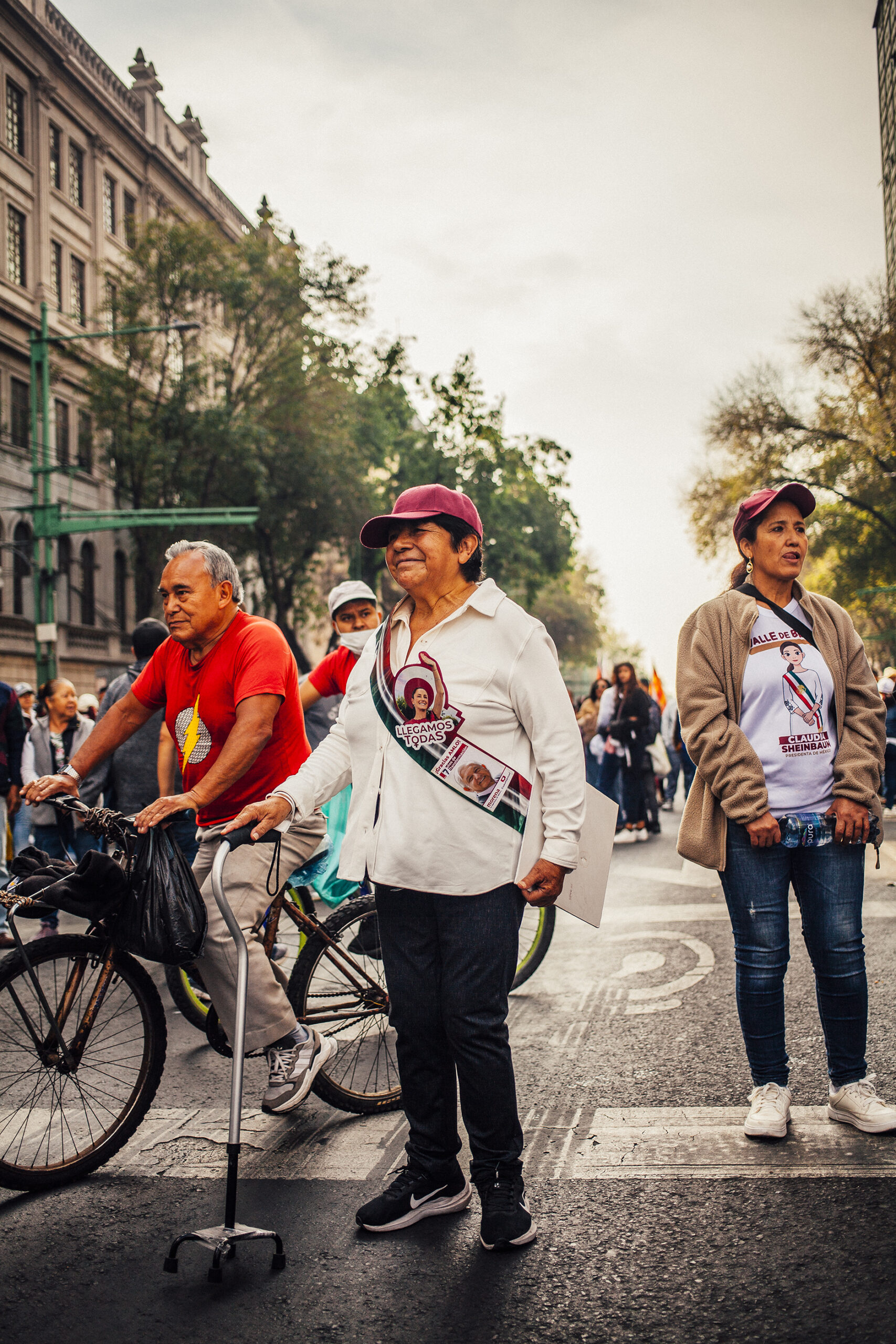
Of course, the claim that Morena is the PRI of the 1970s is baseless, since the votes with which it won in 2018 and 2024 reflect genuine majority popular support; they are real, as is the profound collapse of the opposition. In democracies, the majority rules. The electoral reform that President Sheinbaum Pardo is proposing is entirely legitimate, as it has the support of the majority of Mexicans who back her government in the Chamber of Deputies and the Senate.
Pedro Mellado Rodríguez is a journalist who, for five decades, has been a keen and critical observer of public life in Mexico.
-

Communism Without Rifles
January 23, 2026January 23, 2026
The Communist Party of Mexico’s mere existence helps prevent the political landscape from being reduced to a false dilemma between a managed progressivism & an increasingly aggressive right wing.
-

Morena is not the PRI of the ’70s
January 23, 2026January 23, 2026
The opposition’s claim that Morena is the PRI of the 70s lacks foundation; the votes with which it won in 2018 and 2024 reflect genuine popular support.
-

Mexico SA
January 23, 2026January 23, 2026
Canada has begun to make moves (such as rapprochement with the People’s Republic of China), but Mexico is clinging to the USMCA: all its eggs in one basket, something that, given the frenzied dynamic imposed by Trump, doesn’t seem to be the wisest course of action.
The post Morena is not the PRI of the ’70s appeared first on Mexico Solidarity Media.
From Mexico Solidarity Media via This RSS Feed.