

Traitors, agents of foreign powers, and hitmen with superior electronics and sophisticated weapons interfere with communications, murder dozens of our compatriots, kidnap the elected president, defame him, and prepare for the transition by dividing up the country behind closed doors. The spoils are not bad at all: the largest fossil fuel reserves on the planet, stolen without asking the opinion of their owner, the sovereign [Venezuelan] people.
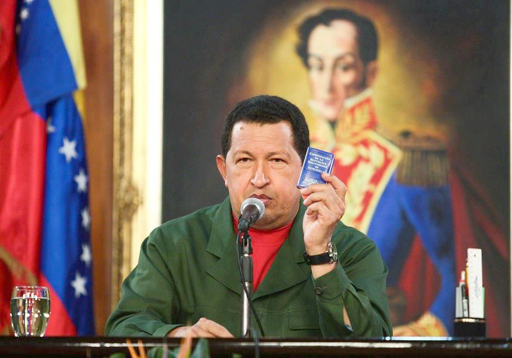
A human avalanche interrupts the looting and reinstates the legitimate authorities. They brandish their secret weapon before the cameras: a little blue book called the Constitution of the Bolivarian Republic of Venezuela. We are, of course, talking about April, 2002. That Fundamental Law is still in force. Let us consult it.
The question arises of whether a foreign leader, who does not even speak our language, can dictate policy to Venezuela and its authorities. In this regard, the Constitution states: “Article 1. The Bolivarian Republic of Venezuela is irrevocably free and independent and founds its moral patrimony and values of liberty, equality, justice, and international peace on the doctrine of Simón Bolívar, the Liberator. Independence, liberty, sovereignty, immunity, territorial integrity, and national self-determination are inalienable rights of the Nation. Article 5. Sovereignty resides inalienably in the people, who exercise it directly in the manner provided for in this Constitution and in the law, and indirectly, through suffrage, through the organs that exercise public power. State organs emanate from popular sovereignty and are subject to it.”
The Constitution clarifies who owns the mineral wealth that a certain foreign leader considers we have “stolen” and which he will “take charge of” until he sees fit: “Article 12. Mining and hydrocarbon deposits, whatever their nature, existing in the national territory, under the territorial sea bed, in the exclusive economic zone, and on the continental shelf, belong to the Republic, are public property, and are therefore inalienable and imprescriptible. The sea coasts are public property.”
Let us ask ourselves whether the murder, without prior declaration of war, of nearly a hundred defenseless fishermen and another hundred of our brothers and sisters is sufficient grounds for the people or authorities to collaborate with the invaders in the destruction of the Republic. In this regard, our Constitution states: “Article 25. Any act carried out in the exercise of public power that violates or undermines the rights guaranteed by this Constitution and the law is null and void, and the public officials who order or execute it incur criminal, civil, and administrative liability, as the case may be, without the excuse of receiving orders from superiors.”
The foreign leader who ordered this series of mass murders declares that Venezuelan oil “belongs to him” and that he will “take charge of it,” as if the kidnapping of an official made him the owner of assets that belong only to the Republic, that is, to the Venezuelan people. In this regard, our Constitution states: “Article 156. The National Public Power has jurisdiction over: 16. The regime and administration of mines and hydrocarbons, the regime of uncultivated lands, and the conservation, promotion, and use of the country’s forests, soils, waters, and other natural resources. The National Executive may not grant mining concessions for an indefinite period (…)“. And for further clarification: ”Article 302. The State reserves, through the respective organic law and for reasons of national convenience, oil activity and other industries, exploitations, services, and assets of public interest and strategic nature. (…)”.
If foreign leaders and capitalists plunder such assets for their own personal gain, the social, economic, educational, welfare, and cultural rights of all Venezuelans recognized by the Constitution will be rendered inapplicable due to a lack of resources.
Does the bombing, massacre, and invasion of our territory grant the criminal the authority to impose measures contrary to our laws and the Constitution? In this regard, the Fundamental Law states: “Article 138. Any usurped authority is ineffective and its acts are null and void.”
Should we tolerate such usurpation? Our inviolable Fundamental Law answers us: “Article 130. Venezuelans have the duty to honor and defend their homeland, its symbols, and cultural values, and to safeguard and protect the sovereignty, nationality, territorial integrity, self-determination, and interests of the Nation. (…) Article 333. This Constitution shall not lose its validity if it ceases to be observed by an act of force or because it is repealed by any means other than those provided for therein. In such an event, every citizen, whether vested with authority or not, shall have the duty to assist in restoring its effective validity.”
We have been victims of an aggressive war. Until a peace treaty is signed, no diplomatic relations will be established, nor can any agreements of any kind be made with the aggressor.
[…]
The only legal effect of the reprehensible and repudiated invasion, apart from the destruction of lives and property, is the illegitimate kidnapping of the Head of State, the massacre of more than two hundred compatriots, and the civil and criminal liability resulting from such crimes. Crime does not engender rights, only punishment.
The views expressed in this article are the author’s own and do not necessarily reflect those of the Venezuelanalysis editorial staff.
Translated and slightly abridged by Venezuelanalysis.
Source: Rebelión
The post Invasion and Constitution appeared first on Venezuelanalysis.
From Venezuelanalysis via This RSS Feed.