


Nika Bartoo-Smith
Underscore Native News + ICT
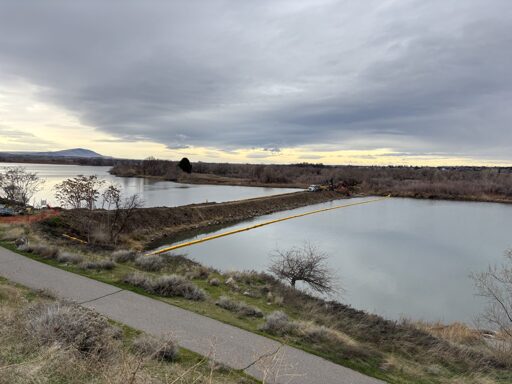
Deconstruction of the Bateman Island causeway in southcentral Washington state began on Jan. 5 as part of greater restoration efforts along the Yakima River Delta.
For over 80 years, the Bateman Island causeway, or raised path, has created stagnant water conditions and a place for sediment to pile up. This has led to warmer water conditions where invasive non-native fish, such as small mouth bass, thrive. It has also led to toxic algae blooms and a prime breeding ground for mosquitos, said Mike Livingston, the south central region director for the Washington Department of Fish and Wildlife.
“Removing the causeway is going to undo 86 years of partially blocked fish passage at the Yakima Delta that was built in 1939 and ever since then, the flow of the river has been forced to go around to the north end of the island,” Livingston said.
Historically, the river would flow around both sides of the island, mixing the cool water of the Columbia River into the Yakima River.
The causeway has also made it difficult for juvenile salmon to migrate downstream in spring and early summer, and limited passage for adult salmon returning for spawning in the summer and fall.
The causeway itself was not permitted, but rather constructed for agricultural purposes and so that farmers could access the island, according to Joe Blodgett, a citizen of Yakama Nation and the Yakima Klickitat Fisheries project manager for Yakama Nation Fisheries.
“So they put it out across the river, without designing a way for fish passage or water movement through that area, just completely dammed up that portion of the Yakima River that was traditionally dumped into the Columbia [River],” Blodgett said.
With the deconstruction of the causeway, there will no longer be direct access to the island, which some members of the public expressed concern about, according to Livingston. He said they made the decision to not build another bridge for foot access to the island primarily due to the cost, as building a bridge would be more expensive than deconstruction.
The whole area also holds cultural importance to Native Nations in the region, including Yakama Nation and the Confederated Tribes of the Umatilla Indian Reservation, said Philip Rigdon, a citizen of Yakama Nation and the superintendent of Yakama Nation’s Department of Natural Resources.
The deconstruction of the causeway is part of the Yakima Basin Integrated Plan, a state, federal, tribal and community collaboration with a 30-year plan to address the basin’s water needs.
Funding for the deconstruction work came from a $1.2 million contract awarded to Pipkin Incorporated by the Walla Walla District of the Army Corps of Engineers. The work itself is a partnership between multiple federal, state, local and tribal governments and agencies.
On federal level that included the Army Corps of Engineers, the Department of Fish and Wildlife, NOAA Fisheries and the Environmental Protection Agency; on the state level that included the Washington Department of Fish and Wildlife, the Washington Department of Ecology and the Washington Department of Natural Resources; Yakama Nation and the Confederated Tribes of the Umatilla Indian Reservation; the Tri Cities government; along with the general public, according to Kathryn Herzog, USACE Walla Walla District planner and project manager.
“For this type of project at this scale, that is a lot of coordination,” Herzog said. “So it did take more time, but it’s really exciting.”
This deconstruction project is more than 10 years in the making, Livingston said. The Washington Department of Fish and Wildlife joined the effort in 2016, though the work toward deconstruction was built upon scientific studies in the area done by Yakama Nation Fisheries and Mid-Columbia Fisheries.
The Walla Walla District joined the project in 2019, starting with a feasibility report, completed in 2024, studying various solutions to improve the overall ecological health of the Yakima River Delta.
After over a decade of permitting, a feasibility study, cultural resource reviews and securing funding, deconstruction is underway and expected to take place through February.
“Yakama Nation, a long time ago, under our treaty of 1855, we’ve been fighting for the right for fish and we do consider it very important, the place and role that we have in not just wanting to say fish are coming back, but making sure that there’s fish available for our membership to catch,” Rigdon said. “And so we’re working on almost every basin through different processes.”
This story is co-published byUnderscore Native News andICT, a news partnership that covers Indigenous communities in the Pacific Northwest.
The post Bateman Island causeway removal to restore fish passage appeared first on ICT.
From ICT via This RSS Feed.