

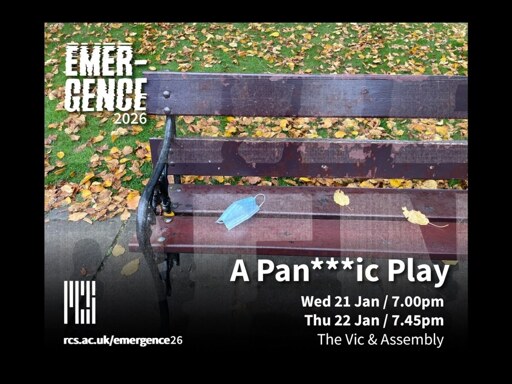

For much of the theatre industry, COVID-19 has been treated as a crisis we “came through.” But a new production at Emergence Festival in Glasgow uses monologues to document how COVID and Long COVID are shaping people’s lives. It comes amid a wider, international push for COVID-conscious practices in theatre and live performance.
A Pan***ic Play, produced and performed by Serina Estrada is “inspired by verbatim theatre” and draws on a model similar to The Vagina Monologues, presenting “real, lived experiences” of the ongoing pandemic. The production runs 21–22 January 2026 at The Art School at 20 Scott St, Glasgow as part of Emergence Festival 2026, a festival of new work from graduating artists in the Royal Conservatoire of Scotland’s MFA Acting/Directing Classical and Contemporary Text programme.
The Glasgow production is arriving in a context where COVID-conscious theatre is developing alongside advocacy for airborne infection prevention in the arts. In the US, two COVID–focused performances took place on 24 April 2025 in New York. The first was Wake Up and Smell the C*VID: An Evening Without Eric Bogosian, a hybrid performance organised by the anonymous arts collective Holy Erotic Propaganda Arson (HEPA). The play consisted of a series of monologues about how COVID and Long COVID are affecting artists’ lives. The second, AIR CHANGE PER HOUR, took place in Brooklyn as part of an Issue Project Room residency by artist Anna RG. It was structured around the presence of air purifiers, and it also had access measures including opportunities for audience members to lie down.
In the UK, advocacy for clean air in live performance has been growing. Dr. Sally Witcher OBE, founder of INN the Arts (“Indoor Safety in the Arts”), has developed a framework of best practices aimed at reducing airborne infection risk in theatres and venues. Separately, Protect the Heart of the Arts, an action network sounding the alarm on COVID’s impact on the performing arts, maintains a spreadsheet of COVID-related event cancellations and celebrity illnesses and deaths. The group also distributed Long COVID awareness ribbons at the 2024 BAFTAs hosted by David Tennant, after which actor Joanne Froggatt from ITV’s pandemic drama Breathtaking wore one on BBC’s One Show.
A Pan***ic Play sits within that international landscape, but it is also a local project with the specific aim to put testimony at the centre of the performance. Protect the Heart of the Arts spoke with Serina Estrada about how the piece was produced, what it means to stage COVID in 2026, and what responsibilities come with making COVID conscious theatre. making work from other people’s experience
Tell us about yourself. Where are you from? What’s your theater background?
Hi! My name is Serina. I’m a Mexican American artist from southern California currently studying at the Royal Conservatoire of Scotland in Glasgow for my MFA in acting. I received my Bachelor of Arts degree in theatre and public law from the University of California, San Diego (UCSD) in 2020.
Ever since I could talk, my dream was to perform. I could not afford to take performance arts classes as a child, so all my childhood theatre experience comes from taking drama classes and performing plays in middle school and high school. Before attending RCS, I played Lucha in La Lucha at La Jolla Playhouse’s WOW Festival in 2023.
Almost all of my acting experience is in theatre, but my goal is to transition to television and film. Hopefully, I will get a UK agent and start booking work by the end of 2026.
What has been the development process? Where and how is it being produced? What is it about? When will it be performed?
In October I posted a Google form in all of the COVID conscious online spaces that I’m a part of asking people to share their experiences with the ongoing pandemic. I received a lot of responses, and I would have received many more if I had kept submissions open for longer than 1 week.
A Pan***ic Play is a collection of these stories. It is a 50 minute verbatim theatre one person show and will be performed at the Vic Assembly Rooms (second floor) in Glasgow on Wednesday, January 21 at 7pm and Thursday, January 22 at 7:45 pm. There will also be a social hour after the show for audience members to discuss the play and build community with other CC people.
The show will be live streamed on YouTube, and footage of the show will be available after the performance as well. Additionally, one of my dress rehearsals will be professionally filmed and edited, so people can watch that footage or the livestream footage on my YouTube channel after the performance: @SerinaEstrada.
What was the moment you knew you wanted to make this piece? Is there a personal experience that shaped the urgency of this work?
I know that talking about the ongoing COVID-19 pandemic is “controversial” and deeply unpopular.
As an actor, everything you say gets linked to your brand, and to be as successful as possible your brand needs to be one that other creators, directors, studios, etc. feel comfortable linking with their brand. My classmates, lecturers, and possibly agents and other industry members will see this play, and performing this piece for them will mostly likely hurt my career rather than help it.
Even if this play doesn’t upset them, I already know the feedback I will receive from anyone who is not COVID conscious. They’re going to say, “I liked your piece, but it would have been better if you weren’t wearing a mask.” They are going to think that I am hiding behind my mask because surely I must be an insecure performer or I wouldn’t feel the need to hide my face. Non-COVID conscious people like to pretend that mask wearing ruins any and all human connection, but I vehemently disagree with that.
This piece is meant to be a creative calling card into the industry, and I have to stay true to myself. I already feel so censored as a CC actor. I have to risk my life and compromise on my values just to be able to participate in the one career that brings me joy. I promised myself a longtime ago that the art I make will be unapologetically me. I resisted writing this play and wrote an entirely different play at the beginning of October, but it was quite bad because I was censoring myself before anyone else could–I think as a defense mechanism. Once I realized this, I knew this was the story that my soul had been screaming at me to tell. I feel so free knowing that I can share stories of the most marginalized people in society, and I am doing so in a way that sits right with my soul.
What does “COVID conscious” mean to you as an artistic framework?
CC as an artistic framework means doing everything in my power to keep myself, collaborators, and audience members safe at every point of the artistic process. This is done through a multi-layered approach of mitigations like mask wearing, COVID testing, using air purifiers, etc. As both an artist and activist, I live by the phrase “We keep each other safe.” I mean safe in a broader sense–not just safety in relation to infectious diseases, but that is certainly the most pertinent danger on set.
How did you invite the community into the work?
I am partnering with Glasgow Mask Bloc and Edinburgh Mask Bloc to provide free disposable respirators and COVID zines for all audience members. I am also in touch with Air Library Scotland as they will loan air purifiers for the space. Also, a member of COVID Action Network will help distribute masks and zines on performance days. I think the best method for inviting community into artistic work is to make the work as accessible as possible, so live streaming this performance is the number one way I’m inviting the community into the work.
Did anything surprise you about the range of experiences people shared?
What surprised me was how even though everyone was so unique in their lived experiences–in their personality, in their personal health journey, in their family and friend dynamics–a lot of people shared eerily similar sentiments. Despite being vastly different people in different circumstances in different cities across the world, everyone had experienced social ostracization and isolation.
All of their worlds had shrunk.
What specific safety practices are part of the performance environment?
With the help of Glasgow and Edinburgh Mask Blocs, there will be free disposable respirators and COVID informative zines provided for the audience members. There will be air purifiers provided by myself and Air Library Scotland. My production team of two will be masked. There are content disclosures on the ticket booking website. There is an age restriction of 16+ – not because anything is particularly graphic, but because the content is quite emotionally heavy. My production team is working on creating an access document for audience members about the details of the performance venue, the surrounding area, etc.
What do you wish more established institutions understood about this moment?
That everyone is slowly but surely dying or becoming disabled by COVID. That history will not look kindly upon them. That future generations might not forgive them for the harm they’ve caused. That COVID-19 is a worker’s rights issue. That they have the power to do better and set the standards for more accessible and safe art creation.
Where does joy live in this piece? Where does humor live?
The joy lives in the community that we have. The joy lives in knowing that we are not alone–there are people all across the globe who care about keeping everyone safe. The humor lives in the ridiculous circumstances we have found ourselves in. There’s a few jokes and moments of levity in this piece that I think audiences will appreciate.
What do you want audiences to carry home?
I want audiences to carry home a sense of empowerment that they are capable of taking small, actionable steps to keep themselves and their community safe. Even if they don’t agree with COVID consciousness, I want them to know that this community exists and will be there for them if they develop long term health effects as a result of repeat COVID infections.
What would a truly COVID conscious theater ecosystem look like?
It would look like installing HEPA filtration/ventilation systems in theaters. It would look like installing CO2 monitors, and maintaining healthy CO2 levels. It would look like PCR testing everyone on set/in the building for COVID-19 daily. Actors should be allowed to wear masks until it’s absolutely necessary to see their face, and they shouldn’t be punished for doing so. Everyone should get paid sick leave, nobody should be on set while symptomatic with anything, people should be allowed to virtually attend rehearsals if they’re sick or if their physical presence isn’t necessary for rehearsal. Performances should have livestream options available for audience members. These are just a few examples.
What advice would you give other emerging artists who want to create with COVID cautious principles?
Remember you are only responsible for the things within your control, so do not be discouraged by systemic barriers. You might not be able to check all the boxes you want to, but some measures are better than none. Once the industry, venues, and fellow artists realize the dangers of COVID and that there is a demand for COVID-safe art, it will get easier to ask for these measures. We will have to compromise sometimes, but that is not defeat.
There are organizations like Inclusive New Normal and Protect the Heart of the Arts that are trying to advocate for Covid consciousness in art, so please join them. They need our support and advocacy because they are the biggest organizational advocates for COVID safety measures.
What are you making next, and how has this project influenced your artistic identity, process, goals, etc.?
I think I will continue expanding this project for at least the next couple of years. I want to take this show to the Edinburgh Festival Fringe in August, and potentially tour it internationally. I want to expand my production team, I want to continue adding new stories to this show, and I want to increase the show length from 50 minutes to 90 minutes or even 2 hours.
This show has solidified my artistic identity. I’ve always wanted to be an artist that reflects the times like Nina Simone said. I want my art to amplify stories of the most marginalized people in society. This project has also taught me the importance of pacing myself and asking for help.
After this project, I will focus solely on my acting career. My goal is to fund projects like this in the future. I hope that other CC creatives will be inspired to keep making art about COVID.
What does care look like as an artistic practice?
Care looks like checking in with your collaborators and with yourself. It looks like taking measures to ensure a safe environment at all stages of the artistic process.
A Pan***ic Play
A 50 minute, one-actor, verbatim monologues curated from lived experiences
Wed 21 January 2026 (19:00); Thu 22 January 2026 (19:45)
The Art School, 20 Scott St, Glasgow G3 6PE
Content disclosures: grief, pandemics, ableism, isolation
Tickets for in person attendance are £5:
https://www.rcs.ac.uk/whats-on/a-panic-play-emergence-2026/
The YouTube livestream is free:
Featured image via the Canary
By Protect the Heart of the Arts
From Canary via This RSS Feed.