

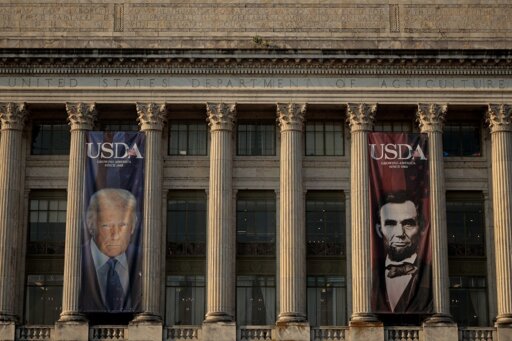
On Inauguration Day, Jan. 20, 2025, we launched the Food Policy Tracker, an accountability reporting project intended to serve as a record of federal food and ag actions. Over the course of the past year, we have published hundreds of stories documenting unprecedented upheavals in U.S. food policy.
Beginning with Trump’s first day in office, we kept our eyes on myriad moves at lightning speed. That day alone, the president signed a range of executive orders affecting the food system, from a boost to fossil fuel production to a crackdown on immigration and a dismantling of environmental justice initiatives.
As we enter the second year of this immersive work, we’re taking stock of all we achieved in just one year and the lessons we’ve learned along the way. We surpassed what we thought was possible for our small team.
Multiple other publications, political commentators, politicians, and food experts have cited us; legislators have given us exclusives; and the National Press Club and the Institute for Nonprofit News (INN) have featured us. We’ve talked about the Tracker on podcasts and panels. And we’ve been told that our work has been “lifesaving,” “critical,” and “transformative,” and have reached thousands of new readers.
We’ve been told that our work has been “lifesaving,” “critical,” and “transformative,” and have reached thousands of new readers.
Our indefatigable Senior Staff Reporter and Contributing Editor Lisa Held has chased every story, breaking the news and scooping mainstream media time and again. Held’s reporting detailed the mayhem unleashed by the Department of Government Efficiency (DOGE) as it slashed the federal workforce across agencies. Her posts covered the administration’s cuts to funding for DEI programs, climate-smart projects, and farmer-grown food for schools and food banks, as well as new SNAP restrictions. As the cuts to farm grants kept coming, Held posted a running list.
The Tracker followed the Make America Healthy Again (MAHA) movement, too, particularly its support of Secretary of Health and Human Services Robert F. Kennedy Jr.’s stated goals to rid the nation of ultra-processed foods and artificial food dyes.
And, as ICE stepped up its actions against immigrants—the foundation of the U.S. food system—we created another running list within the Tracker, documenting arrests and detentions of farm- and food workers. We paid close attention to the impact of the crackdowns on farming and food systems. At the same time, we followed changes to the H-2A Guest Worker program that could leave these workers more vulnerable to exploitation.
In August, Rebekah Alvey joined our team as staff reporter, and shortly thereafter, our senior editor, Brian Calvert, became lead editor of the Tracker, allowing us to increase the pace and breadth of our reporting. Calvert took over from Operations Matt Wheeland, who conceived of and launched the Tracker with Held.
Since that time, we have reported multiple stories around Trump’s ever-changing tariffs and their impact on farmers. We covered the One Big Beautiful Bill as it made its way through Congress, reporting on initial budget proposals, an impassioned Democratic hearing around SNAP cuts, and the final passage of the gargantuan budget bill.
As ICE stepped up its actions against immigrants—the foundation of the U.S. food system—we created a running list within the Tracker, documenting detentions of farm- and food workers.
Then in October came the longest government shutdown in history. We were there at every twist and turn, reporting on the federal food and ag work that was suddenly paused, publishing a cascade of stories about the impending halt in SNAP payments, and following the back-and-forth legal jousting over the administration’s attempts to block the release of SNAP funds. The Tracker covered the aftermath of the shutdown, too, analyzing how that long suspension of government will continue to impact the way America farms and eats.
As the year came to a close, we reported on the Environmental Protection Agency’s registration of another “forever chemical” pesticide, the looming lapse in Affordable Health Care subsidies and how that would upend farm communities, the latest twist in Trump’s tariffs, MAHA’s impact on federal and state policies, and—as Held put it—“about a million other things.”
In other words, it’s been a breakneck year. The Tracker has transformed our newsroom. Before we began this project, we were not a breaking news organization; for most of our 17-year history, we’ve sought to be additive instead, and tell underreported stories that larger, mainstream outlets often miss.
Now we’re doing both. In 2026, you can expect more breaking news from the Tracker as we continue to create a record of federal actions. Posts will be somewhat shorter, with longer news analyses building out on that reporting. And we’ll continue to publish underreported stories, too.
We’re thrilled to say that more of our Tracker posts will soon feature video. We’ve recently expanded our team to include video reporter Vanessa Johnston, and you’ll be seeing more of her work there and elsewhere on the site.
As always, we’ll be tweaking and updating as we go along, making the Food Policy Tracker as useful as possible. We welcome your suggestions by email at tracker@civileats.com.
The post Civil Eats’ Food Policy Tracker: What We Learned From Our First Year appeared first on Civil Eats.
From Civil Eats via This RSS Feed.