

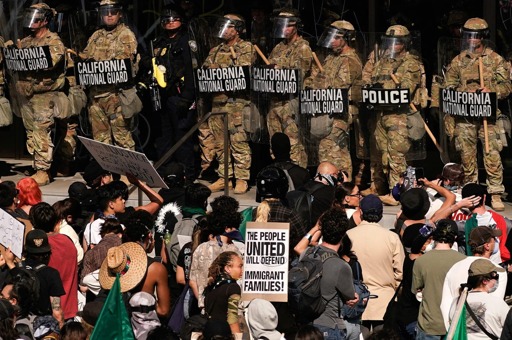
It’s now been an entire year since Donald Trump returned to the White House. For many, it’s felt much longer. The Trump administration wasted no time attacking people throughout the United States and the world.
But the past year has not consisted only of attacks. It has also been marked by resistance. People have bravely taken to the streets against the Trump administration, put their bodies on the line to defend their immigrant neighbors, and even rejected Trump’s violence beyond the United States.
One year into the second Trump administration, it’s essential to reflect on how people have fought back and to remind ourselves that the administration isn’t as strong as it hopes to appear. In doing so, we can learn lessons for our future struggles against the Far Right.
A Growing Movement against ICE
As a candidate, Trump called for mass deportations, and he’s been fulfilling this promise in horrific fashion. ICE and other federal agencies have terrorized immigrant communities across the country. This terror, however, has sparked a renewed hatred of the agency, manifesting in widespread examples of communities defending their immigrant neighbors.
Every case of this is important, but some communities have been especially combative, elevating people’s understanding of what the fight against ICE can look like. Street confrontations in Los Angeles showed that everyday people could force Trump’s forces to withdraw. Importantly, SEIU mobilized its members after ICE attacked labor leader David Huerta, marking an early expression of the strategic role labor can play.
Many of the examples set in Los Angeles inspired other street confrontations in Chicago, Portland, and now Minneapolis. In fact, the fight in Minneapolis has taken resistance to ICE to a new level. The city has been in a state of constant activity after the murder of anti-ICE activist Renée Nicole Good. Unions are beginning to play an even greater role by calling for “no work” on January 23, setting the stage for a new chapter of the movement against ICE, one in which labor can play an even larger role.
Millions in the Streets
Beyond the street confrontations and community resistance to ICE, massive protests have shown that the desire to fight touches much broader sectors of society. This is shown by the No Kings demonstrations, which brought millions into the streets. The nationwide protests, along with turning out massive numbers in major cities like New York, Chicago, Los Angeles, and Philadelphia, also included protests in deep-red states and small communities.
The No Kings protests have taken up a wide range of issues. They’ve denounced Trump’s firing of thousands of public sector workers and funding cuts for important services like education and environmental protections. The protests have also expressed solidarity with high-profile targets of Trump’s attacks on immigrants like Kilmar Abrego Garcia and pro-Palestine activists like Mahmoud Khalil. The mainstream solidarity with these figures helped push the courts to rule against Trump in his attempts to keep Abrego Garcia imprisoned in El Salvador and to fast-track the deportation of Khalil and other pro-Palestine activists.
Importantly, the most recent No Kings demonstrations showed signs of growing anti-imperialist sentiments in the United States, making an explicit call: “Hands off Venezuela, no war for oil!” Many who attended the latest protests made the connection between Trump’s violence against communities in the United States and his violence abroad.
This mainstream sentiment against Trump’s attacks on workers in the United States and abroad was also expressed at the ballot box when New York elected Zohran Mamdani as mayor. Beyond the figure of Mamdani, whose role as a Democrat in an executive position limits how much he’ll confront the Far Right, his historic electoral victory expresses growing support for progressive and even socialist responses to the crises that working people are facing.
International Protests against Imperialism
As the new head of U.S. imperialism, Trump has continued the genocide in Gaza and aggressively sought to dominate Latin America. Much like his domestic agenda, his imperialist agenda has been confronted.
The movement for Palestine saw a powerful example of international solidarity with the Global Sumud Flotilla attempting to break the siege on Gaza. Workers, students, and activists from over 40 countries worked together to show that, rather than relying on capitalist countries and institutions like the United Nations, everyday people organizing internationally can lead the fight against imperialism’s worst atrocities. The example of the Global Sumud Flotilla sparked a general strike in Italy, which reminded the world that workers using the power of their labor are in a strategic position to “Block Everything” and force the hand of imperialist governments.
Latin America, which is increasingly the target of U.S. aggression, has also shown the limits of Trump’s attacks abroad. In response to Trump’s threats to take the Panama Canal and the Panamanian government’s complicity, the country saw powerful strikes and student mobilizations. This was an early sign of growing class struggles throughout Latin America. Just recently, Bolivia experienced a powerful uprising against the new far-right government’s attempts to attack workers and open the country for extraction, largely in alignment with the United States. In Ecuador, votes rejected Trump ally Daniel Noboa’s attempt to entrench his power and open a U.S. military base. Argentine president Javier Milei, one of Trump’s closest regional allies, has also faced resistance from retirees, students, healthcare workers, and the country’s socialist Left.
Resistance to Trump’s “Donroe Doctrine” to control Latin America could sustain a general strike across Latin America that would resist Trump’s looting of Venezuelan oil, continued military threats to the country, and kidnapping of Venezuelan president Nicolás Maduro.
From Los Angeles to Minneapolis, Ecuador to Italy, and everywhere else, workers, students, and communities are confronting the violence of the Trump administration. We’ve already dealt blows to his agenda — and we’re just getting started.
The post The First Year of Trump 2.0 Showed That People Want to Resist the Far Right appeared first on Left Voice.
From Left Voice via This RSS Feed.