


Mark Wagner
Special to ICT
EAST CANTON, Ohio — The memories bring smiles to Renee Powell as she sits in the new Powell Educational Building at the Clearview Golf Club.
Her father, Bill Powell, built the Clearview club, the first in the United States to be constructed, owned and operated by an African-American for all peoples. She grew up on the links and went on to one of the great careers in golf, with induction into 15 Halls of Fame, including the PGA of America.
“I had a club in my hand at the age of three,” said Powell, 79, who still operates the course with her brother, Larry.
Today, 80 years after her father began work on Clearview, her family’s accomplishments are being recognized with the newly completed educational center, which will also house the Bill and Marcella Powell Museum.
The building will have an opening this June with celebrations that will include the Franco Harris Pro-Am women’s tournament June 6-8, along with a dinner — “For the Love of the Game “ — at the Pro Football Hall of Fame.
Before that, at this year’s PGA Expo on Jan. 21, the National Golf Course Owners Association will honor the Powell family with its Award of Merit. The club has also been named to the National Register of Historic Places by the National Parks Service.
“One of the most historically significant courses in American golf,” said Debert Cook, a 2025 inductee into the National Black Golf Hall of Fame who is also founder and publisher of African American Golfer’s Digest. “This is a testament to legacy and pride in maintaining a family-owned business for soon to be 80 years.”

The Clearview Golf Club became the first Black-owned golf course and the first to be open to all people, regardless of color, when founder William Powell began building it in 1946. The club is celebrating its 80th year in 2026 with special events. Credit: Photo via Clearview Golf Club
Coming 130 years after Oscar Smith Bunn, Shinnecock, and John Shippen, African-American, broke the color barrier by playing in the 1896 U.S. Open golf tournament at Shinnecock Hills Golf Club on Long Island, Cook sees Clearview’s new museum and educational building as offering “a unique experience about a landmark course with in-depth narratives about competition and barrier-breaking in the sport.”
Black ownership of golf courses is still rare, with just 10 current Black-owned courses, including Michael Jordan’s Grove XXlll club in Hobe Sound, Florida.
Clearview’s anniversary, however, illuminates the growing access among Native American athletes. Beginning with Inn of the Mountain Gods opened in 1975 by the Mescalero Apaches, many tribal nations – currently 70 – have constructed their own courses, increasing access for golf tourists and tribal citizens.
A time of optimism
Among the fondest memories for Powell are the times she crossed paths with the renowned late golfer Althea Gibson, a champion professional tennis player who went on to make her mark in the golf world and who would become a lifelong friend.
She falls into the memories easily, and with good humor. One in particular stands out.
It was the summer of 1963, and The Choi Settes, an all-Black, all-women’s golf club in Chicago, arranged for two young rising golf stars to take on world champions Gibson, who was Santee/Lumbee, and boxer Joe Louis, a Black boxer of Cherokee descent.
Powell, then 17, and Ted Beattie, 18, were chosen after winning their respective United Golfers Association Junior Championships earlier that summer. They were tapped to take on Gibson and Louis at a course called Pipe O’Peace, a favorite spot for Louis near Chicago that was renamed in the 1980s as Joe Louis “The Champ” Golf Course.
The 18-hole match, designed to promote golf and raise funds, was sponsored by Coca-Cola, and, oh yes, the youngsters were instructed not to beat the world champs. They didn’t listen.
“Ted and I won one-up in 22 holes,” Powell told ICT with a smile. “Althea and Joe were not happy about it.”
The match was just four weeks on from President John F. Kennedy’s “Ich Bin Ein Berliner” speech, and just five weeks before Dr. Martin Luther King Jr.’s “I have a dream” speech. It was a time of great American optimism. That same month, Gibson and Powell, would become the first women of color to play in the U.S. Open Golf Tournament.
By then, Powell already knew Gibson, an 11-time Grand Slam winner in tennis before turning to professional golf in the early 1960s. They met in July 1961, when Powell, at the time a 15-year-old prodigy, earned entrée to the UGA Championship at Ponkapoag Golf Course outside Boston. The UGA had formed in 1925 to provide venues for Black golfers to play tournament golf, but later disbanded in 1976.
In the run-up to the 1961 championship, a Boston Globe headline read, “Renee Powell, 15, Amazing Golfer,” and the article promised Powell would “crowd Althea Gibson for the spotlight at Ponkapoag.”
That championship is notable for other reasons, as well. The overall winner was Vernice Turner, and her daughter, Moochie Turner, won the junior division, making the pair the first mother-daughter tandem to win a major tournament.
Powell would eventually be bested by Clara Bigelow, the great Wampanoag golfer from Coonamessett. Bigelow was the sister of Slow Turtle, the Wampanoag leader who would become Massachusetts’ first Commissioner of Indian Affairs.
Powell recalls being paired at the championship with Gibson and the great Ethel Funches, who had dominated the UGA in the late 1940s and 1950s.
“She was very tall and very, very strong – mentally and physically strong,” Powell said of Gibson. “She could hit it as far as the guys. She had a long powerful swing, and she just wanted to play her sports and not have to face the challenges because of our color.”
Gibson died in 2003 at age 76. Beattie, who later became president and CEO of the Shedd Aquarium in Chicago, died Jan. 6, 2023, at the age of 77.
The Powell legacy
Powell’s father, known as Bill, had been a decorated golfer in high school and college but returned from World War II to a country still blinded by skin color. Supported by his wife Marcella, he overcame loan denials and red-lining to fund a land purchase with Black investors, including his brother.
He then hand-built the Clearview golf course on farmland near East Canton in northeastern Ohio. There, he taught his children — Renee, William and Larry — to play the game he loved, a game he believed all comers should be allowed to play. The course was completed and opened in 1948.
In 1998, the Tiger Woods Foundation established two scholarships in the names of William and Marcella Powell, and Bill Powell received the PGA’s Distinguished Service Award just before his death in 2009. He was posthumously inducted into the PGA Hall of Fame in 2013.
The construction of the Powell Educational Building and the William and Marcella Powell Museum has been a work in progress, with significant support from the Ladies Professional Golf Association and other organizations along with the Powell family’s fundraising efforts.
In 1967, Renee Powell joined the LPGA, which unlike the PGA never had a Caucasian-only clause for members.

Pioneering golfer Renee Powell speaks after receiving the Charlie Sifford Award at the World Golf Hall of Fame ceremony March 9, 2022, in Ponte Vedra Beach, Florida. Credit: AP Photo/Gerald Herbert
She credits the LPGA for creating an event — The Clearview Legacy Benefit —- which has provided funds to establish the Powell Educational Building and museum. The benefit event has been held since 2021.
The LPGA also supports the Renee Powell LPGA Girls Golf Grants which aim to ensure that all girls have an opportunity to play the game.
“I’m proud of my association,” Renee Powell said. “The LPGA today understands the significance of Clearview to golf.”
She said she also received support from LPGA players in facing the racial barriers. Among those she names are Marlene Hagge, Kathy Whitworth, Carol Mann and Mickey Wright — all members of the LPGA Hall of Fame. Powell and Wright were inducted together into the PGA of America Hall of Fame in 2017.
“They knew the challenges and believed in fairness,” she said.
She also credits the LPGA’s director of tournaments, Lenny Wirtz, a former referee in the National Basketball Association, for fighting the good fight. Wirtz would not run tournaments at clubs that prohibited Black players from competing.
“Lenny had been an NBA ref,” she said. “He was tough. A short guy calling the game for all those giants.”
‘Just a match’
The construction of the Powell Educational Building has resulted in a welcoming space filled with trophies, artifacts and documents of a history that continues to celebrate the values of inclusion and access for all.
While the Clearview is still not officially open, Renee Powell took an ICT visitor through the exhibits, highlighting artifacts of the Powell legacy, including honors for her brother Larry, who has run Clearview for many years.
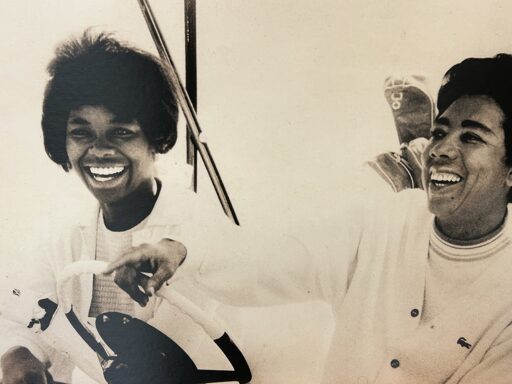
The historic pictures of Powell with her friend, Gibson, turn the discussion back to “the match”’ nearly 60 years ago and an unexpected encounter nearly eight years ago at the esteemed Royal & Ancient Golf Club of St. Andrews in Scotland.
“I was at St. Andrews in 2018,” she recalls. “I was standing behind the 18th green one afternoon and a gentleman comes up to me and says, ‘Renee, it’s Ted.’ He was on a golf trip to Scotland, on a break from his tasks as the director of the [Shedd] aquarium in Chicago.”
It was her former golfing partner, Beattie, from the championship match years ago. The meeting cemented a shared memory of a sunny summer in 1963 when a couple of kids didn’t know enough to take a dive on the course.
As she tells the tales and recounts her family’s history, answering questions along the way about winning a golf match against two of history’s greatest athletes, she understands one of the key teachings of golf — humility.
“It was just a match,” she says with a smile.
Mark Wagner is a golf historian and the founding director of the Binienda Center for Civic Engagement at Worcester State University in Massachusetts. His book, “Native Links, the Surprising History of Our First People in Golf,” was published in 2024 and is available from Back Nine Press and Amazon. He can be reached atmarkgwagner@charter.net.
The post Clearview at 80: A window into history appeared first on ICT.
From ICT via This RSS Feed.