

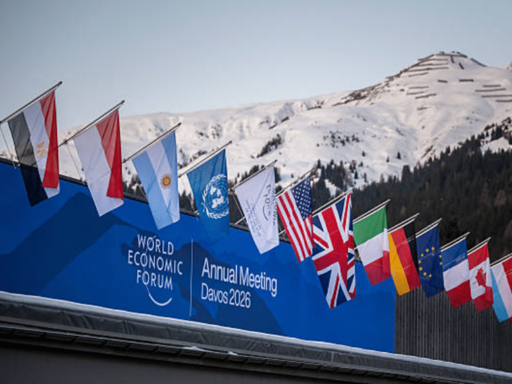

This year’s World Economic Forum began yesterday, 19 January, in the Swiss Alpine town of Davos. The conference of world leaders and business executives has previously been characterised as a stronghold of liberal globalism – or “woke banks” and “lab-grown meat”, in the words of Florida governor Ron DeSantis.
However, this year’s agenda is looking distinctly less liberal, and more in line with the sensibilities of its MAGA-dominated guest list. The year’s theme is a rather wishy-washy ‘A Spirit of Dialogue’. However, given that Trump is headlining the whole affair, you’ll have to forgive us if we don’t take that theme particularly seriously.
Davos and a ‘broad footprint’
At last year’s Davos conference, Trump appeared via video call from the US. At the time, the president had only just been inaugurated for his second tenure in the White House. He used the opportunity to urge NATO to increase its spending, demand that the Federal Reserve cut interest rates, and threaten massive trade tariffs.
This year, however, Trump is appearing in person. That’s due in no small part to WEF president Børge Brende, who pursued the US dictator zealously. Brende told Politico last week that:
Post-Davos last year, I started discussions with the White House and also coordinating with Chief of Staff Susie Wiles. […]
I also visited D.C. in early December, had meetings in the White House, but also with the different Cabinet secretaries, and now we are in a situation where Trump is coming, and we also have five key Cabinet secretaries, There will be a broad footprint of the U.S. in Davos.
‘A broad footprint’ is, if anything, selling it somewhat short. The US brought its largest-ever delegation to the 2026 WEF, including not only Trump but also treasury secretary Scott Bessent, commerce secretary Howard Lutnick, and secretary of state Marco Rubio.
The large US contingent has also chosen, characteristically, to form its own enclave within Davos. The Americans have set up what they’re calling “USA House” – a small church given over to host economic bigwigs trying to gain access to Trump. Microsoft and McKinsey sponsored the USA house endeavor.
‘Geo-economic confrontation’
However, a scramble for world leaders to parley with the US president at the WEF would be understandable. Like a rat running across a ballroom floor, his presence is odious but difficult to ignore. On 18 January, EU ambassadors were holding emergency meetings on Trump’s threats even as their leaders headed for Davos.
In the last few weeks alone, Trump’s administration has invaded Venezuela and kidnapped Maduro. He’s threatened to invade Greenland, and warned of massive tariffs on European countries who told him to go fuck himself.
As the Guardianreported, the omens of war – both overt and covert – have loomed large for the WEF’s attendees:
When WEF asked more than 1,300 politicians, business leaders and academics about their fears for the future, they identified “geo-economic confrontation” as the most pressing risk for the next two years – the clash for economic dominance between the big powers. The second most popular choice was outright war between nations.
And, much like that rat in the ballroom, Trump’s presence also seems to have contaminated everything it touches. When WEF president Brende was asked whether he’d tailored the event’s agenda to suit the MAGA crowd, he insisted that the schedule was:
as we planned and is not edited by any outside players.
However, that was hardly a denial of the notably Trump-aligned lineup. As Politico’sKathryn Carlson commented:
The same gathering that once gave Greta Thunberg its main stage for her “our house is on fire” warning about the climate crisis, that celebrated an all-female lineup of co-chairs in the wake of #MeToo, and that pushed governments to track progress toward the United Nations’ Paris Agreement and the Sustainable Development Goals — is now clearing space for Trump’s MAGA agenda at a moment when the U.S. president has once again upended global diplomacy by threatening tariffs on European countries over their resistance to his efforts to take over Greenland.
‘Such a contradiction’
Some attendees argued that the weighting of the agenda merely reflected the current political moment. For example, Clayton Allen – US practice head for the Eurasia Group – argued that it would be:
entirely reasonable to focus on environmental, social justice concerns, but right now the world is much more concerned with the thorny questions of geopolitics.
Others were more blunt about the US-right slant of the event. Former Trump admin official-turned-Forward Global and Ballard Partners bigwig Mike Rubino, for instance, called the shift:
kind of part and parcel of the new world order.
Meanwhile, some frequent WEF attendees were critical of Trump’s very presence. Former Davos co-chair Winnie Byanyima, now UNAids’ executive director, pointed out the inherent contradiction of the authoritarian US president’s invite to an event themed around dialogue:
It’s such a contradiction, in my view. A world where the WEF would contribute is a rules-based world, where there’s predictability, where business works with governments – business to achieve their profits but governments to meet the needs of their people. But him, he represents might is right.
We’ll go one further than that. Greta Thunberg warned that “the house is on fire” back in 2019. The house is still on fire; the fire has spread. However, as soon as a geopolitical bully big enough to pull focus appeared on the world stage, the ‘green capitalist’ agenda has melted away.
Trump’s presence at the WEF, and the distortion of the event to fit his worldview, is proof if we ever needed it that we cannot look to businesses and economies to save us. If profit is the goal, the lure of short-term profit will win out over minor long-term inconveniences like ‘having no world left’, every time.
Featured image via the Canary
From Canary via This RSS Feed.