

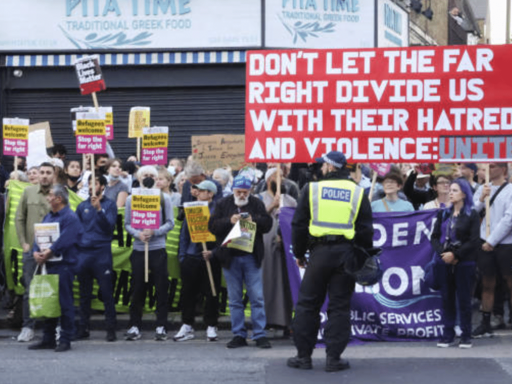

A blistering new report from the Institute of Race Relations has just taken the government apart for refusing to confront racism – even after the 2024 race riots. ‘In Racism’s Echo Chamber‘ shows exactly how the government deliberately stripped racist attacks of their racial context. Instead, ministers reduced the violence to an issue of “mindless thuggery.’ This is not a neutral description. It is a political choice.
And, that choice shaped the legal and criminal justice response that followed. Authorities treated the unrest as general ‘disorder’ rather than blatant racist violence. In doing so, institutions ignored the root cause: Islamophobia and anti-immigrant bigotry.
The report highlights that the justice system then prosecuted people defending their communities, alongside those attacking them:
Defendants lived experience of racism was minimised or dismissed, thus equating actions linked to community defence as equally culpable or ‘incendiary’.
As if racism was irrelevant.
2024 race riots: racism renamed as a disorder
The riots were lethally calculated. Perpetrators attacked mosques, migrant communities, and people they labelled ‘outsiders’. Islamophobic and anti-immigrant rhetoric did not sit at the margins of the unrest. It was at the very heart of it. The violence followed familiar lines: violent online rhetoric against people of colour and Muslims in particular, terrifying sparks of physical abuse, and then the fuelling of hatred via mainstream media outlets.
Yet the government refused to describe the riots in these terms. Instead, ministers reduced the riots to a problem of ‘law and order’. This stripped the violence of its political meaning. By collapsing racist attacks into a narrative of generic disorder carried out by mindless thugs, ministers avoided confronting the role their own rhetoric and policies have played in normalising hostility towards migrants, Muslims, and people of colour more broadly.
How narrative shaped the courts
The report goes on to describe an echo chamber in which racist rhetoric was amplified by sections of the media, then absorbed into public ‘common sense’. By the time cases reached court, prosecutors and judges treated racist motivations as incidental rather than foundational. In this way political framing, media framing and judicial reasoning formed a closed loop. One that rendered racism unspeakable even as it structured every response.
The report found that the response of the criminal justice system was:
to decontextualise the riots, absolving government policies and practices of any culpability, to explain away racist violence as the domain of ‘thuggery’, and to explain away responses in the same vein.
Analysing 126 cases linked to the unrest, the Institute of Racial Relations found that racism was frequently treated as incidental or ignored all together, even where it was explicit. Cases were instead pursued primarily as public order violations with little regard to motive, provocation, or power dynamics.
The consequence, the report finds was a flattening of responsibility – as if all violence existed on an equal footing.
The myth of ‘two-tier justice’
Central to the state’s handling of the riots was the revival of the ‘two-tier justice’ myth.
The report debunks the claim that racialised communities are treated more leniently by the courts:
Even as the ‘riots’ were ongoing, a range of figures sought to spread the notion that white defendants were victims of a ‘two-tier’ policing system that treated them more harshly ‘because of their race and political views’
The report found no evidence for this narrative. Instead it proves how the myth itself shaped public discourse and legal interpretation, providing political cover for harsher sentencing and the criminalisation of resistance. By framing prosecutions of proof as ‘equal treatment’ the justice system obscured the reality that equality applied in conditions of unequal power only entrenches injustice.
Why erasure is a political act
The warning from the Institute of Race Relations is clear. When racism is stripped from public discourse, it does not disappear. It is absorbed into the machinery of the state. By renaming the racist violence during the 2024 race riots as a ‘disorder’, the government curated a justice response that punished without understanding and equalised without accounting for power.
Unless racism is named as a political force rather than an inconvenient detail, the cycle will repeat: violence will be flattened, resistance criminalised, and the conditions that produced the unrest left intact.
Featured image via the Canary
From Canary via This RSS Feed.