


Kevin Abourezk
ICT
LINCOLN, Nebraska – The Omaha Tribe of Nebraska is seeking to require the Nebraska governor’s office to negotiate a tobacco tax compact with the tribe in good faith and not attempt to use non-related issues to affect those negotiations.
The tribe and Gov. Jim Pillen’s office are currently at odds over a possible tobacco tax compact that would involve the state and tribe splitting tax revenues from tobacco sales on the Omaha Reservation, offering a potential windfall of hundreds of thousands of dollars for the tribe.
However, Pillen and Nebraska Attorney General Mike Hilgers have stalled negotiations on the tobacco compact, citing the Omaha Tribe’s efforts to legalize marijuana within its borders as the reason for doing so. The Omaha Tribe’s attorney general, John Cartier, said Thursday that Nebraska officials are retaliating against the tribe for its efforts to legalize marijuana.
If approved, the legislative bill LB1037 would prevent Pillen from using unrelated issues, such as the tribe’s decision to legalize marijuana, to impact negotiations on a tobacco tax compact.
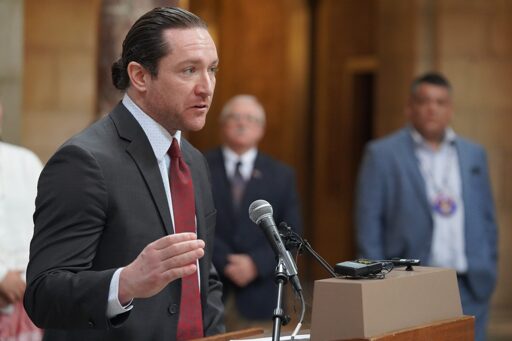
“The current statute says the governor may enter into negotiations with the various Nebraska tribes,” Cartier said. “We want to change that into language that states the governor shall enter into good-faith negotiations where they cannot use unrelated topics to use unnecessary leverage for those talks.”

Omaha Tribe drummers sing inside the Nebraska State Capitol on Thursday, Jan. 15, 2026, during a press conference hosted by the tribe to announce legislation that would require the Nebraska governor to negotiate in good faith a tobacco tax compact with the Omahas. (Kevin Abourezk/ICT)
The Omaha Tribe held a press conference Thursday in the Nebraska State Capitol to announce the introduction of the tobacco tax compact legislation.
The Omaha Tribal Council voted in July to legalize medical cannabis and adult-use recreational marijuana. In November 2024, Nebraska voters approved the medicinal use of marijuana, though state officials have sought to delay the implementation of that law, restrict the number of cannabis dispensaries to 12, and heavily limit the amount of cannabis that those with medical prescriptions can access.
On Thursday, Cartier responded to a statement made by Hilgers, who earlier had said the state would increase policing of the Omaha Tribe’s border because of the tribal marijuana law.
“With respect, we would reply to the governor that the Constitution and Nebraska laws are still in place and you cannot unnecessarily harass folks who are exercising their rights, which as everyone knows today say any Nebraskan with a doctor’s recommendation can possess up to five ounces of medical cannabis,” he said. “For police to try and impede on that legal right, we would urge that is not the great way to handle it. Instead, we really want to come in the spirit of peace and negotiation and hopefully we can enter into our own cannabis compact with the state of Nebraska moving forward.”
Pillen’s office did not respond to a request for comment from ICT. Suzanne Gage, spokesperson for Hilgers’s office offered this response when asked about the proposed tobacco tax compact legislation: “Our office is reviewing as part of our normal legislative process,” she told ICT.
Cartier said the tobacco tax compact being negotiated would allow the Omaha Tribe to keep a portion of the tax revenue generated within its reservation boundaries by tobacco sales. Currently, the state of Nebraska keeps all of that revenue, which is required to be collected as a result of a 1998 settlement agreement between 46 states – including Nebraska – and major tobacco companies, which agreed to pay billions annually to states for healthcare costs related to tobacco use.
In Nebraska, tobacco companies annually pay about $17 million to the state as part of that settlement agreement.
“We don’t want an unfair share of tax revenue,” Cartier told ICT. “We want our fair share because the plain issue is for decades the state has retained 100 percent of not only tobacco taxes but alcohol sales and fuel taxes.”

A drummer sings at a press conference held Thursday, Jan. 15, 2026, inside the Nebraska State Capitol and hosted by the Omaha Tribe in order to announce legislation that would require the Nebraska governor to negotiate in good faith a tobacco tax compact with the tribe. (Kevin Abourezk/ICT)
Cartier said the tribe is moving forward with implementing the council’s decision to legalize marijuana and has begun reviewing applications submitted by Omaha Tribe citizens to operate cannabis dispensaries. The tribe also plans to establish its own dispensaries.
He said he expects the tribe’s cannabis operation will be running by the fourth quarter of this year.
“We’re moving as fast as we can and we’re making great progress,” he said.
The post Nebraska tribe seeks good-faith negotiation with governor on tobacco appeared first on ICT.
From ICT via This RSS Feed.