

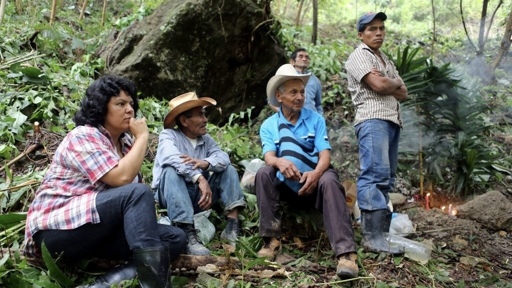
Cáceres was murdered on the night of March 2, 2016, at her home in La Esperanza, Honduras. Several hitmen entered her home and killed her. Cáceres, founder of the Civic Council of Popular and Indigenous Organizations of Honduras (COPINH), had been a tireless fighter for the rights of the Honduran people. Before her murder, she had led a fight against a hydroelectric project called Agua Zarca, developed by the company Desarrollos Energéticos SA (DESA), which faced strong opposition from the Indigenous Lenca people.
After a lengthy trial, the head of DESA, David Castillo, was convicted as a co-perpetrator of the murder. Shortly thereafter, seven people, including former military personnel (among them a major in the Honduran Army), were also convicted as perpetrators of the crime against the environmental leader.
However, several questions remained unanswered, so the investigation carried out by the Interdisciplinary Group of Independent Experts (GIEI) sought to gather more information and make sense of a criminal plot that apparently goes beyond a simple act of political violence.
Some of the GIEI’s findings
In addition to reconfirming that Cáceres’ murder was not an accidental or spontaneous act, but rather premeditated through an organized criminal operation linked to the Agua Zarca project, the GIEI demonstrated through reports that included communications, money transfers, geolocators, and other evidence that the crime is directly related not only to the executives of the DESA company, but also to members of the Atala family.
The GIEI also showed how the funds to guarantee the company’s “security” came from abroad, were then triangulated to offshore accounts, and later deposited into accounts in Honduras. In December 2015, a deposit of USD 2.6 million was made to the CONCASA account, money that would later be distributed to different companies linked to the project’s security measures. This part of the investigation shows that the money that financed Cáceres’ murder may have come from abroad.
How were the hitmen paid?
What is certain is that just 48 hours after the murder, approximately 549,892 lempiras (around USD 24,000) were paid out in the form of three checks to low-ranking DESA employees, who, according to testimony, handed the money over to intermediaries. One of the convicted men, Mariano Díaz, confirmed that these checks were the hitmen’s payment.
The GIEI states that this modus operandi, in which low-ranking employees were instructed to cash checks and then hand over the money to other individuals, was a common practice. This is how other types of dishonest, corrupt, and criminal practices were covered up. The GIEI has also drawn attention to how these attitudes contravene anti-money laundering regulations.
More than 200 communications analyzed
Concerning the technical analysis of Cáceres’ murder, the GIEI created a timeline before and after the murder of Cáceres between the coordinators of the crime (Douglas Bustillo, Henry Hernández) and the perpetrators, as well as the connections between them and the financial and business operators (Castillo, Atala). Nearly 200 communications (phone calls, chats, antenna records) were studied to create the communications diagram.
Before her murder, Cáceres had requested and been offered security due to the high risk to her life. The GIEI demonstrated that the death threat was present before March 2. There had been previous attempts to assassinate her using the same financial scheme explained above. On February 2, 2016, a payment of 50,000 lempiras was detected by a CONCASA employee, after which there were several communications similar to those on the day of the murder, one month later. This shows that the practice of economically powerful groups assassinating social and environmental leaders in Honduras is not new.
The enormous political and media influence of the powerful
To this end, the GIEI demonstrates in its report that there are networks of informants who are paid to share information with the DESA company, including police officers who allegedly received money in exchange for providing a police presence in certain locations. It also revealed the shameful payment of journalists and media outlets to shape the public narrative regarding various social phenomena. This reveals a complex and comprehensive strategy to maintain control of information and weaken social groups that opposed the project.
But the report also documents the enormous influence that companies such as DESA have over the police. According to the GIEI, there is clear evidence of infiltration and conflicts of interest in the initial stage of the investigation: police officers with clear links to DESA participated in the analysis of the crime scene; evidence was planted, phones were tapped, and a protected witness was impersonated; harassment of a key witness to the crime, as well as several members of COPINH, was documented.
In this way, several media outlets attempted to construct a narrative according to which the aim was to criminalize Cáceres’s circle rather than investigate the business, criminal, and financial networks that were actually behind the murder.
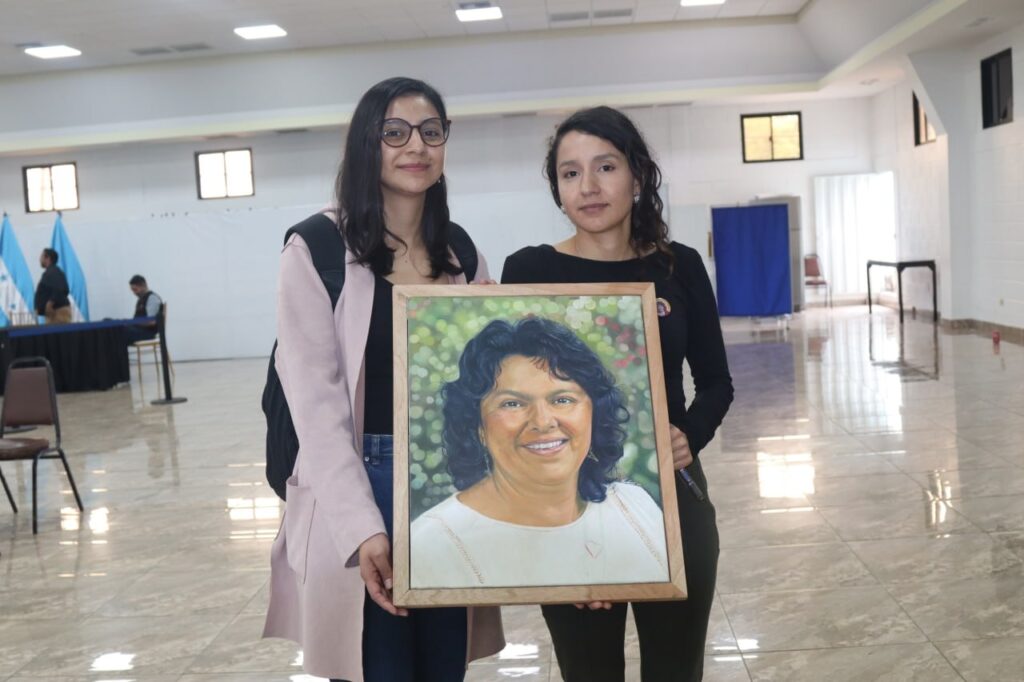
Bertha Zúniga and Laura Zúniga, daughters of Berta Cáceres and members of COPINH. Photo: COPINH
Responsibility of financial institutions
However, the GIEI also criticizes and considers financial institutions that do not effectively control money triangulations used to finance illegal activities to be indirectly responsible. The report states that these institutions did not activate the necessary control mechanisms that could help prevent crimes such as that committed against Cáceres.
Thus, the GIEI report has revealed a complex criminal network associated with the DESA company, which bases its power not only on the use of hitmen and brute force (as many media outlets still want to establish), but also on its penetration of various public institutions (police, justice, etc., acting directly or by omission) and private institutions (media, journalists, etc., which use their influence to redirect narratives, and financial institutions that failed to identify and stop these criminal schemes).
The report concludes that the murder of Berta Cáceres was a corporate, financial, and political crime, whose implications transcend an individual murder, as it affects human rights defenders and the regulation of megaprojects in indigenous territories. Furthermore, it empirically demonstrated how the resources of “development projects” can be used for social repression and political assassination, as well as to infiltrate private interests into institutions clearly and forcefully.
The post New report finds that murder of Berta Cáceres was a corporate, financial, and political crime appeared first on Peoples Dispatch.
From Peoples Dispatch via This RSS Feed.