

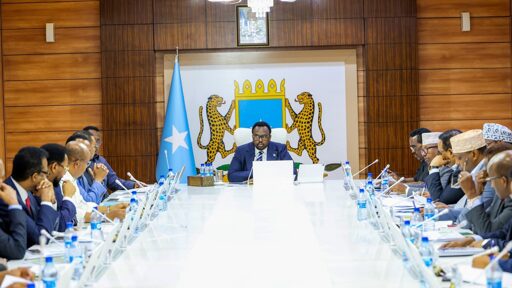
The government of Somalia terminated all agreements with the United Arab Emirates on January 12, ending defense and security cooperation. They also annulled the UAE’s operational control over Somali ports on the strategic sea lane connecting the Red Sea to the Arabian sea through the Gulf of Aden.
The UAE, which the Somali government accused of undermining its sovereignty, has long used its military bases in Somalia and control over its ports to fuel wars in Sudan and Yemen.
However, relations with the Somali government began to sour amid reports that the UAE had facilitated the negotiations leading up to Israel becoming the only country in the world to recognize Somaliland – a separatist enclave in northern Somalia – as a sovereign country.
Israeli newspapers and think tanks were unequivocal that the purpose of recognizing Somaliland is to militarize its strategic coastline to launch attacks across the Gulf into Yemen. The Ansar Allah government, which controls the northern and northwestern regions where the majority of its population resides, blocked Israel’s Red Sea shipping to disrupt its genocide in Gaza, and endured several retaliatory attacks by Israel.
Fractured anti-Ansar Allah coalition
However, within days of Israeli recognition on December 26, clashes erupted within the anti-Ansar Allah coalition propped up in southern and eastern regions of Yemen by Saudi Arabia and the UAE, with the backing of the US.
The UAE’s proxy Southern Transitional Council (STC) – a separatist group in southern Yemen whose stated intent is to secede and form a separate country that will immediately normalize diplomatic ties with Israel – captured areas on the border with Saudi Arabia in December. As the Presidential Leadership Council (PLC), Yemen’s UN-recognized government propped up by Saudi Arabia, tried to reassert control, clashes erupted on January 2 between the PLC and the STC. Backed by Saudi airstrikes, the PLC routed the STC from South Yemen.
Following these events, on the night of January 7, the UAE allegedly smuggled STC leader Aidarous al-Zubaidi from the Port of Aden to Berbera port in the separatist-controlled Somaliland. The spokesperson of the Saudi-led coalition forces in Yemen said that he was flown from Berbera to Abu Dhabi after a brief stopover in Somalia’s capital, Mogadishu.
UAE military and cargo flights banned from Somali airspace
Outraged by this covert operation on its territory, the Somali government banned the UAE’s military and cargo planes from using its airspace on January 8. Only evacuation flights, including four from Mogadishu airport and six from the airport in Bosaso, were exempted to facilitate the withdrawal of UAE military forces and equipment.
Then, on January 12, citing “strong evidence of serious steps being taken to undermine the sovereignty” of Somalia, the cabinet scrapped all agreements with the UAE, to protect “the nation’s unity, territorial integrity, and constitutional order”. The cancellation also applies to deals with Somali “government agencies, entities, and regional administrations”.
“We entered into agreements with the United Arab Emirates in good faith, but the Emirates did not act as if they were dealing with an independent country,” President Hassan Sheikh said in a national address the following day.
“We have repeatedly urged them to treat Somalia as a single country, and to stop their covert … activities inside our country without the approval of the Federal Government,” he emphasized. “After extensive evaluation and careful consideration, we have no choice but to take yesterday’s decision to terminate the agreements we entered into with the Government of the United Arab Emirates.”
Strategic ports
The cabinet’s statement added that the decision applies to all “agreements and partnerships relating to the ports of Berbera, Bosaso, and Kismayo.” The regional administrations of Jubaland and Puntland, which had entered into agreements with the UAE over ports in Kismayo and Bosaso, respectively, called the federal government’s decision illegal.
Nevertheless, the UAE had already begun evacuating its military personnel and equipment from Bosaso after the ban on its military and cargo flights. This event has implications for the war in Sudan, as the UAE was sending supplies to its notorious paramilitary, the Rapid Support Forces (RSF), from its base in this city on Gulf of Aden’s southern coast.
In defiance of the federal government, the Dubai-based multinational company DP World continues to operate another node in the Emirati weapons supply chain to the RSF – the Berbera port. Also on the Gulf’s southern coast, to the west of Bosaso, Berbera is 250 km from the Bab-al-Mandeb strait, through which almost a third of the world’s oil is shipped.
DP World acquired a controlling stake in the port by signing a USD 442 million deal with the separatist Somaliland administration in 2016, which also includes a 30-year concession followed by an automatic 10-year extension to operate the port. The UAE has subsequently built a naval base nearby. Britain, whose weapons sold to the UAE were used by the Rapid Support Forces (RSF) to commit mass atrocities in Sudan’s Darfur region, is also a minority investor in Berbera port.
Two days before the UAE covertly transferred al-Zubaidi through this port, Israeli Foreign Minister Gideon Saar was in Berbera, praising Somaliland as “pro-Western and friendly to Israel”.
It was his country’s first official visit to Somaliland after the diplomatic recognition on December 26. Somaliland, in turn, recognized Israel, establishing mutual diplomatic relations, although it has no legal authority to do so, with the UN, the African Union (AU), the European Union (EU), the US, and all the other countries of the world, recognizing it as a part of the Republic of Somalia.
Israeli base on the Somali coast?
The Somali federal government has proposed that in exchange for Israeli recognition, Somaliland’s administration agreed to accept Palestinians relocated from Gaza as a part of Israel’s ethnic cleansing efforts in the besieged strip. The Somaliland administration has denied this accusation.
Initially, it had also denied the Somali government’s assertion that Somaliland had agreed to host an Israeli base. However, Deqa Qasim, director of the political department of Somaliland’s foreign ministry, told Israel’s Channel 12 that a military base in Somaliland is under discussion, adding: “We see significant opportunity for real cooperation.”
Yemen’s Ansar Allah, which Israel intends to attack from here, has warned Somaliland that such a base would be considered a military target. Condemning Israel for exporting its wars to Somali territory, the federal government has warned that Somali lives will be put at risk.
Nevertheless, increasingly desperate for Western recognition of its claim to sovereignty, the Somaliland administration also offered a base to the US in June 2025, soon after a bill was introduced in the US Congress to “recognize Somaliland of the Federal Republic of Somalia as a separate, independent country.”
In December, when Israel recognized Somaliland, the US was the only country at the emergency meeting of the UN Security Council to defend Israel’s decision, criticized by all other member states. “Earlier this year [2025], several countries, including members of this council, made the unilateral decision to recognize a non-existent Palestinian state, and yet no emergency meeting was called to express this Council’s outrage,” US ambassador Tammy Bruce said at the meeting.
Saar repeated this comparison on his state visit on January 6, saying: “Unlike Palestine, Somaliland is not a virtual state.”
Somaliland unraveling
In the aftermath of the civil war and collapse in 1991, separatist forces predominantly from the Isaaq clan took control of 176,120 km² of northern Somalia and declared it an independent country called Somaliland.
Other clans on this territory who had not supported the secession had long complained of marginalization under a one-clan rule. Calling for reunification with Somalia, protests erupted in the eastern region in January 2023, demanding the withdrawal of Somaliland’s security forces from the eastern region of Sool, Sanag, and Cayn.
After security forces unleashed violence, killing at least 20 protesters, unionist forces waged an armed struggle, defeated the Somaliland army and set up an interim administration, before formally integrating with Somalia as the North-Eastern state in June 2025.
Somaliland thus lost about 45% of its territory. In the area that remains under its control, popular support for the separatist project remains only in the eastern half, predominantly populated by the Isaaq clan. Somaliland’s capital, Hargeisa, as well as the port of Berbera, are located in this region. In the western region of Awdal, on the border with Djibouti, the unionist movement is on the rise, with increasing protests against separatist rule and calls for reunification with Somalia.
Having lost territory to the east and at the risk of losing more in the west, the Somaliland administration may be hoping to bolster its territorial control by making itself geopolitically useful, offering the strategic coastline for the US, Israel, and UAE to militarize. However, this is also escalating tensions with the Awdal region.
When an Israeli flag was hoisted in Hargeisa after securing its diplomatic recognition, thousands waving Palestinian flags took to the streets in Awdal’s regional capital, Borama, emphasizing anti-Zionist messages and asserting Somalia’s sovereignty and territorial integrity.
The post UAE loses bases in Somalia over dealings with pro-Israel separatist group appeared first on Peoples Dispatch.
From Peoples Dispatch via This RSS Feed.