

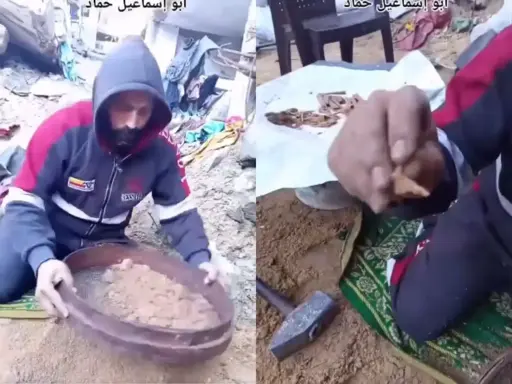

Mahmoud Hammad, known as ‘Abu Ismail,’ never imagined that grey hair could come before old age, or that his back could bend not from the weight of years, but from the weight of loss. At only 37, the man looks like he has lived through a century of pain; his features are sunken, his shoulders slumped, and his gaze dull, a far cry from his appearance two years ago.
Mahmoud: the horror of genocide, encapsulated
Before Israel’s genocide, he was a young man with a quick gait and a steady voice. Today, his body bears witness to the unbearable. The story of his pain began on 6 December 2023, when Israeli bombing targeted his home, killing his wife and two children, along with their unborn baby. It was not so much a farewell as a disappearance; bodies under the rubble, and a father left alive with one question: where are they?
For two years, Mahmoud never stopped returning to the rubble of his home. He dug with his bare hands, descending more than nine metres underground, his body injured and exhausted, not in search of lost lives, but of a delayed farewell. Mahmoud wanted a grave, a name, a certainty that would quell the anxiety of waiting.
He found only the body of his eldest son, Ismail. He was found intact, as if time had stopped out of respect for him. It was an incomplete consolation; joy mixed with pain, because the rest remained nameless and without graves.
When he was unable to reach them, he resorted to what was simplest and most cruel: a simple sieve. He sat on the rubble, bent over for a long time, and began sifting through the sand grain by grain, searching for a trace that would tell him they had been there. A bone, a tooth, anything. Two years were enough to erase the features of the body, but the memory remained.
Devastated
His sister, Samar Hammad, says:
I was devastated when I saw my brother… Mahmoud was only physically present, his soul had gone with his wife and children. He looked as if he had lived a hundred years, not two.
She adds:
He said, “That’s it, I’m done, I can’t go on,” but he couldn’t. He went back and sifted through the sand with his hands. The result is clear: his face has changed, his back is bent, and his spirit is broken.
Mahmoud’s tragedy did not go unnoticed. Appeals were published, petitions were written, and letters were sent to various authorities, but there was no response. In contrast, the world was in an uproar when it came to the bodies of Israelis, while in Gaza, parents were searching with their own hands for the remains of their children.
Today, Mahmoud is no longer waiting. With his sieve and his pain, he says with bitter conviction:
I found my wife’s remains, and in this primitive way, I gathered them together with her unborn child. God willing, I will find what remains of my children.
He then adds a prayer that sums up his acceptance amid the tragedy:
If they have been burned and their bones have evaporated, I am satisfied, O Lord, and if any of them remain elsewhere, O God, return my lost ones to me.
Stories cannot be reduced to numbers
In this context, the Civil Defence confirms that it is continuing its search and recovery operations within the limits of its available resources, emphasising its urgent need for heavy equipment after most of its capabilities were destroyed during the war. The Directorate explains that it needs dozens of excavators and machines to recover thousands of bodies trapped under the rubble, so that the martyrs can be buried with dignity.
The Directorate questions the silence of the international community and its double standards, despite the fact that international humanitarian law and the Geneva Conventions stipulate respect for the bodies of the dead and disclosure of the fate of the missing. It also renews its call for international organisations to intervene urgently and bring in the necessary equipment, and calls on humanitarian organisations to participate in humanitarian projects that restore the names of the victims and give their families the right to say goodbye.
In Gaza, stories cannot be reduced to numbers. Mahmoud’s story is one of thousands, where a father becomes a searcher of his memory, and a sieve becomes a tool for searching for humanity still trapped under the rubble.
Featured image via the Canary
By Alaa Shamali
From Canary via This RSS Feed.