

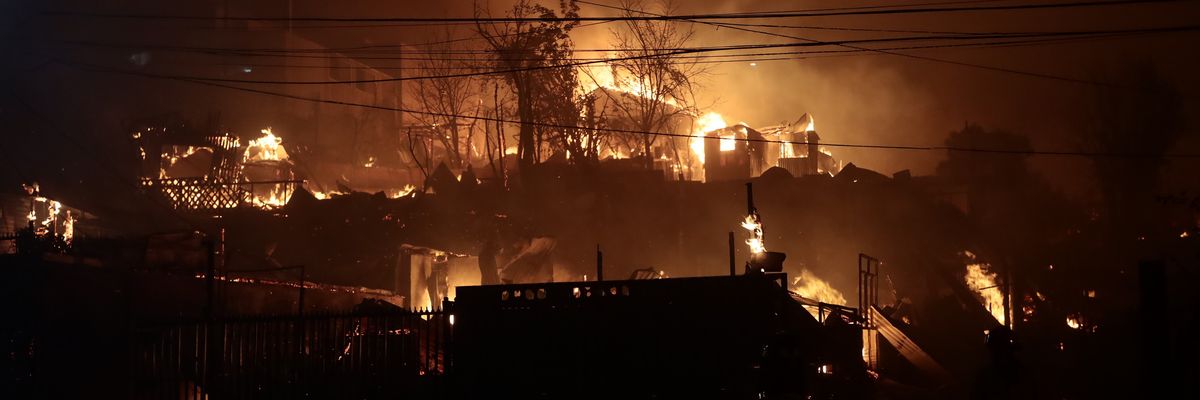
On the heels of another historically hot year for Earth, disasters tied to the fossil fuel-driven climate emergency have yet again turned deadly, with wildfires in Chile’s Ñuble and Biobío regions killing at least 18 people—a figure that Chilean President Gabriel Boric said he expects to rise.
The South American leader on Sunday declared a “state of catastrophe” in the two regions, where ongoing wildfires have also forced more than 50,000 people to evacuate. The Associated Press reported that during a Sunday press conference in Concepción, Boric estimated that “certainly more than a thousand” homes had already been impacted in just Biobío.
“The first priority, as you know, in these emergencies is always to fight and extinguish the fire. But we cannot forget, at any time, that there are human tragedies here, families who are suffering,” the president said. “These are difficult times.”
According to the BBC, “The bulk of the evacuations were carried out in the cities of Penco and Lirquen, just north of Concepción, which have a combined population of 60,000.”
— (@)
Some Penco residents told the AP that they were surprised by the fire overnight.
“Many people didn’t evacuate. They stayed in their houses because they thought the fire would stop at the edge of the forest,” 55-year-old John Guzmán told the outlet. “It was completely out of control. No one expected it.”
Chile’s National Forest Corporation (CONAF) said that as of late Monday morning, crews were fighting 26 fires across the regions.
As Reuters detailed:
Authorities say adverse conditions like strong winds and high temperatures helped wildfires spread and complicated firefighters’ abilities to control the fires. Much of Chile was under extreme heat alerts, with temperatures expected to reach up to 38ºC (100ºF) from Santiago to Biobío on Sunday and Monday.
Both Chile and Argentina have experienced extreme temperatures and heatwaves since the beginning of the year, with devastating wildfires breaking out in Argentina’s Patagonia earlier this month.
Scientists have warned and research continues to show that, as one Australian expert who led a relevant 2024 study put it to the Guardian, “the fingerprints of climate change are all over” the world’s rise in extreme wildfires.
“We’ve long seen model projections of how fire weather is increasing with climate change,” Calum Cunningham of Australia’s University of Tasmania said when that study was released. “But now we’re at the point where the wildfires themselves, the manifestation of climate change, are occurring in front of our eyes. This is the effect of what we’re doing to the atmosphere, so action is urgent.”
Sharing the Guardian’s report on the current fires in Chile, British climate scientist Bill McGuire declared: “This is what climate breakdown looks like. But this is just the beginning…”
— (@)
The most recent United Nations Climate Change Conference, where world leaders aim to coordinate a global response to the planetary crisis, was held in another South American nation that has faced devastating wildfires—and those intentionally set by various industries—in recent years: Brazil. COP30 concluded in November with a deal that doesn’t even include the words “fossil fuels.”
“This is an empty deal,” Nikki Reisch of the Center for International Environmental Law said at the time. “COP30 provides a stark reminder that the answers to the climate crisis do not lie inside the climate talks—they lie with the people and movements leading the way toward a just, equitable, fossil-free future. The science is settled and the law is clear: We must keep fossil fuels in the ground and make polluters pay.”
From Common Dreams via This RSS Feed.