


Luna Reyna
ICT+ Underscore Native News
SEATTLE – Like so many other parents and caregivers, Tracy Rector struggled to make ends meet while raising her two kids and working toward accomplishing her goals. The physical, emotional, and social responsibilities of being an engaged mother took sacrifice and support from community resources.
Local Seattle food banks and living what Rector calls “a simple life” allowed her to pursue her art and activism. She’s no stranger to hard work and the importance of community and collaboration. Her children, Chai and Solomon, grew up alongside this work, often joining her at school and film sets. Motherhood has been deeply intertwined with her work ever since.

Rector and her son Chai at Squaxin Island at the Longhouse Media youth camp SuperFly. Photo courtesy of Rector.
“They were literally by my side, strapped to me during class, production shoots, and community gatherings,” Rector said.
But the roots of her advocacy and community organizing go back even further, to her own childhood, when she began volunteering with her godmother at Daybreak Star Indian Cultural Center’s powwows, community cleanups, gardening, and cultural practices in Seattle. At the Atlantic Street Center, also in Seattle, she supported learning and advocacy for Black families and young children.
“Being of both of those cultural communities, it just felt right, and good, and what I wanted to do with my life,” Rector said.
Rector carried this intentionality from volunteering into filmmaking, focusing on Indigenous sovereignty, Black liberation, social justice, civic engagement, and environmental stewardship, with her own motherhood informing her approach for the last three decades.
“I believe in art as a tool for remembering, imagining, and building,” Rector said. “And I hold onto the hope that my children will feel free to be fully themselves, and that they, too, will find meaningful ways to give back to community and the Earth through whatever paths they choose.”

Tracy Report (left), founder and co-director of 4th World Media Lab, introduced Indigenous filmmakers after screenings of their films during the 51st Seattle International Film Festival (SIFF). 2025 marks the 10th anniversary of 4th World Media Lab as part of the Seattle International Film Festival which takes place in person May 15th to 25th and online May 26th to June 1st.(Photo by Jarrette Werk, Underscore Native News / Report for America)
Rector — who identifies as mixed heritage is of Indigenous, Black, Jewish and European descent — is a nationally acclaimed filmmaker, curator, educator and activist. Throughout her career, she has directed and produced more than 400 shorts films and other films, including the award-winning Reciprocity Project series, Outta the Muck, Sweetheart Deal, and March Point. She has received the National Association for Media Literacy Education Award, as well as a 2016 Stranger Genius Award, among other honors.
In 2005, Chai and Solomon were 9 and 4-years-old when Rector started Longhouse Media with Annie Silverstein in order to support Native youth in telling their own stories. That year she reached out to the Seattle International Film Festival to ask about marketing films created by Native kids and festival organizers agreed. That project grew into Superfly Filmmaking.

Superfly Filmmaking at Suquamish in 2013. Photo courtesy of Rector.
Superfly Filmmaking brought in 50 young people from around the country to work in a Pacific Northwest Native community to create five to seven films in a 48-hour film challenge. The fellowship cohorts were roughly 60-70 percent Indigenous and 30-40 percent non-Native, mostly people of color, with prominent mentors including Sterlin Harjo, Sydney Freeland, Sierra Ornelas, Lily Gladstone, Blackhorse Lowe, Owuor Arunga, and many others. Those films were then played at the film festival.

A young Sterlin Harjo as a Superfly Filmmaking mentor 2008. Photo courtesy of Rector.
“It’s been a very braided experience with SIFF [the film festival],” Rector said.
After nine years, Rector was tired and wanted a change of pace. She knew she loved the Superfly Filmmaking Fellowship work, so she pivoted her focus to supporting emerging or mid-career filmmakers with at least two years of filmmaking experience and started 4th World Media Lab in 2015 in partnership with the Seattle International Film Festival and Independent Television Service, with support from the Sundance Native Lab. Seattle International Film Festival and Independent Television Service have remained partners ever since.
This year, Rector celebrated two major milestones: 20 years of Indigenous-made programming at the Seattle International Film Festival and the 10th anniversary of 4th World Media Lab.
4th World Media
The 4th World concept came from a Coast Salish elder.
“It is the story about a time when the environment and the Earth are suffering, and Indigenous storytelling functions as the medicine to create healing,” the company website explains. “The 4th World Media Lab experience has been designed to uplift Indigenous voices and perspectives through artist fellowship, immersion in industry events and Indigenous project development as we collectively envision a future more whole.”
The year-long traveling fellowship for emerging and mid-career Indigenous filmmakers is rooted in cultural and community care, according to Rector. An annual cohort of 6-8 fellows are given hands-on training, master classes, workshopping projects in development, pitching activities, and meetings with funders and other industry decision-makers. In the past, fellows have had a chance to build community and benefit from mentorship from ITVS, PBS, Seed & Spark, ImagineNative, and Sundance Native lab program. SIFF and ITVS remain core partners.
“The work that inspires me the most is the fellowship work,” Rector said. “There’s a local Coast Salish [saying], ‘You are only as wealthy as what you give away,’ Offering a generous heart at all times in those spaces feels like my life’s path and what I’m meant to do.”
Fellowship activities started at SIFF and have since expanded to Big Sky Documentary Film Festival and Camden International Film Festival. Some fellows are attending film festivals for the first time. They are able to learn from other filmmakers, and since many of them are DIY filmmakers, they are exposed to film theory and other concepts that others learn in film school.
“It felt very much like an organic community-driven grassroots beginning for 4th World,” Rector shared.

Tracy Rector, Indigenous, Black and European descent, is the founder and co-director of 4th World Media Lab, a year-long immersive fellowship program supporting emerging and mid-career Indigenous filmmakers and visual artists. This year, the 4th World Media Lab celebrated its 10th anniversary as an official part of the Seattle International Film Festival. (Photo by Jarrette Werk, Underscore Native News / Report for America)
In the first five years, 4th World Media Lab has grown through support from Vision Maker Media, regional tribes, and new partnerships with film festivals. As it’s grown so has its support, and by 2020, 4th World Media Lab was able to offer $10,000 participation stipends. For its 10th anniversary this year, IllumiNative funded all six stipends for the current cohort, which supports each filmmaker’s creative practice but is not tied to a final completed project.
“It’s always been important to me to give back to Indigenous relatives, and being clear as a media maker, as a woman of color, that the most historically marginalized group of people tend to be Indigenous filmmakers and Pasifika peoples,” Rector said. “So it just also made good sense in my way of thinking to support and find resources to uplift these filmmakers.”
This year, 4th World Media and SIFF’s cINeDIGENOUS program featured a total of 11 feature films and one short film program, for a total of 12 films telling Native stories from across the world.
“It’s cool that [SIFF] made so much space and recognition for prioritizing and forefronting Indigenous made stories,” Rector said.
This is Rector’s 20th year working with SIFF. The partnership has developed into collaborations with others like the Seattle Art Museum, Amplifier and Folklife creating experiential art shows.
Creating bridges and community
In the 20 years Rector has been elevating Indigenous filmmakers, she has brought hundreds of Indigenous filmmakers and their films and their unique stories to audiences that may not have otherwise had the opportunity to experience and learn from them.
“There’s so many interesting creative stories that Indigenous filmmakers want to share, and with access to tools and resources and platforms for visibility, there’s so many creative talents out there who can step up and fill those spaces with their stories,” Rector shared. “They just need the opportunity or that chance.”
Rector also acknowledged that, for many Indigenous peoples, the arts are not separate but are interwoven in life, across all mediums. Understanding this, different artist mentors and educators are invited every year in order to bridge those conversations about different elements of filmmaking and inspire new relationships and ideas.

Following a screening on May 17, 2025, Tracy Rector, founder and co-director of 4th World Media Lab, introduces the directors and featured subjects of the documentaries Tiger and Remaining Native. From left: Tracy Rector, Dana Tiger, Loren Waters, Robert L. Hunter, Paige Bethmann, and Kutoven “Ku” Stevens. (Photo by Jarrette Werk, Underscore Native News / Report for America)
For example, composer Jeremy Dutcher, a classically trained vocalist and from the Tobique First Nation in New Brunswick, Canada, spoke with the 8th cohort about composing musical scores for their films. He described what sharing music in a visual form like a film meant for him. Dutcher is known for his work in revitalizing the Wolastoqey language through music and shared his goal to uplift and support language revitalization.
“Just seeing how that dialogue began to take form between filmmakers and the composer, and talking about different artistic practices as a vehicle for preserving language and connecting to ancestors,” Rector said.
Building bridges between Indigenous and other filmmakers of color and queer filmmakers with the broader industry became a major goal with 4th World Media.
Rector hoped to create spaces and open doors for collaborations where these voices can have a platform. In her early career she felt like her work could be a good bridge between the dominant white male world of filmmaking and the global majority, but she’s no longer interested in centering their power.
“Now the bridge I’m most interested in building is between marginalized communities and filmmakers with similar values and networks of solidarity,” Rector said. “I’ve started to revoke my power and efforts from white-led organizations and mainly focusing on just POC-led orgs, stories and spaces.”
“That looks like choosing to premiere a film at an Indigenous or a Black led film festival instead of one of the big tier one film festivals,” Rector continued. “Making this decision builds power across our communities instead of giving our power away to these larger organizations.”
Part of that work is sharing stories like that of Mildred Bailey, a Native jazz singer, and the communities of color who showed up at speakeasies late at night to hear her music. The film is expected to be ready to submit to film festivals early in 2026.

Tracy Rector, founder and co-director of 4th World Media Lab, poses with director Paige Bethmann and film subject Kutoven “Ku” Stevens during the 51st Seattle International Film Festival. Bethmann, a 2023 4th World Media Lab fellow, directed Remaining Native, a coming-of-age documentary centered on Stevens, a 17-year-old Native runner navigating his athletic dreams while confronting the legacy of his great-grandfather’s escape from an Indian boarding school. (Photo by Jarrette Werk, Underscore Native News / Report for America)
Another recent film, Remaining Native, for which Rector is an executive producer, is an example of how Native filmmakers create community, according to Rector. Remaining Native follows 17-year-old Paiute runner Kutoven Stevens as he chases a scholarship and honors his great-grandfather’s legacy of survival from the Stewart Indian School. The director, Paige Bethmann, Haudenosaunee, has prioritized screenings for Native nations and her team is creating a curriculum that resonates with Native youth about the history of boarding schools from footage that didn’t make it into the film.
“These stories don’t always have to be for consumption or on the terms of dominant culture or the colonizer, but these stories can be driven by community and meant for community, and prioritizing community is exactly the next step for these stories,” Rector said. “Getting these narratives out into the world for other Indigenous peoples, Native peoples to see themselves reflected in a positive way, is medicine, is healing, is having an impact. So I am most proud of these storytellers being in service of community and making a palpable change.”
This is a critical part of what Rector calls “narrative sovereignty.”
“It means that a community has the tools and agency and the support to tell their own stories in the way they want to tell them and to share them with the world or not, in the way they feel is best,” Rector said. “So many of the people we work with are Indigenous, Black, from the global south, people of color, trans and queer folks so we see narrative sovereignty as an intersectional movement that touches all of these spaces that we try to uplift and support and be part of.”
And her impact has inspired others to start their own groups or productions uplifting other people.
“We can do things differently,” Rector said. “That’s what I’m so excited about. We can create our own spaces, our own processes, our own industries, and it can be values based and feel good too.”
Motherhood and media justice
For Rector, part of doing things differently takes thinking critically about the ways that media has been abused and propaganda spreads. Some of this was born from learning about transformative media from Dr. Gilda Sheppard at Evergreen State College, whose course explored how media shapes public perception, especially the representation of people of color living with HIV and AIDS. Rector had already been volunteering with the Chicken Soup Brigade in her 20s, providing home care to people living with AIDS. She learned about the deep grief and extraordinary community care of the 1980s and early ’90s, which profoundly resonated with her.
“It just clicked for me about this piece of advocacy and storytelling and how powerful storytelling can be to liberate people of these social chains that we feel bound by,” Rector said.

Tracy Rector, founder and co-director of 4th World Media Lab, greets attendees before the screenings of the short film West Shore, directed by Jordan Riber and Jon Carroll, and the feature documentary Free Leonard Peltier, directed by Jesse Short Bull (Oglala Sioux) and David France. (Photo by Jarrette Werk, Underscore Native News / Report for America)
In her second year at Evergreen, she transferred to the Olympia campus and began working in the garden of Bruce “subiyay” Miller, a Skokomish spiritual leader whose teachings are known for what some call a Salish renaissance of art and culture in the Northwest and beyond. Through this connection, she joined her first film project, Teachings of the Tree People, directed by Katie Jennings, and began volunteering at 911 Media Arts in Seattle with the Native Lens program, led by Annie Silverstein and Ben Alex-Dupris, Colville Confederated Tribes.
“That experience grounded my love for compost, storytelling, and weaving together media-making, nature, and community education,” Rector said.
All of these experiences and influences led to Rector winning the Horace Mann Award for her work in utilizing media for social justice, and in 2023 Rector was recognized by Forbes as one of the most influential media makers in television and film addressing the climate crisis.
Rector’s activism also extends beyond film. She stood against the Dakota Access Pipeline at the Standing Rock protests in 2016 and believes that the federal surveillance of the water protectors at Standing Rock resulted in her being put on a two-year probation from airport Transportation Security Administration (TSA) precheck clearances.
Rector has worked on the Native Vote campaign, which resulted in numerous death threats, and far right extremists even showed up at her post office box, thinking that was her home.
“That taught me about the power of getting out the vote across Indigenous peoples, including Spanish-speaking Indigenous peoples,” Rector said.
She has also been outspoken against the occupation of Palestine and what a U.N. special committee and human-rights groups say is a genocide happening there.
“I choose to be pretty outspoken about Palestine because I am an American citizen and not beholden to large funders or government entities,” Rector said. “I choose to utilize that privilege in order to stand in solidarity.”

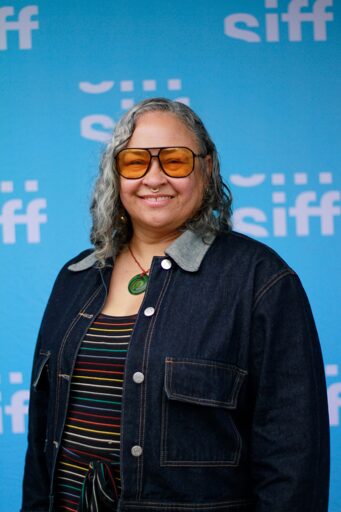
Tracy Rector, founder and co-director of 4th Media World, poses for her portrait during the 51st Seattle International Film Festival. (Photo by Jarrette Werk, Underscore Native News / Report for America)
But Rector believes her advocacy for Palestine played a hand in her leaving Nia Tero in 2024. According to Rector, Nia Tero refused to speak up about Palestine, despite their mission to serve Indigenous peoples globally, and the CEO reached out to one of the organization’s grantees to tell her she shouldn’t be posting about Palestine.
“(Nia Tero) was an incredible resource and opportunity for me to be part of for five years getting money out to community, but it was clear that my positionality as a storyteller, a media maker and accountable to the community was very different from the mostly white leadership of Nia Tero,” Rector shared. “My activism is interwoven in my DNA and part of every aspect of my filmmaking practice, my curation practice. But it’s clear that this true frontline work is oftentimes at odds with corporate spaces and big nonprofits and institutions.”
Since leaving Nia Tero, her advocacy for Black, Indigenous and people of color has resulted in major grant support and individual donors for 4th World Media. According to Rector, people have been excited to fund the organization because they believe they are supporting freedom of speech, something many are concerned about losing with this administration. Others who admire Rector’s outspokenness have told her that they chose to support her work with resources because they don’t feel ready or able to publicly support Palestine or other advocacy efforts.
Rector says about a decade ago she also began to reflect more intentionally on what it meant to hold space in both creative and community-centered environments. A recent example of this is ENCODED, an Indigenous augmented reality (AR) takeover of the American Wing of The Metropolitan Museum of Art in New York City on Indigenous People’s Day, co-curated by Rector. Seventeen Indigenous artists from across North America installed their own exhibition using a web-based AR to “watch the museum’s paintings and sculptures transform into living works by contemporary Indigenous artists.”

Paige Bethmann (center), Haudenosaunee and director of Remaining Native, poses with executive producers Billy Mills (Oglala Lakota), an Olympic gold medalist, and Tracy Rector, founder and co-director of 4th World Media Lab, ahead of the film’s screening at the 51st Seattle International Film Festival, held May 15–25. Bethmann was a 2023 4th World Media Lab Fellow. (Photo by Jarrette Werk, Underscore Native News / Report for America)
“ENCODED is not a protest, or a demand for inclusion, it is a ceremonial act of remembering and reimagining; it is a portal inviting us to see what happens when new narratives enter old frames,” the ENCODED website reads.
“I understood that my responsibility wasn’t just to tell stories, but to help support and create pathways for others to tell theirs,” Rector said. “I chose to center my role as one of service and advocacy, to use my skills, access, and platforms to support others in sharing their truths and narratives with power and dignity.”
This guides how she moves through the world, as a filmmaker, educator, advocate, curator, and collaborator.
“For me, the work is about listening deeply, making room for complexity, and investing in a future where a wider range of voices can be heard, seen, and celebrated through solidarity and action,” Rector continued.
Motherhood has propelled her advocacy and activism forward as well. Rector’s kids have been a regular reminder of the importance of creating change.
“They just are consistent reminders to me, for example, if I wasn’t showing up in this moment, they would let me know,” Rector said. “I show up because it’s the right thing to do in solidarity for Palestine, for example, or Congo, or Sudan, but I also show up because that’s just the way we are as a family, and they always are reminders of that.”
This story is co-published byUnderscore Native NewsandICT, a news partnership that covers Indigenous communities in the Pacific Northwest.
The post Bridging worlds through film and community appeared first on ICT.
From ICT via This RSS Feed.
You must log in or # to comment.