


By David Swanson, World BEYOND War, January 19, 2026
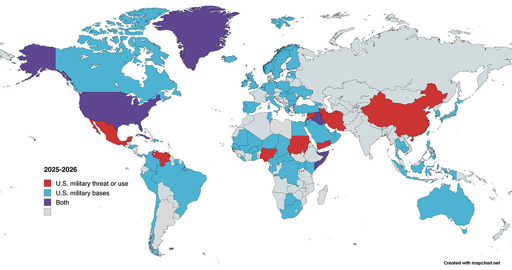
Of course it would take millions of images to convey the full story of the harm done by military bases, foreign and domestic, but a key point is, I think, conveyed by the map above. The countries colored blue or purple have U.S. military bases in them. The countries colored red or purple have been threated with war by the United States or actually attacked or invaded by the U.S. military within the past year.
The blue countries tell a story of global empire, of a nation seeking to dominate the planet. Similar maps could be drawn up on a smaller scale for several other base empires. See them all and details about each base here. No other base empire map, however, would be remotely this extensive or include remotely this many places threatened or attacked. The U.S. government treats conflict between its military and others, anywhere on Earth, as “defensive,” because it believes it owns the world. It describes murdering people in boats near Venezuela, not as being near Venezuela but as being in the zone of the Southern Command. Every spot on the planet is categorized under one or another of the U.S. military’s “commands.” And so, Trump threatens at his whim.
In South America, where Ecuador’s public just voted to reject foreign bases, Ecuador stands out as a blank spot surrounded by blue. But Venezuela is closer to the United States, and Mexico even closer. They are red.
The red countries across the globe have had U.S. bases piled up near their borders. The United States has used its bases in Latin America and the Caribbean to attack Venezuela. Iran is bordered by seven nations with U.S. bases. The nations to the south and east of China are packed with U.S. bases, as is Europe, as is Israel.
The United States itself is colored purple because U.S. troops have been deployed on U.S. streets in the form of the so-called National Guard, as well as ICE, Border Patrol, and various other militarized agencies, plus the threat of the U.S. Army.
Cuba is purple because it is under threat of attack but also already has a U.S. base there, uniquely against the concerted will and efforts of the “host” government.
Greenland, meanwhile, is purple because it has long had a U.S. military base and a license for the U.S. to coat the rest of the island with bases, but Trump thinks he can get more than that (and wants to, for whatever combination of reasons, including vicinity to the United States, absence of too many of the wrong varieties of people, etc.).
Canada is in a similar situation and shading toward purple at the moment.
Somalia and Iraq have U.S. bases and have nonetheless been attacked by the United States for unique reasons related to the level of chaos and the U.S. desire to threaten neighboring states. Of course Israel has U.S. bases and the U.S. has supported attacks on Palestine which Trump hopes to ethnically cleanse and colonize.
There are other priorities beyond location. Of the top seven nations for reserves of oil, two are red, one purple, and the others all blue on the map above. The eighth is Russia, which some in the U.S. government would like to break apart and against which the United States is waging a proxy war in Ukraine. The ninth is the United States itself. It’s hard to steal oil without bases.
In short, bases heighten tensions, facilitate wars, and encourage militarism. They also provoke terrorism, endanger “host” countries, house nuclear weapons, prop up dictators and repressive, undemocratic regimes, cause irreparable environmental damage, severely impact the Earth’s climate, cost an exorbitant amount of money desperately needed for useful purposes, deny land to indigenous populations, cause economic problems for “host” countries, facilitate the commission of crimes by occupying troops granted immunity from local laws, and establish in many cases min-apartheid regimes of segregation.
A year ago, concerned people and groups held the first annual Global Day of Action to #CloseBases. This year, we’re combining the day of education, day of media, and day of action (which were spread out across last year as three different events) into one. So, people can do whatever sort of local real-world event they find most useful. We’ve got resources to make it easy for local groups to do panels, film screenings, press conferences, rallies, marches, banner-drops, protests, etc.
This year, events will be planned for anytime February 21-23, Saturday through Monday.
Here is more information,
- a place to endorse as an organization,
- a place to list your planned event on a map,
- a major toolkit with all kinds of resources to make it easy,
- a place to register for either of two planning zoom calls to be held on February 3,
- reports from last year’s events,
- and much more:
The post A Picture That Shows What’s Wrong With Military Bases appeared first on World BEYOND War.
From World BEYOND War via This RSS Feed.