

- cross-posted to:
- ecosocial
- cross-posted to:
- ecosocial
cross-posted from: https://news.abolish.capital/post/20844
Stewart Huntington
ICTThe wave of federal immigration agents swarming the Minneapolis area might be unprecedented in law enforcement history, but the response in the Indigenous community is not.
Half a century ago, the American Indian Movement was founded on Franklin Avenue, the heart of the urban Indian diaspora in South Minneapolis, to counter overzealous municipal policing.
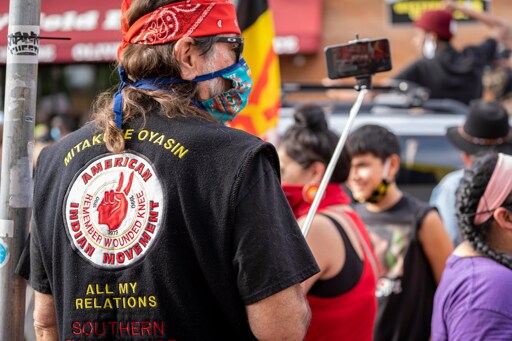
Today, AIM patrols are back, watching over elders, youths and aunties along the same avenue in what is now known as the city’s American Indian Cultural Corridor.
“History shows us time and time again, it doesn’t repeat, but it rhymes,” said Heather Bruegl, an activist, historian and Oneida Tribe of Wisconsin citizen who has studied the American Indian Movement. “So you can look throughout history and see different examples of what we see today happening in the past.”
And if the history rhymes, some of the names do even more. Some are the same.
Crow Bellecourt, Bad River Band of Chippewa, has been out on the recent patrols. His father, the late Clyde Bellecourt, was a founding member of AIM in 1968 along with Russel Means and Dennis Banks.
“I grew up in the movement,” said Bellecourt, executive director of the Indigenous Protector Movement, a group with AIM roots. “I always like to say, ‘I’m second-generation American Indian Movement.’ It’s, like, full circle for me.”
AIM members attend a demonstration in 2020 in Minneapolis after the death of George Floyd at the hands of police. Credit: Photo by John Arthur Anderson
The confrontations between law enforcement and protestors in Minneapolis – including the shooting of 37-year-old Renee Good – have brought reports that Indigenous people have also been swept into custody.
A cohort of Indigenous patrollers has now reached close to 100, Bellecourt said.
“We’re running from seven in the morning to seven in the evening,” he said. “And even more. We still have some patrollers going out until like 11 or 12 at night.”
And just like in 1968, the patrollers are on the street to help community members feel safe.
“It’s really scary here,” said Mary LaGarde, executive director of the Minneapolis American Indian Center, which operates from its base on Franklin Avenue.
Federal Immigration and Customs Enforcement officers have surged into the Twin Cities area to counter what the Trump administration has called corruption and criminality in area immigrant populations. At this point, there are more federal law enforcement officers in Minneapolis than metropolitan police.
The dramatic presence has prompted widespread protests and rebukes from state and local officials. There have been at least two shootings involving the federal officers.
“We woke up and we had all these ICE agents everywhere,” said Bellecourt. “They’re all over our neighborhood. I’m scared for our old people and the young ones who just wanted to catch the city bus to go to the grocery store. … I worry about them getting picked up from ICE.”
LaGarde, White Earth Band of Chippewa, knows the feeling.
“It’s like you don’t want to leave the house,” LaGarde told ICT. “That’s how most of our people are feeling right now. Our elders are scared. Our young people, too. This is really impacting our kids.”
LaGarde said the patrols — by AIM members and other groups such as the Many Shields Warrior Society — are needed.
“it’s really important that we’re out protecting,” she said.
The numbers of volunteers out patrolling are growing.
“We have relatives coming in from South Dakota, Wisconsin and neighboring states,” Bellecourt said. Some have come from as far away as Oklahoma, he said.
Just like in the old days, AIM members are gathering along Franklin Avenue just as they gathered for occupations of Alcatraz Island in San Francisco in 1969, the Bureau of Indian Affairs headquarters in 1972, and the Wounded Knee massacre site in 1973.
American Indian Movement leaders watch as the U.S. Department of Justice removes government forces from around Wounded Knee, South Dakota, on March 10, 1973. Shown in foreground are AIM leaders from left, Clyde Bellecourt, Dennis Banks, Russell Means and Carter Camp. Credit: AP Photo/FILE
AIM members also turned out in force in Minneapolis in 2020 after the death of George Floyd at the hands of law enforcement.
What’s different from the early years? Modern communication tools.
“We didn’t have these cell phones and all this social media back in them days,” Bellecourt said. “Everybody called on house phones and it was amazing how many people would show up. My dad called it the ‘moccasin telegraph’ and people would just call one another and, wherever they needed people to be, everyone would show up.”
They came to help the people.Then and today.
“One of the first acts that AIM did when they were forming was patrolling the streets and making sure that if their community members were stopped or pulled over by the police, that their rights were being followed, like, you know, ‘Hey, you have the right to this, you have the right to that,’” Bruegl said.
“And we see that now happening again [because] people’s rights are being violated. We see Indigenous folks, tribal members being detained,” Bruegl said. “It’s important that groups like AIM and other groups are coming out again, working in community and making sure that we’re protecting each other.”
The post ‘Full Circle’: AIM patrols back on Minneapolis streets as tensions rise appeared first on ICT.
From ICT via This RSS Feed.


You must log in or # to comment.