

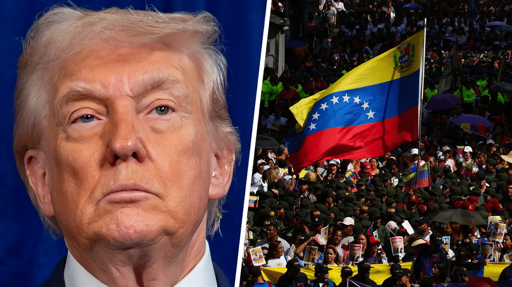
We denounce those who celebrated Trump’s attack, seeing it as a liberation. Regrettably, many Venezuelan migrants believe Trump will liberate us. That is why we are on the front line of the anti-imperialist struggle against the neocolonial offensive, and we call for mobilization to confront and defeat it. What Trump and U.S. imperialism are doing in our country is the first step toward doing the same in the rest of Latin America. We join forces with all those who want to confront this imperialist offensive, and we do so from a perspective independent of the government.
Many wonder why the government seems to be giving up now, why it is immobilized in the face of this imperialist attack, and why, ultimately, there was no resistance from the government either before or during the attack. Many comrades are asking these questions, including both critics and supporters of Chavismo. Here, I want to engage all these sectors and forge an independent anti-imperialist position for those mobilizing in response to this urgent need.
Saturday, January 3, marked more than just a new episode of imperialist aggression by the United States against Venezuela. Maduro’s government, which claimed to be anti-imperialist and sought national independence, offered no serious resistance — politically, economically, or militarily. In the lead-up to the attack, the government limited itself to empty rhetoric, denunciations without action, and the theatricalization of a supposed “revolutionary fortress.”
The current government of President Delcy Rodríguez has fallen under the tutelage of U.S. imperialism, which imposes its conditions on it, effectively administering a surrender.
The absence of serious resistance, the paralysis of the military caste, and the impotence of the Maduro government in the face of Washington’s show of force — all this laid bare the fact that the government’s “anti-imperialism” never went beyond demagogic rhetoric. For years, it was used to cover up a deeply conciliatory policy toward capital. Its empty, impotent rhetoric never challenged a single strategic interest of imperialism or the local bourgeoisie.
But the U.S. attack did not come out of nowhere. Venezuela’s right-wing opposition — especially its most reactionary sectors, represented today by María Corina Machado and Leopoldo López — have a program to transform Venezuela into a protectorate. They are the ultra-reactionaries who have always called for military intervention to hand everything over to the United States.
From the beginning of Chávez’s government, the old guard acted as direct agents of imperialism within Venezuela, carrying out coups, such as that of April 2002, and sabotage in the oil industry, such as the 2003 PDVSA lockout, all with Washington’s backing. They relentlessly launched pro-imperialist attacks throughout these years, including the coup attempts with the puppet Juan Guaidó in 2019, who proclaimed himself interim president and was supported by the first Trump administration, the entire South American right wing, and European imperialists.
Over the years, severe imperialist economic sanctions brutally impacted Venezuela’s working people. These attacks did not operate in a vacuum, not least because the United States saw the Chávez government as contrary to its interests and imperial ambitions, even under Maduro.
Chavismo emerged in the late 1990s as a response to a deep crisis in Venezuela’s political regime, which had been sustained for decades by the United States and was sinking after decades of looting, corruption, and subordination to imperialism. Chávez channeled popular rejection of the Puntofijo Pact, relying on a nationalist, anti-oligarchic, and later “anti-imperialist” discourse. It responded to the decomposition of the traditional parties (AD and COPEI) and the vacuum left by 1989 “Caracazo” protests in response to President Pérez’s austerity measures.
Against a backdrop of high oil prices, Chavismo built a broad social base, relying on material concessions financed by oil revenues. Within this framework, Chávez embodied features of what Leon Trotsky defined as a left-leaning Bonapartism sui generis: a leader who relies on the mass movement and the army to arbitrate between imperialism and national interests, attempting to gain room for maneuver.
Imperialism never tolerated this position, even though Chávez consistently refused to break with the material pillars of capitalist power, beyond the rhetoric of “21st-century socialism.” It was never a project of breaking with capitalism but rather an attempt at “bourgeois nationalist” management. The Chavistas took advantage of an exceptional cycle of oil prices, granting concessions to the masses and nationalizing key companies (with compensation) that had formerly belonged to the state but had been privatized. At the same time, he advanced relations with China and supported Cuba, which was subject to historic sanctions. He questioned and sank the Free Trade Area of the Americas (FTAA) in 2005, all of which led to friction with imperialism.
Chávez had strong support from the mass movement, which was clearly expressed during the 2002 coup d’état when the masses came out to defend him, restoring him to power less than 36 hours after his overthrow. Yet in channeling the country’s widespread discontent, he prevented it from developing into an independent uprising of the working class and the poor.
The United States’ hostile policy toward Venezuela extended under Maduro’s government, despite the economic shift and his authoritarian, repressive policies — including the payment of foreign debt while oil prices fell. More than $74 billion was paid in less than three years, depleting reserves and reducing imports, which led to an unprecedented shortage and an economic and social catastrophe exacerbated by the first economic sanctions, in August 2017. In August 2018, a severe economic “recovery” plan was launched, opening up the economy, semi-dollarizing the country, and restructuring the oil industry toward international capital. The plan brutally impacted working people.
Meanwhile, continued alliances with Russia, China, and Cuba, in the context of an offensive U.S. imperialist policy to control the hemisphere under Trump’s second administration, made Chavismo’s political position contradictory, culminating in the aggression and military attack on January 3 and the kidnapping of Maduro and Flores.
From the outset, Chávez’s project centered on reforming Venezuela’s dependent capitalism, not overcoming capitalism. He never proposed expropriating the bourgeoisie or breaking with imperialism. The so-called nationalizations were carried out by paying millions in compensation to capitalists, both domestic and foreign.
A prime example was the payment of enormous sums to conglomerates such as Paolo Rocca’s Techint and the purchase of electricity, telephone, and banking companies at New York Stock Exchange prices, setting the precedent of respecting capitalist property. Cristina Fernández de Kirchner’s compensation to Repsol in Argentina followed the same pattern.
Chavismo’s so-called anti-imperialism never went beyond seeking room to maneuver. The interests of the large transnational corporations operating in Venezuela were never seriously affected, nor was any progress made in establishing a state monopoly on foreign trade under workers’ control — an elementary measure for any real policy of national independence.
Even at the height of the verbal confrontation with Washington, Chavismo guaranteed foreign debt payments, respected agreements with foreign oil companies, and maintained an economic model dependent on primary exports. Far from being overcome, the rentier structure was deepened.
When the international balance of power shifted, with the fall in oil prices and the imposition of imperialist sanctions, the project’s fragility was revealed. Without having transformed the country’s productive base or empowered the working class, Chavismo was exposed to imperialist attack.
This logic is not unique to Venezuela. It is part of a tradition of bourgeois nationalism in Latin America, one that, during periods of export bonanzas, attempts limited redistribution policies to contain the class struggle without altering property relations. Chávez was perhaps the most “radical” in his rhetoric, but not in his actions. The so-called Bolivarian revolution was never socialist, much less anti-capitalist.
While this article does not aim to provide a complete historical and political assessment of Chavismo — from Chávez’s original project to the current disaster — we do want to highlight central issues that led to the political project’s fatal outcome.
From Chávez to Maduro: Exhaustion, Catastrophe, Surrender
Maduro’s rise to power marked the transition from the exhaustion of the Chavista project to its outright disintegration. Without Chávez’s charismatic leadership and amid a growing economic catastrophe, the government chose to place the burden of austerity onto the backs of working people. Maduro’s policy combined three central elements: brutal wage cuts, the destruction of collective bargaining agreements, and growing repression of workers’ and popular struggles. Under the guise of “defending the homeland,” protest was criminalized, businesses were militarized, and union activists were persecuted.
The result was devastating. What was once an important and relatively organized Venezuelan proletariat was transformed into a disorganized, impoverished class pushed into near destitution. Millions of workers were forced to emigrate, while those who remained faced poverty wages, hyperinflation, and the collapse of public services.
In the 1970s and 1980s, Venezuela had a concentrated industrial proletariat. The Maduro regime achieved what the traditional right wing could not: dismantling the working class, fragmenting it, and making it precarious. Through a systematic anti-worker policy, which combined the co-opting of unions with the creation of token workers’ councils, the Maduro government destroyed historic gains.
Collective agreements were dismantled, dissident workers (such as those in steel, electricity, and oil) were persecuted, and paramilitary and judicial violence was used against strikes and protests. When imperialism’s criminal sanctions arrived, they fell on an already weakened working class. Hyperinflation, shortages, and the brutal fall in GDP turned workers into a mass of semi-destitute people. Given these conditions, Chavismo in power did not prepare the people for resistance; it demoralized them and reduced their lives to a struggle for survival.
The bankruptcy of Chavismo did not begin with Maduro, but under his government it reached a terminal stage: economic surrender, anti-worker repression, and open capitulation to the United States. With Delcy Rodríguez as president, Venezuela is now administered under a government supervised by the United States.
Imperialist Sanctions and the Responsibilities of Chavismo in the Maduro Government
The United States’ imperialist sanctions have brutally aggravated the Venezuelan crisis. These sanctions are a crime against the Venezuelan people, and we unequivocally oppose them. They are part of a continental strategy of domination intended to deter any country from straying from the imperialist script. They are an instrument of imperialist domination that seeks to discipline not only Venezuela but all of Latin America.
Yet rejecting the sanctions does not mean absolving Chavismo. When the sanctions were imposed, the Maduro government used them to conceal its own responsibility for the crisis and to justify even more brutal austerity measures against working people, while the military and political elite enriched themselves.
Far from substantively confronting imperialism, the government used the sanctions as an excuse to intensify its capitulationist and anti-worker policies. Debt payments were never suspended, transnational corporations were never expropriated, and there was never an appeal to independent working-class mobilization.
The impotence demonstrated in the face of the January 3 military aggression epitomizes this catastrophic policy. A government that claims to be anti-imperialist but does not challenge imperialist interests is destined to capitulate. In the face of U.S. military aggression, Maduro’s leadership revealed itself as a cowardly caste that fears its own armed people more than it fears the imperialist marines.
After years of belligerent speeches about the “economic war,” the “iron circle,” and the “defense of the homeland,” Maduro and his leadership did nothing to organize popular resistance, whether armed or not. Nor did they take measures against the imperialist economic interests still operating in Venezuela. Joint ventures with foreign capital in the oil industry (Chevron, ENI, Repsol, etc.) continued to operate.
Chavismo has proved itself incapable of defending the nation because its own survival depends on secret pacts with sectors of global capital and on maintaining the internal bourgeois order. They prefer a negotiated surrender that preserves their caste privileges over an uprising that awakens the masses, who have been lulled into passivity by Chavismo itself, first through co-optation and then through dismantling.
A Historical Perspective: The Cowardice of “National” Bourgeoisies in the Face of Imperialism
The bankruptcy of Chavismo, in administering the country’s handover under the government of Delcy Rodríguez, reflects a broader historical trend. The United States seeks to discipline the Latin American continent, but the national bourgeoisies have repeatedly demonstrated their inability to mount consistent resistance. Chavismo was not a historical anomaly but a belated expression of old Latin American bourgeois nationalism.
Latin American history is full of examples of sui generis Bonapartist governments, leaning to the left in their early days. Take, for example, Lázaro Cárdenas in Mexico, who peacefully handed over power to pro-U.S. fugitives; Getúlio Vargas in Brazil, who, cornered, chose suicide; or Argentina’s Juan Domingo Perón, who, after 18 years in exile, returned to curb the Cordobazo workers’ uprising and died an instrument of “social peace” that benefited the monopolies.
After the defeats of the proletarian revolutions in the Southern Cone (Chile 1973, Uruguay 1973, Argentina 1976, preceded by Brazil in 1964), the “national” bourgeoisies abandoned any pretense of autonomy and fully integrated themselves as junior partners of imperialism. Chavismo, with its radical discourse, was the last illusion on that road, which led to a dead end. Its bankruptcy is the bankruptcy of an entire political strategy. Chavismo did not escape this logic; it confirmed it.
The Immediate Tasks and the Need for a Revolutionary, Class-Based, and Internationalist Strategy
Our immediate task is to defeat the neocolonial, imperialist politics of the United States, with Donald Trump at the helm. The League of Workers for Socialism (LTS) in Venezuela and our international organization, the Permanent Revolution Current — Fourth International (CRP-CI), of which Left Voice is a part, calls for active mobilization on an international scale. We are ready to fight alongside all those who want to resist this imperialist offensive.
That is why we have been mobilizing from the very beginning with everyone in every country where we have forces, and we call for redoubling the struggle on a continental level. We demand that the trade union federations, social and political movements, starting with those who have repudiated the attack, call for a continental strike of the working class. This would be the centerpiece of an international mobilization capable of stopping imperialist aggression, expelling Yankee imperialism from Venezuela, and opening up a perspective of struggle for all of Latin America. Today, Venezuela is under attack, but in reality it is the vanguard of the regional discipline that U.S. imperialism is trying to impose.
As we stated in our second international declaration, we denounce this imperialist aggression in the strongest possible terms. While we are left-wing and anti-imperialist opponents of the Venezuelan government, we demand the freedom of Maduro and Flores because we do not recognize the slightest right of the U.S. imperialist state and its justice system to judge them.
We unambiguously position ourselves in the military camp against Yankee imperialism, and we call for the mass mobilization of the international working class and the peoples of the world to defeat it. We do so without giving any political support to the Maduro government, now continued by Rodríguez.
U.S. imperialism is imposing a negotiated transition at gunpoint, with its warships off the Venezuelan coast. This must be confronted by unleashing the power of the masses, not by harboring the illusion that reconciliation, settlement, or negotiation with Trump is possible. In reality, they are preparing for the complete return of the Right.
We demand that the current Venezuelan government grant full freedom and annul the convictions and trials of imprisoned workers and protesters. We demand the release of any worker, union leader, or social activist imprisoned as a result of the government’s intensifying repressive crackdown against our class. We demand the repeal of laws that criminalize struggles.
The Venezuelan people have the inalienable right to discuss their destiny and the present situation of their country. Therefore, we demand full freedom to hold assemblies in workplaces, schools, and communities, where we can discuss how to confront imperialist aggression and its attempts to subjugate the national economy, as well as the problems afflicting the Venezuelan people. Full rights of assembly, organization, and demonstration for working people, women, and youth!
This catastrophe, in which the ruling Chavist government surrendered after the imperialist military attack, has demonstrated once again that there is no progressive way out within Latin American capitalist dependency or its nationalist variants. Maduro’s capitulation and Rodríguez’s U.S.-backed surrender fatally mark the end of reformist illusions.
The task at hand is to rebuild the political independence of the Venezuelan working class, expel imperialism through mass mobilization, and expropriate the bourgeoisie and the Bolivarian bourgeoisie in order to put resources at the service of social needs.
Chavismo has demonstrated, in its latest act in the face of imperialist aggression, that its anti-imperialism was pure rhetoric. Its historical bankruptcy is the bankruptcy of an entire strategy of class conciliation. For the Venezuelan and Latin American working class, the lesson is clear: there are no national shortcuts within dependent capitalism. Imperialist aggression against Venezuela reaffirms a fundamental truth: no Latin American country can face imperialism alone. The tasks at hand — breaking with foreign debt, stopping the plundering of common natural resources, and confronting soybean monoculture and the military threat — are continental in scope. A real solution can be proposed only by uniting the demographic and productive power of Brazil, as well as Argentina, despite its regression, with the enormous experience in class struggle of Bolivia, Peru, Chile, and even Uruguay.
This unity cannot be achieved under the leadership of the national bourgeoisies, but rather by the working class organized independently.
Our Trotskyist organization, the Current for Permanent Revolution — Fourth International (CPR-FI), maintains that the only progressive way forward for Latin America is the struggle for a federation of socialist republics. Given the bankruptcy of Chavismo and all bourgeois nationalist projects, this perspective is not an abstract slogan, but a historical necessity.
The political fall of Chavismo should not be exploited by the pro-imperialist Right but used by the revolutionary Left to draw strategic lessons. The task is to rebuild a socialist and internationalist alternative, capable of transforming defeat into a starting point for new struggles. Only workers’ governments, supported by direct democratic organizations and the revolutionary mobilization of the masses, can expropriate transnational corporations, break with imperialism, and reorganize the economy on new foundations. The task is to rebuild a revolutionary, internationalist, and class-conscious left that fights for the political independence of the working class and for a workers’ government.
Chavismo’s bankruptcy must be the final lesson: the path is not bourgeois nationalism but socialist revolution on an international scale. The only way out is socialist, internationalist, and revolutionary. That is the perspective we defend.
Originally published in Spanish on January 11 in La Izquierda Diario.
The post The Imperialist Attack on Venezuela, the Crisis of Chavismo, and the Prospect of a Continental Anti-imperialist Struggle appeared first on Left Voice.
From Left Voice via This RSS Feed.