

Aside from financial struggles, the Anoling evacuees are facing numerous challenges, including inadequate sanitation facilities.
Camalig, ALBAY – “We don’t have income since we evacuated.”
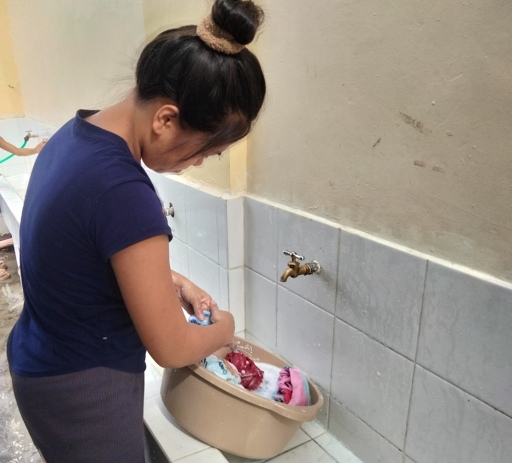
Ma. Melany Dela Cruz, 19, said her family is relying solely on her husband’s farming in their own agricultural land located in the Mayon Volcano’s danger zone to make a living in Brgy. Anoling, Camalig.
Her husband, Mark Jonel, 23, plants vegetables like yardlong beans and green beans while she takes care of their three-month-old child.

Mother’s Care: Melany washing their clothes while waiting for Mayon’s rest on Jan. 11. (Photo By Reynard Magtoto/Bulatlat)
On Tuesday night, January 6, Dela Cruz’s family immediately evacuated to Tagaytay Elementary School (ES) in Camalig, Albay due to Mayon Volcano’s unrest. They are among the 123 families consisting of 430 individuals evacuated from Brgy. Anoling, Camalig within the 6-kilometer radius permanent danger zone (PDZ).
On Sunday morning, January 11, her husband went back to their farm to check their newly planted vegetables. Based on his assessment, however, their plants will no longer give them any profit.
“The crops and animals also need to be taken care of even if it is dangerous. With each harvest, we earn P3,000 and more,” Dela Cruz said. “Because of the Mayon’s ashfall, it was just wasted.”
Evacuee Merlyn Saunar, 70, built her makeshift sari-sari store in the evacuation center to sustain her daily needs. “I don’t have children to support me because everyone already has their own families.”

Alternative Livelihood: Senior Citizen Merlyn Saunar tries to cope with life in the evacuation center with her sari-sari store. (Photo By Reynard Magtoto/Bulatlat)
Saunar has three sons who are also farmers who evacuated but were forced to return to the danger zone to check their vegetables.
“They were in their barangay in Anoling because they were harvesting vegetables like green beans, pechay, and chili. They asked at the checkpoint for them to be able to take care of the vegetables. They were allowed and will come back in the afternoon,” Saunar said.
“On the part of the evacuees, it’s difficult for them because of their livelihood. That is their source of income, farming,” Brgy. Anoling councilor Richard Lomibao said. “It’s dangerous, but of course they need to return to the animals and other plants because what about their other needs here in the resettlement?”
According to Tarabang para sa Bicol, Inc. (TABI), many have been unable to continue income-generating activities due to displacement and the distance of the evacuation center from their homes.
“While some evacuees are temporarily allowed to return to their communities to check on their crops and feed the livestock, they noted that this results in additional transportation costs due to the distance between the evacuation centers and their places of origin,” TABI said.

Alert Level 3: Mayon’s unrest remains at Alert Level 3 with recorded 308 rockfall events and 68 pyroclastic density currents on Jan. 16. (Photo by Mary Joy Lorino)
According to the Philippine Institute of Volcanology and Seismology (Phivolcs), Mayon’s unrest remains at Alert Level 3 with recorded 308 rockfall events and 68 pyroclastic density currents. The entry into the 6-kilometer radius PDZ and entry without vigilance into the Extended Danger Zone (EDZ) are prohibited.
Phivolcs Supervising Science Research Specialist Dr. Paul Karson Alanis confirmed that the eruption of Mayon could last several months based on historical records from the 2023 eruption that lasted for almost six months.
On January 13, the agency recorded lava that occurred at 1:39 a.m., reaching 100 meters in height and lasting for 35 seconds.
Phivolcs said that there are no visible signs that Alert Level 4 can be raised. But the local government units’ preparedness measures for the volcano’s 7-8 km EDZ are still good.
Albay Governor Noel Rosal said that the provincial and local governments are preparing for escalating scenarios, including the possible declaration of an Alert Level 4.
“There’s nothing I can do,” Dela Cruz said. She is a permanent resident in Bry. Anoling’s 6-kilometer radius PDZ. “We have no plans to move because that’s where our livelihood is.”
Just like her, evacuees at Tagaytay Elementary School are relying on non-government organizations (NGOs) and the local government’s food assistance and donations.
Based on a report, the Albay Provincial Agricultural Office recorded that about 1,816.823 hectares of crops and hundreds of farmers incurred damages due to ash fall and other effects of the volcanic eruption in Malilipot, Bacacay, Legazpi City, Daraga, Camalig, Guinobatan, and Tabaco City.
More than 2,000 hectares of fishponds, 534 hectares of coconuts, 527 hectares of vegetables, and 377 hectares of palay were affected, according to the data of the agency as around 2,279 farmers and operators were affected by the volcanic activity.

Building Alternatives: Job order personnel Alex Nantes helps make a makeshift bathroom for the evacuees in Tagaytay ES on Jan. 11. (Photo By Reynard Magtoto/Bulatlat)
Challenges
Aside from financial struggles, the Anoling evacuees are facing numerous challenges, including inadequate sanitation facilities.
This week, starting January 12, Tagaytay Elementary School evacuees can use one makeshift bathroom provided by LGU-Camalig beside the school building. The children evacuees will also begin to continue their studies at Tagaytay Elementary School as Mayon Volcano continues to erupt, according to Lomibao.
“We built a bathroom because it would be embarrassing for the visitors. I am willing to assist because this is the only help I can provide. I don’t have any money to give,” said Alex Nantes, 49, a job order (JO) personnel of LGU-Camalig’s engineering department.
According to Dela Cruz, the comfort rooms inside the classrooms are not enough and not suitable for taking baths. “We won’t have any more difficulties when that [bath] is done,” she said.
Water access remains a concern in certain evacuation centers, particularly those located on the upper floors of school buildings, according to TABI. “In facilities such as San Jose Elementary School [in Malilipot, Albay], evacuees housed on the second floor and above are required to fetch water from lower levels. Additionally, not all bathing areas and comfort rooms are fully functional, further affecting sanitation and hygiene conditions.”
TABI said that some evacuees reported difficulties in food preparation due to the absence of designated community kitchens. As a result, families are compelled to purchase cooked food, while rice is prepared individually using rice cookers. “During nighttime, evacuees also experience discomfort due to cold temperatures. Some families sleep only on mats or thin bedding, especially those staying in tents at the Buang Evacuation Center covered court, where limited space and inadequate sleeping materials were observed. In this location, evacuees also share a single functional comfort room, resulting in congestion and sanitation concerns.”

Providing Assistance: The local council of Brgy. Anoling are assisting and assessing the current situations of their fellow residents. (Photo By Reynard Magtoto)
On the Situation Report No. 1 of the group, TABI documented 930 families consisting of 3,466 individuals affected by the Mayon’s unrest. Five barangays are affected in Tabaco City, three barangays in Malilipot municipality, two barangays in Camalig, and one barangay in Ligao City.
The priority needs of the evacuees according to TABI are potable water, food supplies, hygiene kits and medicines. (RTS, DAA)
The post Evacuees’ woes due to Mayon unrest may last 6 months appeared first on Bulatlat.
From Bulatlat via This RSS Feed.