

The views expressed in this article are the authors’* own and do not necessarily reflect those ofMexico Solidarity Mediaor theMexico Solidarity Project.*
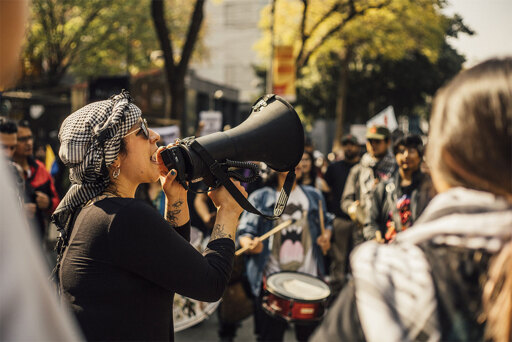
We were four. Four among, as one (unofficial) estimate puts it, 10,000 that Saturday. We met up between the Ángel de la Independencia and La Gloria de Las y Los Desaparecidos along Avenida Paseo de la Reforma in Mexico City. We had gathered, we four and we ten thousand, to march against the US’s abduction of the Maduros and gringo imperialism—in Venezuela, but also in México, in América Latina, in Palestine, in the world. It was the kickoff of what was intended to (and hopefully will) be an extended campaign.
The march proceeded apace, terminating in the Plaza Palestina, where representatives of the organizing committees—grassroots collectives, unions, youth organizations, solidarity groups—gave speeches from a platform, while farther back a drum circle played to an impromptu audience of dancing protesters in their revelry. There was little incident in the course of the march aside from the usual and predictable light vandalism (graffiti and wheat-pasting; no broken windows, no clashes with police as far as I saw). Our little contingent was able to walk at a comfortable pace, maintain conversation, pause and chit-chat, and flirt with each other and half-formed political theories at leisure.
We occupied only one lane of the broad, multi-lane Reforma. We were enough that we could have taken the entire avenue. We didn’t. After about three-quarters of an hour listening to speeches full of rousing, passionate rebukes of U.S. intervention and needful if unspecific calls to action (coming together, yes, but coming together in what way? To what material end?), pacifistic affirmations of sovereignty made against the hypnotic, repetitive, strident droning of snare drums we peeled off, looking for a cantina to have lunch.
We headed south, then made a left on Independencia, where we saw maybe a squadron of 50-100 gendarmes and their shields massed and ready for deployment at the first word. We continued on to a bar, where we spent several hours drinking, throwing tarot, and discussing Vonnegutian coincidence, destiny, and interconnectedness.
Then we left and headed north, and soon found ourselves in another, this time unplanned, march—at times walking with, at other times against, the stream. This march was seemingly without origin and without terminus; it ran the length and width of 16 de Septiembre, a major commercial epicenter. It was the march of commerce, the march of consumerism, the march of gentrification, the march of tourism, the march of capitalism. Its constituent human elements brought to mind Sarraute’s elusive urban “They” who, following their tropismatic inclinations,
“seem… to spring up from nowhere, blossoming out in the slightly moist tepidity of the air, they flowed gently along as though they were seeping from the walls, from the boxed trees, the benches, the dirty sidewalks, the public squares… now and then, before the shop windows, [forming] more compact, motionless little knots, giving rise to occasional eddies, slight cloggings.”
Only less placid. This was almost a stampede of bargain-hunting shoppers sniffing out post-holiday rebates; a busload of unashamed English-speaking tourists recently arrived, rolling their compact bags over the clattering flagstones; families with strollers; blind buskers; indigent prophesiers; ironic flâneurs; and at least four souls taking a break from their careers in civil disobedience, to name a few. I was elbowed at least once for stepping out of my implicit lane.
“What an abrupt juxtaposition,” I commented to my fellow travelers, to go from one form of mass mobilization, intentional, anti-establishment, legitimate, to this grotesque confluence of proliferated individualism and single-minded avidity. The shift was enough to provoke in me a vertiginous, if manageable, panic attack, and after half an hour trying to endure it in public, I retired.
A significant similitude between the two marches began to crystallize, if not in their content then in their form. That symmetry was most obviously apparent in the way each mobilization was kept contained, such that neither posed a real threat to the state or capital: The march on Reforma was kept peaceful and uniform by protest marshals guiding the flow and discouraging violence, and by the understanding that the state could rear its repressive head at any moment; on 16 de Septiembre, police (both real and imagined, on the beat and internalized), video cameras, alarms, socialization, and neutralization kept the mass of passersby from looting the big brand stores and redistributing the fast food to all (or, as the late Joshua Clover would say, market regulation by other means).
In the quiet remove of my apartment, I was given to private reflection. I began to try to decipher the text that, as de Certeau says, we as pedestrians write on the palimpsest of the city “without being able to read it.” From that meditation two texts emerged, two texts with lots of crossover, and I began to question just how different the two “mobilizations” were.
True, each unfolded according to its own set of logics, internally originating and externally imposed. The march on Reforma was impelled, ostensibly, by an innate, righteous, incarnated condemnation of gross injustice—its motive force—felt in the hearts and minds of the marchers, roused by slogans, signs, and performances, and given shape, velocity, and direction by the organizers. The latter was spurred on by the euphoria of weekend pleasure-seeking, the inertia of casual hedonism, the pressure of check-in times and FOMO, and the very real gnawing of hunger in the belly.

That distinction notwithstanding, a significant similitude between the two marches began to crystallize, if not in their content then in their form. That symmetry was most obviously apparent in the way each mobilization was kept contained, such that neither posed a real threat to the state or capital: The march on Reforma was kept peaceful and uniform by protest marshals guiding the flow and discouraging violence, and by the understanding that the state could rear its repressive head at any moment; on 16 de Septiembre, police (both real and imagined, on the beat and internalized), video cameras, alarms, socialization, and neutralization kept the mass of passersby from looting the big brand stores and redistributing the fast food to all (or, as the late Joshua Clover would say, market regulation by other means).
Seen through the analytical lens of Canetti’s Crowds and Power, the two marches share another (negative) quality, in that neither rose to the categorical level of an open crowd, “the true crowd… abandoning itself freely to its natural urge for growth.” For Canetti,
“an open crowd has no clear feeling or idea of the size it may attain; it does not depend on a known building which it has to fill; its size is not determined; it wants to grow indefinitely and what it needs for this is more and more people.”
Store owners and street vendors, perhaps, would have been delighted to receive more customers, more bodies, on that saturated avenue on that chilly winter Saturday; but I’d bet if you asked any of the pedestrians in the crowd that day, you wouldn’t have found a single soul yearning for more moving targets to dodge.
Not so, at least in theory, for the march on Reforma and for the kind of march it represented. Numbers and turnout play important roles in how a political rally’s success and potential are perceived. Rhetorically, active participation is highly encouraged, and the integration of onlookers is considered a small triumph. This may very well have happened on a small scale.
Still, the structural realities of the two social formations made them both more akin to the closed, rather than the open, crowd.
“The first thing to be noticed about [the closed crowd] is that it has a boundary. It establishes itself by accepting its limitation. It creates a space for itself which it will fill. This space can be compared to a vessel into which liquid is being poured and whose capacity is known.”
We have already seen how both marches were subject to and respectful of their particular boundaries—geographical, psychical, proscriptive. The march on Reforma, before it even began, had delimited itself, had created its own vessel and had directed its contents thereto. The other, though convoked by no one in particular and not held together by any unifying message or ideology, respected its own boundaries to such a degree that if you put one block between yourself and 16 de Septiembre, the city felt like a graveyard by comparison.
It is fair to question whether an opening in the march on Reforma was ever intended, or even desirable. I, for one, believe it was not intended in any real way, but that it was very really desired. But, for argument’s sake, if it had taken on that quality, what would it have looked like? A riot? Is that the logical conclusion (or extension) of the open crowd? If so, Clover’s framing is illuminating/orienting. For Clover, “the riot is the form of collective action that… is unified by shared dispossession, and unfolds in the context of consumption.” Clover’s localization of the riot at the point of consumption is particularly and personally interesting given my dualistic experience that Saturday.
The locus of social reproduction, as Clover observes, is no longer in the realm of production but that of consumption. Assuming this is true, and without paying lip service to the obnoxious notion of conscious consumerism, perhaps there is yet more to parse in the enunciations, to borrow de Certeau’s term, made by the marches on 16 de Septiembre, not just a site but one of Mexico City’s Meccas of consumption.
I glimpsed the dance of the clinamen on 16 de Septiembre, with its atoms, although bound, enjoying a kind of freedom of expression that made me think of the idealistic potential for all closed crowds to transform into open ones, for all marches to become riots — real ones, that really interrupt commercial circulation.
How did the consumers on that human highway appropriate “the topographical system” and “impl[y] relations among differentiated positions” (de Certeau)? Easy: by pushing and shoving, by winding and evading, by criss-crossing and doubling back, by starting and stopping without warning. Routes were improvised and negotiated explicitly and implicitly, borders were drawn, circumvented, transgressed. What kind of exegesis can we arrive at from these utterances?
Well, for one, we certainly cannot read it as a riot, for far from “featuring the interruption of commercial circulation”—a central point to Clover’s definition—the march on 16 de Septiembre was facilitating circulation, not obstructing it. That said, there was a variety and diversity, a randomness, even an anarchy inscribed on that avenue that, at least for me, was absent in the march on Reforma. I glimpsed the dance of the clinamen on 16 de Septiembre, with its atoms, although bound, enjoying a kind of freedom of expression that made me think of the idealistic potential for all closed crowds to transform into open ones, for all marches to become riots — real ones, that really interrupt commercial circulation.
But for that, as Canetti reminds us, is required the eruption, the inflection from closed to open that happens in space-time as much as it does internally, emotionally and psychically. At the moment of eruption, and thereafter, “a crowd quite often seems to overflow from some well-guarded space into the squares and streets of a town where it can move about freely, exposed to everything and attracting everyone.” We have seen this motion played out in recent years (in Nepal, in Italy, in the George Floyd uprisings in the United States). And the calls for solidarity—with workers, with Venezuelans, with Latinoamérica—made that Saturday and at almost every political gathering would imply that this openness, this “passionate determination to reach all [people]” (Canetti) undoubtedly considered in the minds and felt in the hearts of the crowd members is characteristic of and key to the movement’s survival and success.
But that post-eruption openness will not be found in the marches on Reforma, impressive and populous as they may be, so long as their boundaries are neatly outlined and maintained. And they certainly will not be found in the weekend outings on 16 de Septiembre, so long as that impatient, jittery, frenetic energy remains subjugated and contributory to the forces of consumption. But perhaps a combination of the two energies, the two forms might foment that rupture.
In The Coming Insurrection, the Invisible Committee affirms that,
“Revolutionary movements do not spread by contamination but by resonance. Something that is constituted here resonates with the shock wave emitted by something constituted over there. A body that resonates does so according to its own mode. An insurrection is not like a plague or a forest fire – a linear process which spreads from place to place after an initial spark. It rather takes the shape of a music, whose focal points, though dispersed in time and space, succeed in imposing the rhythm of their own vibrations, always taking on more density.”
Could a winning (or at least viable) formula be: to take the feisty, impolite, stubborn resonance of the march on 16 de Septiembre, and infuse the march on Reform with it? And from that march, to impose that new compound rhythm beyond the banquetas and the weekends, into the side streets and societies, filtering through and dissolving those boundaries, extending in all directions without beginning and without end, such that the whole region, connected by various focal points that resist any kind of boundary, is pulsing with real, open, overflowing, uncontainable resistance?
All power to the people and their communes.
-

A Tale of Two Marches: Reflections on a Saturday Spent on Reforma and 16 de Septiembre
January 16, 2026January 16, 2026
The calls for solidarity made that Saturday and at almost every political gathering would imply that this openness, this “passionate determination to reach all” is characteristic of and key to the movement’s survival and success.
-

People’s Mañanera January 16
January 16, 2026
President Sheinbaum’s daily press conference, with comments on Edomex security strategy, Mexico-US cooperation, and electoral reform.
-

The PAN’s “Trophy” in Guanajuato: 30,000 Murders in the Last Decade
January 16, 2026January 16, 2026
Over three decades of rule, the right wing PAN implemented failed policies and oversaw record levels of violence in the state.
The post A Tale of Two Marches: Reflections on a Saturday Spent on Reforma and 16 de Septiembre appeared first on Mexico Solidarity Media.
From Mexico Solidarity Media via This RSS Feed.