

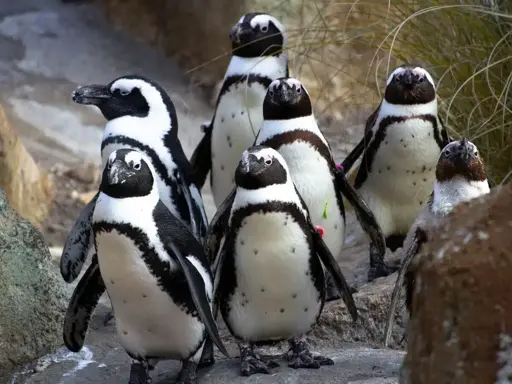

A new study suggests that critically endangered African Penguins in South Africa are likely to have starved en masse.
In 2024, the IUCN Red List uplisted the African Penguin to Critically Endangered. There are fewer than 32,000 left in the wild; of these, 19,800 are mature and able to breed. Shockingly, this is down from 35,400 mature birds in 2019 and 282,000 in 1957.
The global population of the species had declined by nearly 80% in the past 30 years.
African Penguins in critical danger
The new study was conducted by the University of Exeter and the South African Department of Forestry, Fisheries and the Environment. It suggests that between 2004 and 2011, two of the most important breeding colonies near Cape Town collapsed. Scientists estimate that 62,000 African Penguins died.
Populations in some areas dropped by 95% in just eight years. This is thought to be due to the declining sardine populations in South African waters, which are the penguins’ primary food source. A combination of overfishing and rising water temperatures is the reason for the decline in sardine numbers.
Penguins mould annually. During this time, they shed and replace all their old, worn-out feathers with new ones. This improves their insulation and waterproofing.
However, during this time, which lasts about 21 days, they cannot swim or hunt. They must remain on land and stay dry.
This means that before this can happen, African Penguins have to fatten up.
Co-author of the study, and conservation biologist Dr Richard Sherley, said:
They are evolved to build up fat and then to fast whilst their body metabolises those reserves, and the protein in their muscles, to get them through moult.
They then need to be able to regain body condition rapidly afterwards.
So, essentially, if food is too hard to find before they moult or immediately afterwards, they will have insufficient reserves to survive the fast.
Of course, a shortage of food means that this has not been able to happen successfully, leading to a high amount of deaths.
Tourist attraction
Additionally, African Penguins are popular among tourists. However, the stress and noise this creates also puts the birds in danger.
Given the current rate of population collapse, the bird could be extinct in the wild by 2035.
Researchers are now focusing on promoting the long-term recovery of sardine populations.
Authorities have implemented a commercial fishing ban around six penguin colonies, as well as creating artificial nests and new colonies.
Dr Richard Sherley concluded:
We hope that the recent conservation interventions put in place, together with reduced exploitation rates of sardine when its abundance is less than the 25% of maximum threshold, will begin to arrest the decline and that the species will show some signs of recovery.
Feature image via Jen Dries on Unsplash
By HG
From Canary via This RSS Feed.