

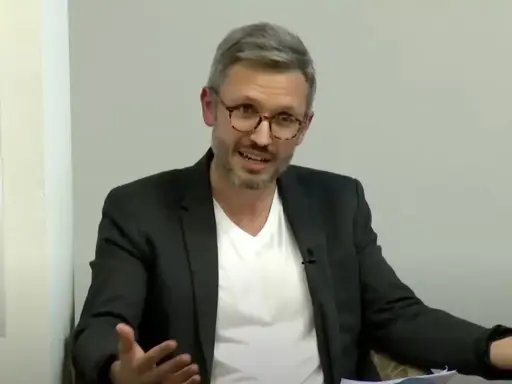

Anthropologist Jason Hickel has taken apart the myth that we rely on the rich to fund public services.
Money organises public services, it doesn’t create them, points out Jason Hickel
Often, corporate pundits argue that the rich pay higher total sums in taxes and therefore they are providing more for people. But as Jason Hickel points out:
Once we understand that the main fiscal purpose of taxation is not to fund public services but to reduce excess demand, we can have a clear view of who should be taxed: the rich.
Taxation controls inflation; it doesn’t fund public services. Labour and resources establish public services; money just organises them.
When there is too much money (too much demand) for the country’s productive capacity to facilitate, that leads to inflation. But taxation mediates that by removing that demand from the economy.
Right now, there isn’t enough demand from everyday people, with unprecedented levels of economic inequality. But there is high demand from the super rich. So the country’s production is diverted to excessive climate destroying items such as yachts and private jets.
Jason Hickel continues:
The problem with the rich is that they demand too much of our productive capacities. Their money translates into massive purchasing power (and also enables them to increase their investments and ownership of production). So we are then required to use our labour and resources to produce things like mansions, private jets, sports cars, estates, luxury goods and so on. This facilitates elite consumption and accumulation but it does not benefit society – it is wasteful, ecologically destructive, and it should be curtailed so that we can undertake production that does benefit society.
Indeed, the super rich’s asset bubble is now worth £138bn in the UK. As they take up 90% of bank lending (more returns than providing their own capital) in order to compete for pre-existing ‘assets’ like property, which inflates the price of those assets. This drives up rent and other costs for the rest of us.
Jason Hickel, professor at ICTA-UAB, also said:
Taxation can be used to help achieve this in two ways: a) tax income and wealth over a certain threshold, and b) tax damaging and unnecessary goods.
Taxes can reduce excessive demand from the rich on the country’s labour and resources. It can also help influence behaviour by making damaging production more expensive. For instance, from 2017-2024, global luxury goods spending increased by 28%. Taxing this doesn’t have to mean reducing quality but differentiating between worthwhile quality and branding/ excess.
100% tax please
Jason Hickel further argues that a “good life” shouldn’t be taxed, while an overly excessive one should be:
Ultimately, we do not need to tax wage labour at all. If a key purpose of taxation is to reduce excess demand and consumption, then it is reasonable to implement a very simple and straightforward tax rule. All income below a certain minimum threshold (the level needed to acquire goods and services necessary to live a good life) should be taxed at zero per cent, and all income above a certain maximum threshold (a level beyond which additional consumption is clearly unnecessary and destructive) should be taxed at 100 per cent.
It’s clear that campaign for a wealth tax from progressive politicians, figures like Gary Stevenson and the Green Party has never been more necessary.
Featured image via the Canary
By James Wright
From Canary via This RSS Feed.