

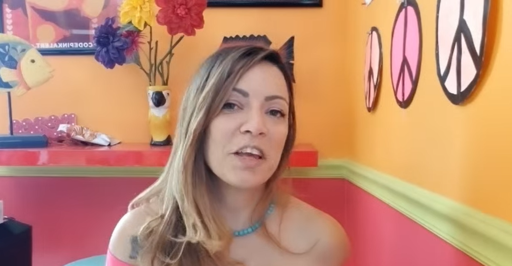
Janine Jackson interviewed CODEPINK’s Michelle Ellner about the US invasion of Venezuela for the January 9, 2026, episode of CounterSpin*. This is a lightly edited transcript.*
https://media.blubrry.com/counterspin/content.blubrry.com/counterspin/CounterSpin260109Ellner.mp3
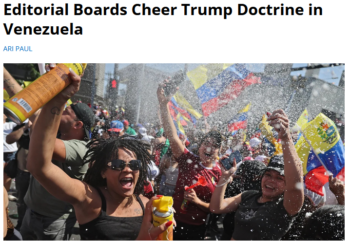
Janine Jackson: Recent months have seen the US government commit illegal action after illegal action in and around Venezuela: killing people on boats in the Caribbean, bombing civilians and (happy New Year) kidnapping Venezuelan President Nicolás Maduro, and his wife and former leader of the National Assembly Cilia Flores.
And all along, US corporate news media have whitewashed every step, with language that excused rather than interrogated: It was a “capture,” not a kidnapping, an “operation,” not a crime. And “act of war,” what’s that?”
This, along with a “follow the bouncing ball” approach, as every incoherent rationale leads to the next. “Narcoterrorism,” except Venezuela contributes next to nothing to drugs entering the US. And how would that square, anyway, with pardoning Honduran President Juan Orlando Hernández, convicted in a US court for large-scale cocaine trafficking?
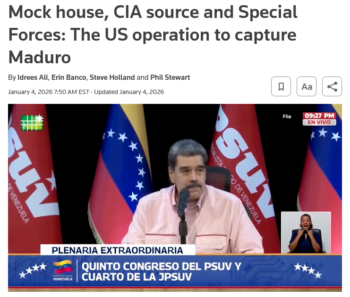
Reuters (1/4/26)
OK, but they “stole our oil”? That’s weird on its face, and also, US oil companies are not shut out of Venezuela, and those that left said that they wanted to. OK, but “regime change”—because the US is allowed to choose other countries’ leaders because, well… because, because, because of the wonderful things he does.
If you don’t think Donald freaking Trump should rule the Hemisphere, and hey, why not the world, well, then you’d best avoid news like that coming from Reuters on January 3, which oohs and ahs over how Trump carried out a “daring mission” involving “elite US troops,” who had “insight into Maduro’s pattern of life that made grabbing him seamless.”
The world and the news about it are disheartening. But work like that of our guest reminds us that there is a way forward in these times, and it’s found with one another, whatever the papers might say. Michelle Ellner is a Latin America campaign coordinator of the feminist grassroots organization CODEPINK. She joins us now by phone. Welcome to CounterSpin, Michelle Ellner.
Michelle Ellner: Thank you for inviting me.
JJ: I would ask you, first of all, just to help us fill in a space that US corporate news media leave empty, and that is the voices of Venezuelan people. And I say “voices,” because part of what we want to do is get past this “them versus us” conversation, in which Venezuelans speak with one voice, and United States citizens speak with another, univocal voice. I know we’re still in early days, but what would you have people understand about the response of Venezuelans, and Venezuelan Americans, to this almost unbelievable violation?
ME: Yes. Well, I’m going to start by saying that I’m a Venezuelan American, and in Venezuela we have a day that, it’s more or less like April Fool’s Day. It’s called the Dia de los Inocentes, like “Innocent’s Day.” And this year, I pranked a lot of people. So when I got the news that the president of Venezuela was kidnapped, with his wife, I really thought that that was a prank. I really couldn’t believe it.
And then when I saw the press conference on the 3rd, I just, everything I felt, it was in my stomach; I got nausea seeing this president basically say that the country where I grew up, and where my family is, it’s disposable. That they’re going to “run” the country, and they’re going to take the oil that “belongs” to the US.
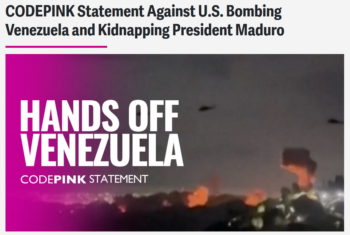
CODEPINK (1/3/26)
And then see the media, right, repeat this, some of them saying that this is a good thing for Venezuela. So I think that what the media is doing is basically not listening to voices that are in Venezuela that maybe are not influencers, analysts; maybe they don’t even speak English, you know? They don’t have platforms. Maybe they don’t have, I don’t know, internet or whatever. These voices in Venezuela had been excluded before the Bolivarian Revolution, those are the same voices that today the US government continues to ignore.
Because the truth is that Venezuelans are not politically monolith. There is a diversity in the minds of Venezuelans, in terms of politics. And people in Venezuela can oppose the government, but still reject US intervention. They can be angry at corruption or mistakes that the government has done, but still remember foreign interventions and foreign meddling.
So when the US media just puts Venezuelan into a single voice, sometimes they quote the “poor helpless” victims of the Maduro regime. Or they talk about the other side, like ideological supporters, and it erases the rest of the experiences and the memory and the history, you know? And so I think that’s what’s missing.
And then, also, the moral accountability, right? Because once this complex situation, in terms of Venezuela, disappears, then the intervention is actually easier to justify, because the public here in the US won’t consider, or won’t think about Venezuelans—the fear that they have, families that cannot sleep at night. I talk to my friends every single day, and they’re mothers that are supposed to be strong for their community, because they’re community leaders, and they need to be strong for their family and their children. And they are terrified. They cannot sleep at night.
They’re not thinking about what the Venezuelans fear or think, but only if the actions that the US is doing are effective or not, that’s all the media is talking right now: Is the Trump administration, is this good for Venezuelans? Is this technically OK? Is this legal? They’re not talking about what Venezuelans and Venezuela think or feel, because they’re not teaching people to hate Venezuelans, but they’re basically teaching them to not care about them.
JJ: The same way they treat US opinion. And I know that CODEPINK has talked about, and others are aware of the fact, that there is widespread opposition to this undeclared, illegal, unsubstantiated war against Venezuela. There is objection to that among US people as well. So if we remove this top-down conversation, if we talk about people-to-people, we would be having a very different conversation.
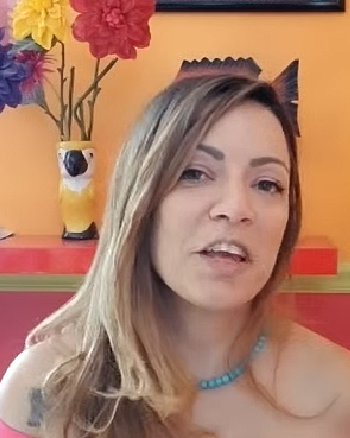
Michelle Ellner: “That’s what I want people to understand, that that opposition that is asking for the US to bomb their country, they are not the majority of Venezuela.”
ME: Yes, you’re absolutely correct. Palestine is a clear example of how this works, because the US media just presents what’s happening like it’s a conflict between governments, or between organizations, and everything else is stripped out, that human connection. So what the people in the US have to do to rely on for the information is watch social media, the videos coming out from Gaza. And we don’t have that right now in Venezuela, because, as I said, people are terrified. The people who right now are the voices being elevated are the influencers, are the opposition, who, I must say, they’re not the majority of Venezuelans.
And that’s what I want people to understand, that that opposition that is asking for the US to bomb their country, they are not the majority of Venezuela. So, yes, they are the voices that are elevated. Even Maria Corina Machado, the leader of that opposition, received the Nobel Prize. This is something that, for me, was also a shock, and it got me really mad. But those are the voices who are being elevated. It’s just ridiculous, that the media is basically manufacturing consent for every war that the US is bringing us into.
JJ: I saw you cited in a piece by Jose Atiles that was about Puerto Rico, and I think folks will be like, “Wait, we’re talking about Venezuela.” But in many ways, it’s the same story, because this Monroe Doctrine—as reinvented if anything more violently, or more indiscriminately, by Donald Trump—is not about borders. And as Atiles says, military officials refer to Puerto Rico as an “aircraft carrier,” as a landing strip for their planned operations in the Caribbean, and Latin and South America. And I can’t even start about how this is happening in Vieques, which our older and more historically minded listeners will know that…anyway.
This is just an utter silencing of the impact on regular people, people who are not necessarily the targeted enemy that you’re going to read about in the press, but they’re still going to bear the brunt of US military “presence,” shall we say, for their whole lifetime. So I think it highlights how we are not talking about the people who are actually impacted by these maneuvers or operations or whatever you want to call them. There are real people at the sharp end of this, yes?
ME: Yes. And this is what Trump is doing, in using Puerto Rico as a launch pad for the war in Venezuela. It’s getting the Puerto Ricans more surveillance, more environmental risk; already a lot of people are suffering from cancer, due to all the experiments made on the island. For them, this is not just abstract; that is why people in Puerto Rico, some people here in the US from the Diaspora Pa’lante Collective and others, are raising their voice, because the same logic that was said in Vieques, using that occupied territory to project power abroad, is being used now for Venezuela.
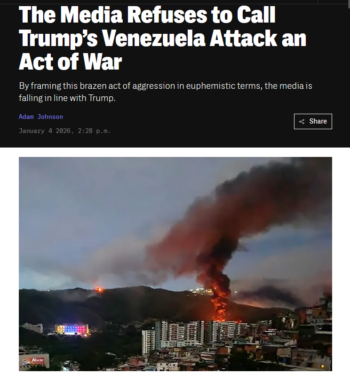
Intercept (1/4/26)
JJ: And US media consumers live, and we are very much encouraged to live, inside a kind of bubble, where, for instance, as Adam Johnson points out in the Intercept, you might think from reading the US media that there was an international call out for Maduro’s arrest. But no, that was just the US. You might think there were international sanctions on Venezuelan oil trade, but no, those were just US sanctions, you know?
International law is reported largely as an interference in US hemispheric policing, when actually the whole world outside the US wants international law to be meaningful. And so it’s scary that US media are building and pushing a story where what the US says, just goes.
But it’s hopeful, I want to say, that billions of people are not buying that storyline, and they’re protesting. And what should we know about what’s happening, and maybe we aren’t seeing in the US media, but what’s happening in resistance to this?
ME: First I want to comment on what you said about the bubble. And it’s what happened after the Iraq War, and how all these legal theories were manufactured and abused after 9/11. What we hear now is the same messages. “Terrorism,” it’s “narcoterrorism“: That word has been used and abused to justify so many things, including the kidnapping of a sitting president in Venezuela.

And what I say to everyone is: Venezuela is a testing ground. And if Trump is successful in removing the person in power right now, removing the revolution, if it’s successful in keeping Maduro kidnapped, etc., then the next country will be Cuba and the next country will be Mexico, and Colombia, and then us, because they’re already treating opposition in the US as domestic terrorism.
And that word is just invented. There’s no nothing, absolutely nothing that can prove any of that. Even the indictment of Maduro, they took off the “terrorism” language, and now they’re using other things, because they just use it to manufacture consent for that.
So, yes, the US bends the rules the way that they want, and invents rules, also, that are US law, but not international law. And it is scary, like you say, it is very, very scary. But also what gives me hope, that I know that 70% of the US public is against this war, and they’re opening their eyes, as you said, and it’s the only way that we can stop him.
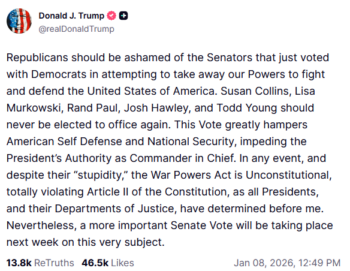
Truth Social (1/8/26)
Today there was a vote to advance a war powers resolution against the war in Venezuela that passed. But immediately, he wrote a tweet, talking bad about the Republicans that voted yes for a debate. It was not even the vote. (I don’t know when your listeners are going to hear about this.) But it’s his way of saying, basically, “I can do whatever I want.”
And it’s not the War Powers Resolution that is going to stop him. Even the ICC, it doesn’t stop Netanyahu, right? The only people that can stop him is us. For that, we need to unify our fight, and also care about Venezuelans. So don’t let the media distract you from the procedures or the technical stuff, and focus on the Venezuelan people who don’t want an intervention. We have our problems, we have our opinions, but we do not want bombs. This has never happened to us. We are a peaceful country. We are a peaceful continent.
So I just ask your listeners and everyone to open up a little bit your hearts, and listen to Venezuelans in Venezuela. There are media that elevate, some social media, small social media, that are over there, demanding people to talk, and recording the people that are mobilizing. They’re huge, huge mobilizations against what the US is doing. So listen to those voices.
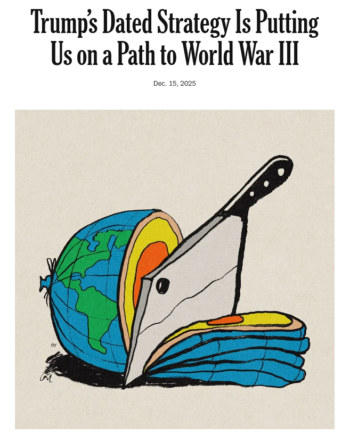
New York Times (12/15/25)
JJ: Including around the world. Around the world, there are protests against this. And I would just finally bring you back, because I do feel that there are non-corporate media who are stepping up, who are trying to present those voices, and, as you point out, social media that are bringing us voices directly. And I do sense a lot of outrage, but it’s so, almost big, because we understand it’s not just about Venezuela. We understand it’s this Monroe Doctrine, this idea that the US is in charge of every other country in the Hemisphere, in the world. And we understand that there’s a large system problem. And I think lots of people also understand that corporate news are not going to explain that problem accurately, or let them know how to intervene in it.
But there are reporters who are kind of boats against the current, and they deserve support. But we do need to have different news sources.
And I just wonder, in terms of journalism, finally, what would you be asking for? How does appropriate journalism of this kind of situation, what does it do that we’re not seeing from corporate journalism? What could good reporting do?
ME: Yeah. Well, I think, as I said, that the reporting right now is only talking about the procedures, only talking about if the strategy is good or not for the US, etc. So what I would like to see is reporters really elevating voices in Venezuela, but also [getting] a little bit deeper into the consequences of this precedent. Because, as I said, it’s not only Venezuela, and the legal arguments that the Trump administration is using right now, they don’t have any limit. They are saying, basically, like, for example, the blowing up of the boats. They’re saying that they can go there, because there’s drugs, there is no limitation of anything, they can just go. And if they think that there’s drugs in that boat, they can kill everyone. No due process, no evidence, nothing, just blow up a boat that they think has drugs.
So what happens if tomorrow, I don’t know, Trump says that there is a gang of “Cartel de las Lunas” in Chicago, right, in a residence or in someplace, and then just decides to blow up one city of America? If we don’t stop this right now, it’s going to come back to us. And it does already.
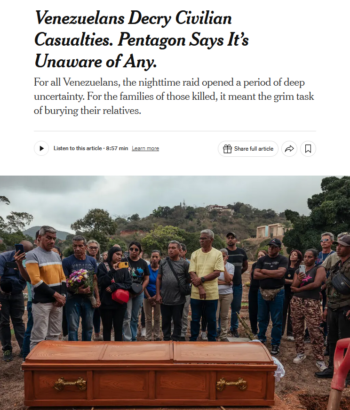
New York Times (1/8/26)
Another thing that is missing, and that I am really upset about, is that when this happened, when he kidnapped the president in Venezuela, he said, “Well, we didn’t lose any military assets. We didn’t lose any US soldiers. We didn’t lose the helicopters.”
But 80 people died that day. Eighty people. And there are no names that the media is even trying to figure out who they are. Only Cuba did put out the names of the people, but the media is not searching for that information, they’re erasing the lives of Venezuelans—and Cubans, but the lives of people who are in Venezuela.
So that’s another thing that I think that the media is not doing. And if you don’t put a face and you don’t put a light, you just say, “Oh, we did not lose any helicopters”? But 80 people, you know, 80 lives, 80 people with family, 80 parents, 80 siblings. And so it’s really upsetting for me.
And the other thing is that they say, well, they were mostly not civilians, they were soldiers, or they were from the military. And I just want to say something that people here in the US, because there’s a bubble, don’t understand about the military in Venezuela, and it’s that the military in Venezuela is not really like here. The military in Venezuela, they’re really embedded in Venezuelan lives. They’re people that provide help when they’re distributing food. They provide help when there’s a climate emergency. It’s not like here, for example, where ICE agents just shot a woman.
JJ: It’s not combatants, like they’re on a battlefield, you know?
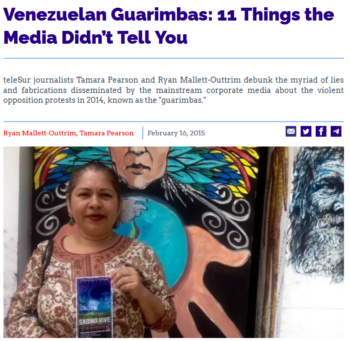
Venezuelanalysis (2/16/15)
ME: Exactly. Here in the US, they are like they are on a battlefield, but it’s not like that in Venezuela. And some people do quote instances where the military has intervened in protest. But the other thing that they don’t say is that the opposition in Venezuela who do this protest, or have done guarimbas, they are really, really violent opposition. They killed a Chavista, they burned him alive, just because he was Chavista.
So this wouldn’t be allowed here in the US. Can you imagine? These things that happened here, with the military or the ICE, imagine this happened in Venezuela, this ICE agent that just killed someone in the car? If that happened in Venezuela, that will be the news, you know, like “horrible Maduro,” “thugs” or “terrorists,” whatever.
Those nuances, the media, if they wanted to, they would do it. I think they just don’t want to. They’re just, as I said before, manufacturing consent for US wars. But if they really wanted to, they would go into Venezuela, and they would listen to Venezuela.
JJ: Absolutely. We’ll end it on that note for now.
We’ve been speaking with Michelle Ellner. She’s Latin America campaign coordinator at CODEPINK. You can follow their work online at CodePink.org, but I suspect they’d rather see you out in the street. Thank you very much, Michelle Ellner, for joining us this week on CounterSpin.
ME: Thank you so much. And yes, please, out in the streets right now.
From FAIR via This RSS Feed.