

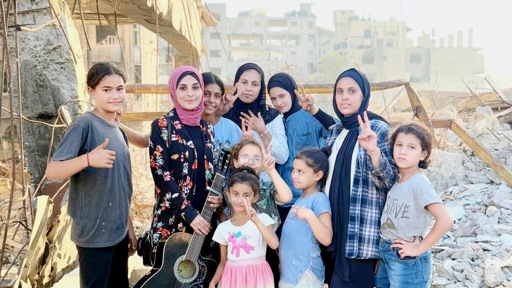
Gaza’s Rola Dalloul recalls the long weekly trips which she would take to her grandfather’s house as a child. Her bond with that land was characterized by 80-year-old olive trees and the sonorous, though intimate, songs of her family members. While the Israeli occupation forces destroyed this location early in the genocide, she says she carries its spirit in her heart. As one of the Palestinians who refused Israeli relocation to Southern Gaza in 2023, she is staying close to home both physically and culturally.
Today, the 32-year-old travels long strenuous routes to teach music to the children of Northern Gaza. During these 45 minute sessions, she introduces students to folk songs which they memorize and recite together. The study of lyrics, rhyme schemes, and guitar chords provides a needed respite from the children’s unending search for food, water, and shelter from Israeli bombardment.
Unity and resistance through song
Dalloul’s connection with her students echoes her relationship with her first music teacher – Ms. Shireen Zeidan. At the age of three, Rola heard the woman playing piano for another class and insisted that she teach her as well. A fast learner, she seized the rare opportunity. For two classes a week over the course of three years, she formed the basis of her musical skill set. Rola carried songs like Yamma Mweil El Hawa to adulthood and shared her own cover of the song in early 2023.
More recently, she decided to introduce her students to the Italian anti-fascist anthem “Bella Ciao”. While Dalloul was hesitant to teach them a song in the foreign language, her students insisted on learning, memorizing, and performing it with great enthusiasm. Filmmaker Mahmoud Abu Qaraya’s clip of this performance “among the rubble” quickly garnered more than 2.4 million views on Instagram.
She said, “The whole point of music and singing is to feel that we’re all united somehow, and songs are meant to connect people together, by choosing the songs that are internationally known and popular, this way I can actually bridge Gaza with the other side of the world.” (Translated by Dima Dalloul)
Music to reveal the truth
However, Rola was not always a popular musician, and looking at her former career reveals the basis of her musical pedagogy. As a young girl, she would sit with her father and watch live coverage of Israel’s 2006 war in Lebanon. With few opportunities to study music, and fewer Palestinian women singers to take as her role models, she modeled herself after journalists reporting on the ground.
Dalloul says her intention was to reveal the truth. She would achieve that goal differently however. It became clear that she had more in common with the likes of Lebanese artists Marcel Khalife and Julia Boutros than she did with other reporters.
From artist to teacher
Her introduction to teaching was somewhat spontaneous. While she started with a small circle of students, they demanded increasingly longer and more consistent sessions. Despite lacking the space and capacity for more professional classes, she was willing to meet the moment. “I’ve become responsible for these kids,” she said. “I really need to learn more, practice more, because I’m not a professional teacher. But these kids don’t know anything about music so at least I can teach them what I know … develop my skills so I can transfer them to them.”
In 2025, she applied for and won the British Council’s Mishkal grant for performing artists. Dalloul says that the project, focused on production funding, cultural exchange, capacity building, and showcasing, changed everything for her. Toward the beginning of the genocide, she instructed six classes of students in “education clusters” that stood in for the schools which Israel had bombed. Later, she started teaching 25 students in displacement camps, 13 of whom are learning guitar. As more people recognize and encourage her work, organizations invite her to sing and play guitar for children.
She effectively passes down songs from her own childhood despite continuous Israeli bombardment. As the students look to Dalloul as a role model, they internalize her deep love of their homeland. She is careful not to conflate the conditions of genocide and forced starvation with the basis of Palestinian life: pride in and responsibility for the people and land.
Witnessing dignity among ruins
Peoples Dispatch spoke to Mahmoud Abu Qaraya, the director of “A String Among Ruins”. The short film follows Dalloul, as she uses music education to construct a new reality for her students, one built on discipline, persistence, and curiosity. While viewers will doubtlessly hear the devastation caused by Israeli’s genocide – mourning, fear, the precarity of resources – Qaraya also invites them to listen to the dignity of learning and the humble intricacies of teaching. His focus is not spectacle, but a sympathetic sense of urgency.
“Rola carries responsibility with a calm strength – you can feel she is protecting these kids, not only teaching them,” he said. “The students surprised me: they are children, yet they hold a focus that many adults lose under pressure. I didn’t feel like I was “directing” them; I was witnessing them. I learned that even in extreme conditions, children still want to laugh, learn, and express themselves. For girls, it is especially powerful to see a woman leading, teaching, creating structure, and protecting a space of culture. For boys, it shows that strength is not only physical – strength can be sensitivity, discipline, and respect.”
Dalloul’s lessons resound far beyond any improvised class room, and her students’ rhythms signal changes to come. In the future, she wants to study music more thoroughly and eventually host concerts honoring Gaza. Finally, she wants to travel the world and represent her homeland with confidence in her right to return.
The post Studying the changes: a Palestinian music teacher’s lesson on will appeared first on Peoples Dispatch.
From Peoples Dispatch via This RSS Feed.