

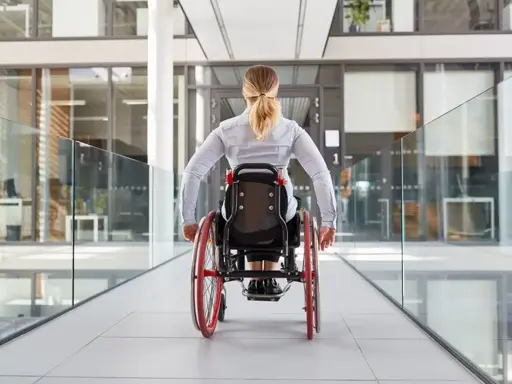

Recently, I was watching the news for my area, and one segment was dedicated to a story from two women who had spinal-cord injuries who both had encountered difficulties getting scans and other tests within the NHS. Their confidence in the NHS had been severely rocked because of the problems they had encountered.
I can imagine people watching, feeling confused that our ‘world-beating NHS’ is failing women who use a wheelchair due to key scans not being accessible to them.
But many women are being failed by the NHS. I have also experienced these problems multiple times. Prior to my most recent experience with the NHS, I was refusing to go for scans and other medical tests due to a previous poor experience with staff and equipment.
Spinal scan on the NHS
But when last year, a worrying lump on my back appeared, I reluctantly agreed to go for a scan. Mainly because I was curious about the lump.
So, on the day, the district nurses came early to dress my pressure sore and make sure it was ok for me to go out. After they gave the green light, and a long wait for the wheelchair taxi, my mum and I finally arrived at the clinic.
We were dismayed to see an overcrowded waiting room but we had both brought supplies. So, after I was booked-in, my mum found a place for us to sit, not far from the booking-in desk.
After some time, my mum started to notice people who arrived after us being called into the clinic. She put her book down and started to check who was being called in. When this continued to happen, my mum told me to keep her seat as she was going to the booking-in desk. At this point, we had already been there for nearly two hours.
Not here
The booking-in person told my mum the scanning equipment this NHS hospital had wasn’t suitable for someone using a wheelchair. I should ask my GP to refer me to a nearby hospital that was equipped for wheelchair-accessible scans.
They knew this information as we were booked-in but failed to tell us. But rather than an apology, we got a smug, almost sarcastic response, that reminded me of previous encounters with clinic staff.
By the time we left, I was nearly in tears, knowing just how much it had taken to get me to the clinic. And now they wanted me to do it all over again at a different hospital. No way, I thought. That’s what happened, I never went back to my GP, and the lump is still on my back.
Wheelchair access
Recently, I was writing a column about wheelchairs. I concluded that in my 36 years living with a spinal-cord injury the biggest improvements have been the development and design of new manual and powered wheelchairs. These include new hybrid wheelchairs that are manual but have powered adaptations.
The other improvement has been with access. But even as I was writing that down I knew there was a large caveat. And that was access within the NHS. This has been a long-standing problem.
For example, many years ago, I was making a visit as a non-executive trustee. It was a brand-new psychiatric hospital, yet to open its doors to the patients. As we were going around, I entered one of the bedrooms that had an ensuite toilet and sink. No matter how I tried I couldn’t wheel-in to the ensuite toilet. There was no way the angles worked.
I brought it up and got two replies. One that the service-user could use a locked bathroom that was situated at the other end of the corridor. But the other answer was that they didn’t think they would get many service-users using a wheelchair.
That isn’t the point. Even if they only have one service-user using a wheelchair, they still deserve the same access as everyone else.
Attitudes in the NHS
But it’s not just the lack of access in the NHS but the attitude of some staff within the system towards those with complex needs.
We all know that staff are working in a hugely pressurised setting, and yes, we should applaud their resilience. But we must call out this type of toxic behaviour as well as the lack of accessible resources.
Dharshana Sridhar, campaigns manager at the Spinal Injuries Association, said:
The system is not made for women’s health to start with, and it’s even worse for women with disabilities. Some of the barriers are entirely preventable, like inadequate equipment, and a lack of height-adjustable examination beds, but this has still been an ongoing problem for decades.
The damage these long-term failures cause is immense. Women, like those I was watching on the news, were hesitant about going back for scans within the NHS due to the negative experiences they both had encountered. For a ‘world-beating service’, this needs tackling as a matter of urgency.
Further support from the Spinal Injuries Association can be found here.
Featured image via the Canary
By Ruth Hunt
From Canary via This RSS Feed.