

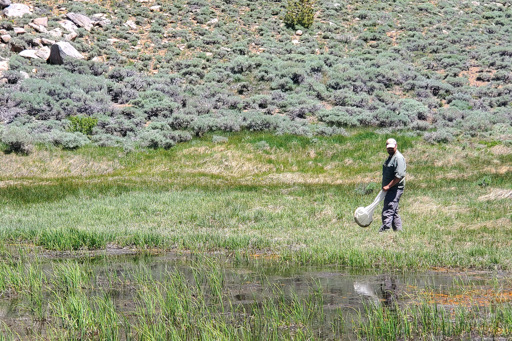
California’s insects are as outsized as the state itself. Between its redwood forests and desert basins may live 60,000, perhaps even 100,000 species — though no one truly knows. That uncertainty drives the California Insect Barcode Initiative, an audacious attempt to document every insect in the state through DNA sequencing. Leading the effort is Austin Baker, a postdoctoral researcher at the Natural History Museum of Los Angeles County. His mission sounds improbable: to collect, sequence and catalog every fly, ant and beetle that hums, crawls or burrows across California. “You could visit any vegetated area across that state and potentially collect several new (undiscovered and unnamed) insect species,” he says. Baker and his colleagues are working under the California All-Taxa Biodiversity Inventory (CalATBI), which seeks to “discover it all, protect it forever.” Their approach is exhaustive. California’s habitats range from fog-draped coasts to alpine forests and sun-scorched deserts, each with its own suite of species. To cover this diversity, the team is sampling every ecoregion recognized by the Environmental Protection Agency, deploying a mix of techniques and leaving passive traps in the field for months at a time. Every specimen collected is preserved and archived, forming a permanent record alongside its DNA barcode. “DNA barcoding is an excellent way to discover and delimit species, although it is not perfect,” Baker says. “Verifying accuracy requires going back to the voucher material for further examination.” The undertaking is vast and collaborative. Scientists from the University of California, Berkeley, the California Academy of…This article was originally published on Mongabay
From Conservation news via This RSS Feed.