

This article by Arturo Daen originally appeared in the January 16, 2026 edition of Sin Embargo.
Mexico City. Guanajuato saw 30,000 murders in a decade. During those ten years, governments of the National Action Party (PAN) implemented failed policies and made unsuccessful appointments in key areas, leading to social deterioration and record levels of violence in the state.
SinEmbargo‘s Data Unit reviewed figures from the Executive Secretariat and found that Guanajuato ended 2025 with 2,539 victims of intentional homicide. This marks the first time since 2017 that the Bajío state had fewer than 3,000 murders. Compared to 2024, this represents a 19 percent decrease in these crimes.
However, as has been the case since 2018, Guanajuato appeared as the state with the most murders in the country , in absolute numbers, accounting for 10 percent of homicides nationwide. Chihuahua, another state governed by the PAN party, ranked second with 1,791 intentional homicides.
10 States with the Most Intentional Homicides
| State | Number of Homicides |
|---|---|
| Guanajuato | 2,539 |
| Chihuahua | 1,791 |
| Baja California | 1,714 |
| Sinaloa | 1,663 |
| Estado de México | 1,519 |
| Guerrero | 1,312 |
| Michoacán | 1,267 |
| Jalisco | 1,198 |
| Sonora | 1,138 |
| Morelos | 1,119 |
And at what point did the situation break down in Guanajuato territory?
The following graph shows how in 2015 this state registered 975 murder victims. The following year there were 1,110, then 1,435 in 2017, and the number skyrocketed in 2018, with more than 3,000 homicides by the end of the administration of PAN party member Miguel Márquez Márquez:
Victims of Intentional Homicide in Guanajuato (2015-2025)

The rising trend of murders continued under the administration of Diego Sinhue Rodríguez Vallejo, also a member of the PAN party. During his term, Guanajuato experienced its bloodiest year in history, 2020, when, amidst the COVID-19 pandemic, the state recorded 4,490 victims of intentional homicide.
Regarding femicides in Guanajuato, the Executive Secretariat recorded 181 between 2017 and November 2025, with a peak in 2021 of 34 cases:
Victims of Femicide in Guanajuato (2017-2024)

The National Institute of Statistics and Geography (INEGI) is another source of data for visualizing homicides in the country. This agency’s primary source of information is death certificates and records from forensic medical services, unlike the Secretariat, which relies solely on data submitted by state prosecutors in investigation files. Its figures tend to be higher for this reason, and also because it does not distinguish between intentional homicides and manslaughter, or femicides, as the Secretariat does.
According to the Institute’s count, Guanajuato recorded 33,124 homicides between 2015 and 2024 (INEGI does not yet have figures for 2025). If cases are considered since the PAN party took office in 1991, the total is 41,758 murders.
Homicides in Guanajuato During PAN Rule

Oliva, Márquez and Sinhue Responsible
When consulted by SinEmbargo, Saúl Arellano, a researcher and specialist in security and violence prevention, pointed out that the situation in Guanajuato began to deteriorate during the government of Juan Manuel Oliva (2006-2012), the problem worsened during the term of Miguel Márquez Márquez (2012-2018) and reached its worst point during the administration of Diego Sinuhe Rodríguez Vallejo (2018-2024).
“The breakdown was very gradual. In my opinion, it was a breakdown that generated cumulative negative effects. The real problem began with Juan Manuel Oliva, who started his term and appointed Zamarripa as Attorney General. At that time, Guanajuato had maintained a relatively stable average of 250 or 350 homicides for decades—and when I say decades, I mean from 1980 to 2000, up until 2005 in fact. When Juan Manuel Oliva took office, things started to fall apart. Because there wasn’t a single year after he took office in which Guanajuato didn’t register a sustained increase in intentional homicides in the state,” the researcher pointed out.
“If we think in terms of six-year periods, the government that ended just a year ago, of Diego Sinhue Rodríguez Vallejo, has been the worst governor in the country, in terms of absolute numbers of homicides.”

Governor Diego Sinhue Rodríguez Vallejo
“Diego Sinhue should at least be, if not investigated, then at least summoned to testify about what happened in the state. It’s unacceptable that the governor turned a blind eye the whole time, simply saying, ‘Well, that’s the security apparatus’s job, don’t even ask me.’ You can’t evade the enormous political responsibility of being the governor with the highest number of deaths in the country’s history. We’re not talking about minor matters, and in that sense, I think the former governor bears a tremendous responsibility,” he added.
Even with the deterioration in an entity they have governed for 34 years, and with the precedent that at the federal level one of their Secretaries of Security, Genaro García Luna, was sentenced for working for drug trafficking, the PAN has been a constant critic of the security strategy of the Morena administrations of Andrés Manuel López Obrador and Claudia Sheinbaum, even pointing to an alleged pact with organized crime, without presenting any evidence in this regard.
From the perspective of researcher Saúl Arellano, the PAN has no excuse and must assume responsibility for what happened in Guanajuato, since it allowed the growth of criminal organizations such as the Santa Rosa de Lima Cartel.
“What we see is that the National Action Party is, of course, entirely responsible for this debacle in the state. Because not only does it govern the state, but it also governs the largest number of municipalities within it. It has historically governed them. And not just the municipalities in general, but the most populated ones. León, Salamanca, Irapuato. They have historically been governed by the National Action Party,” the researcher said.
“If it had been a state like Sinaloa, Jalisco, Michoacán, or Guerrero, where there has been a historical presence of cartels operating and controlling territories since the 1970s, then you would say it’s more of a federal problem than a state one. But here, I insist, a cartel literally sprang up right in front of you. So the PAN party has no excuse to say ‘I bear no responsibility,’” he added.
Among the shortcomings attributed to the PAN party in Guanajuato is having kept Carlos Zamaripa Aguirre as Attorney General for more than 15 years , and Alvar Cabeza de Vaca Appendini as Secretary of Security for 12 years between 2012 and 2024, despite their lack of results in ending impunity and curbing violence in the state.
The Guanajuato-based media outlet PopLab.mx reported in this article that Alvar Cabeza de Vaca Appendini’s administration was marked by a lack of results in security, abuses by local police that resulted in 363 complaint files with the State Human Rights Commission, infiltration of organized crime into security forces, and a lack of coordination with the federal government, which was necessary to confront cartels such as Santa Rosa de Lima, Jalisco New Generation, or the Sinaloa Cartel, as well as fuel trafficking networks known as huachicol.
A decade ago, in 2015, INEGI found that in Guanajuato, 60.7 percent of the population considered insecurity to be the main problem in the state, and by 2025, this indicator had risen to 71.5 percent.
The current governor of Guanajuato, Libia Denisse García, also a member of the PAN party, has highlighted the reduction in homicides in 2025; however, local media warned that at the beginning of this year there were incidents such as the discovery of at least five clandestine graves in municipalities of Guanajuato, and the murder of six people in Valle de Santiago, including two minors.

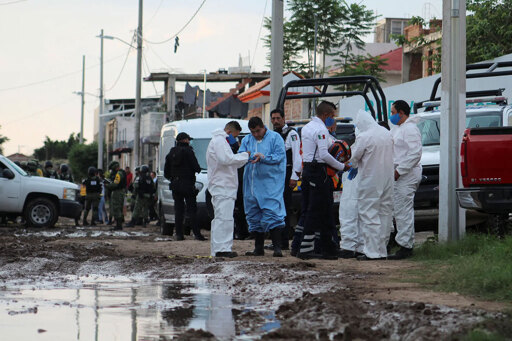
In 2020, 26 people were murdered at a drug rehab facility in Irapuato, Guanajuato.
Inequality and Deficiencies in Guanajuato
Among the 32 entities, Guanajuato is the fifth largest economy in the country, according to its contribution to Gross Domestic Product, only behind Mexico City, State of Mexico, Nuevo León and Jalisco.
It ranks among the top 10 states with the most foreign direct investment, and in 2024 it recorded exports to the United States exceeding $12 billion. Its main export products are auto parts and vehicle accessories, electrical cables, and footwear, according to data from the Ministry of Economy.
Guanajuato has wealth, industrial corridors, and tourism, but the benefits do not flow equitably. According to the most recent INEGI measurement, the percentage of the population living in poverty fell from 39.4 percent in 2016 to 26 percent, or a quarter, in 2024. Extreme poverty stands at 1.7 percent.
In comparison, Nuevo León had 10.6 percent of its population living in poverty, Jalisco had 18.6 percent, and Mexico City had 19.7 percent.
The lack of access to health services grew from 13.4 percent in 2016 to 33.7 percent – with Guanajuato refusing to accept the IMSS-Bienestar program for people without social security so far – and 46 percent of its population lacked access to social security in 2024.
Guanajuato has been governed for 33 years with the same neoliberal economic model implemented by the right wing, and the same authorities in charge of law enforcement and prosecution have remained in place for over a decade. As a result, inequality, crime, and drug use have increased.
The lack of job opportunities led this state to become the leading source of migrants nationwide, according to an analysis presented by the federal government. In 2020, according to data from Conapo (National Population Council), 8.75 percent of households in Guanajuato received remittances; in some municipalities, such as Tarandacuao, Ocampo, and Jerécuaro, this figure exceeded 20 percent.
Thus, Guanajuato ranked alongside Michoacán until 2024 as one of the two states with the highest income from remittances, exceeding 5.6 billion dollars, although at the cost that family members had to leave their country and move to the United States to earn income.
These social deficiencies and inequalities generated by the neoliberal model were highlighted in January 2025 by President Claudia Sheinbaum as causes of the violence in Guanajuato:
“It is also a product of a failed development model in the state of Guanajuato,” the President stated. “Therefore, it must be addressed from different perspectives; yes, from the Attorney General’s Office, the State Security Secretariat, and in coordination with federal forces and the Secretariat of Security and Citizen Protection of the Mexican government, but also by fundamentally addressing a development model that led to violence, poverty, and inequality. So, that is the starting point for addressing it.”
Previously, in September 2024, the then Secretary of Federal Security, Rosa Icela Rodríguez, also pointed out that the neoliberal economic model, the precariousness of working conditions and the concentration of wealth in an industrial corridor deteriorated the social fabric in Guanajuato, and facilitated the growth of crime.
“(Guanajuato) has been governed for 33 years with the same neoliberal economic model implemented by the right wing, and the same authorities in charge of law enforcement and prosecution have remained in place for over a decade. As a result, inequality, crime, and drug use have increased.”
“From 1991 to 2024 there have been seven local governments from the right that increased their alliances with the traditional leadership of conservatism and the extreme right represented by ‘El Yunque’,” the official said.

Guanajuato has wealth, industrial corridors, and tourism, but the benefits do not flow equitably, decades of neoliberalism have produced misery and violence for its working population.
“The neoliberal model is evident in the concentration of wealth without any impact on improving the living conditions of the population, since eight of its 46 municipalities, located in the industrial corridor, concentrate almost 60 percent of the poor in Guanajuato. Just to give one example, the thriving municipality of León is the municipality with the most poor people in the country and the second with the most people living in extreme poverty,” she added.
Rosa Icela Rodríguez also mentioned a special survey conducted by the National Commission for Mental Health and Addictions (Conasama) on the consumption of psychoactive substances applied to 1,066 workers at the entrances of factories in the Celaya-León industrial corridor.
With it, she said, it was possible to establish that 51 percent of the workers knew someone who used drugs.
“The negative impact of methamphetamine use is felt among workers seeking to improve their performance during long working hours… 26 percent of workers in this industrial corridor of the manufacturing industry have used substances at some point in their lives and 54 percent stated that obtaining drugs in their environment is very easy.”
According to researcher Saúl Arellano, while poverty and inequality can influence the level of insecurity in a state, other key factors in analyzing homicidal violence and the behavior of organized crime include the population size of different cities or municipalities within a state, their geographic location, and their economic activities. He also considers the effectiveness of security programs and actions implemented by governments, and their capacity to prevent corruption within their security forces.
According to the researcher’s studies, there is evidence that states like Guanajuato or Michoacán, with a high level of foreign investment, exports and remittances, are also the ones that suffer the most from the impact of organized crime.
“The states with the most foreign direct investment and the highest volume of exports are the states that concentrate the highest absolute number and the highest rates of homicides in the country. What does this mean? That death, and death associated with crime, follows money, not poverty,” he said.
-

People’s Mañanera January 16
January 16, 2026
President Sheinbaum’s daily press conference, with comments on Edomex security strategy, Mexico-US cooperation, and electoral reform.
-

The PAN’s “Trophy” in Guanajuato: 30,000 Murders in the Last Decade
January 16, 2026January 16, 2026
Over three decades of rule, the right wing PAN implemented failed policies and oversaw record levels of violence in the state.
-

Mexico City Landgrabs: 94 Properties Recovered, Six People Arrested
January 15, 2026January 15, 2026
Mexico City has been plagued with high-profile night raids by criminal gangs, sometimes accompanied by police, invading and capturing properties throughout the capital.
The post The PAN’s “Trophy” in Guanajuato: 30,000 Murders in the Last Decade appeared first on Mexico Solidarity Media.
From Mexico Solidarity Media via This RSS Feed.