

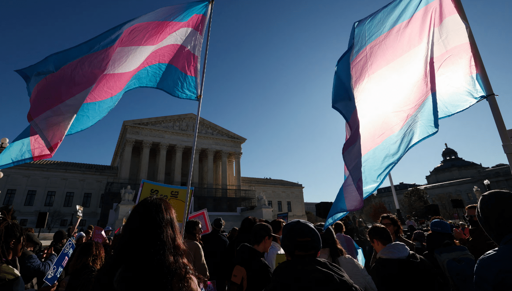
On January 13, the U.S. Supreme Court heard oral arguments on two cases related to trans students’ right to participate on school sports teams. The Idaho and West Virginia state laws in question were passed in 2020 and 2021, respectively, making them early entries in the flood of anti-trans legislation proposed and passed over the last few years in a nationwide effort coordinated by far-right organizations, exposed by trans activist Elisa Rae Shupe in 2023. It’s typical for legal challenges to take several years to reach the Supreme Court; in both cases, the U.S. Courts of Appeals ruled against the bans, and it’s the states, not the athletes, that are taking them to the Supreme Court.
Last year, the Supreme Court ruled in the Skrmetti decision in favor of a Teneessee law banning gender-affirming care for trans youth, but the decision framed it as a matter of age and medical regulation, not one of anti-trans discrimination, meaning that the court avoided answering certain anti-trans legal questions. These two new cases raise legal questions about Title IX and the equal protection clause of the fourteenth amendment that could significantly expand the scope of legal anti-trans discrimination in the United States.
The Right has long viewed sports as a viable starting point for establishing legal precedents to lay the groundwork for more sweeping anti-trans legislation. Participation in school sports can be framed as merely a hobby and therefore lower-stakes than social transition and access to gender-affirming medical care. Courts can thus avoid emotionally-charged arguments in the public square about mental health and suicidality.
Questions of competitive “fairness” raise the specter of other people being harmed by trans girls’ existence in a way that is inherent to sport participation instead of relying on increasingly unlikely frightening hypotheticals. Anti-trans discrimination in this type of situation is considered more palatable to centrists and liberals, and the Right tries to use agreement with sports-related discrimination to establish legal precedents that can then be applied in other situations. After all, if trans people aren’t entitled to equal protection under the fourteenth amendment, then all kinds of discriminatory laws can be passed to exclude or closet them.
The Domino Effect of Anti-Trans Litigation
The state of Idaho argues that prohibiting Lindsey Hecox from competing in women’s track is not a matter of sex discrimination. According to journalist Christopher Wiggins, Justice Sotomayor seems to be suggesting that accepting this framing would have bigger implications for sex discrimination protections as a whole. The current legal foundation for anti-trans discrimination — classified as discrimination on the basis of sex — accepts assigned sex at birth as a relevant category. It argues that if a trans woman is treated differently than a cis woman for the same behaviors, she’s being discriminated against because of her assigned sex.
If the court rules that a case like Hecox don’t count as “sex discrimination,” it would undermine the legal reasoning behind many pro-trans protections and open the doors to future carve-outs. That is, if some women can be discriminated against on the basis of sex, then similar arguments could be made for other exceptions for sex-based discrimination or discrimination on the basis of other protected categories, such as race. S. Baum reports that even conservative justice Amy Coney Barrett seems concerned that a broad ruling in this case could result in greater gender segregation and, thus, fewer opportunities for women, including cis women.
Transmisogyny, Plain and Simple
The laws in question also don’t apply to all trans athletes; only trans girls and women. While this might be used to argue that these laws aren’t anti-trans discrimination because they don’t apply to all trans people, this distinction is a prime example of intersectionality in its original legal sense: A law or practice can still be discrimination based on a protected characteristic even if not everyone with that characteristic is treated the same way.
As Baum writes, Sotomayor has previously pointed out that it was argued about Loving v. Virginia that bans on interracial marriage were race neutral because people of all races were banned from interracial marriage. The same argument has been made about same sex marriage — that bans aren’t discriminatory because straight people aren’t allowed to get gay married either.
These laws are plainly anti-trans discrimination even if they only apply to trans women and girls, and singling them out is transmisogyny.
The Working Class, Not the Courts, Can Protect Trans People
Analysts anticipate the Supreme Court will uphold the laws in its final ruling (expected in June), but what remains unclear is how narrow the ruling will be, and which legal questions the Court will choose to address or avoid.
In any case, the decisions have the potential to have significant implications for the legal landscape for trans people in the years to come. While the lower courts’ rulings successfully prevented the laws from being enforced for several years, the likely outcome of the Supreme Court rulings shows that a strategy that relies solely on lawsuits, legal arguments, and sympathetic justices will not deliver the protections trans people need.
Attacks on trans people’s rights, even the right for teachers to acknowledge trans people’s existence, are continuing to escalate, and a strong, combative movement is needed. For example, while some schools are censoring curricula related to trans people specifically — and LGBTQ+ people in general — and capitulating to the Trump administration’s demands to discriminate against trans athletes, other school districts are reaffirming their commitments to support of all students. For example, the Chicago Teachers Union recently negotiated stronger protections for LGBTQ+ teachers and students in its contract. Just as everyday people are in the streets defending their neighbors against ICE, regular people can and must organize in their communities, schools, and workplaces to defend their trans neighbors too.
The post The Supreme Court Is Endangering Far More than Trans Athletes — We Must Fight Back appeared first on Left Voice.
From Left Voice via This RSS Feed.