

Caracas (OrinocoTribune.com)—Acting Venezuelan President Delcy Rodríguez has delivered a message of unity and dignity during the presentation of her Annual Message to the Nation. In her speech, she detailed the political, economic, social, and administrative achievements of President Nicolás Maduro’s administration throughout 2025, reiterating that he remains the leader of Venezuela and Chavismo.
“There is a stain on our relations, because they have crossed the red line,” the Chavista leader stated this Thursday, January 15. “They attacked, assaulted, killed, invaded, and kidnapped President Maduro and our first lady. It is a stain on the relations between the US and Venezuela, and we swore to our heroes and heroines that we were going to resolve it diplomatically, face to face, as Bolívar taught us.” She reported that she had discussed the content of this message with President Maduro just hours before he was kidnapped by the US empire.
Speaking from the Federal Legislative Palace, headquarters of the National Assembly, Rodríguez pointed out that while the aggression of January 3 is unprecedented, the contradictions that led to the attack are historical. She explained that the Monroe Doctrine seeks imperialist territorial expansion, while the Liberator Simón Bolívar advocated for freedom from colonialism and imperialism.
The constitutional ceremony began with the acting president calling for a minute of applause in honor of those killed in the January 3 military attack—the operation in which President Nicolás Maduro and his wife were kidnapped by the US regime.
During her speech, noted by analysts in particular for its brevity and gravitas, Rodríguez called for political dialogue and an end to “anti-political practices” which, in her view, had removedd into a competition to determine “who could grovel the most.”
“The people are waiting for tolerance and respect,” she stated.
Economic growth
Rodríguez announced the creation of two sovereign wealth funds derived from oil revenues. The first is earmarked for social protection to improve workers’ income, education, and healthcare, while the second will fund infrastructure and public services. She further called for the creation of a technological platform for the effective management of both funds, in order to ensure transparency and prevent corruption.
The acting president also presented a draft Organic Law for the Protection of Socioeconomic Rights, explaining that the law will protect consumers and guarantee the quality of goods and services. She highlighted 19 quarters of sustained growth—almost five years’ worth—and an 8.5% increase in the country’s GDP in 2025.
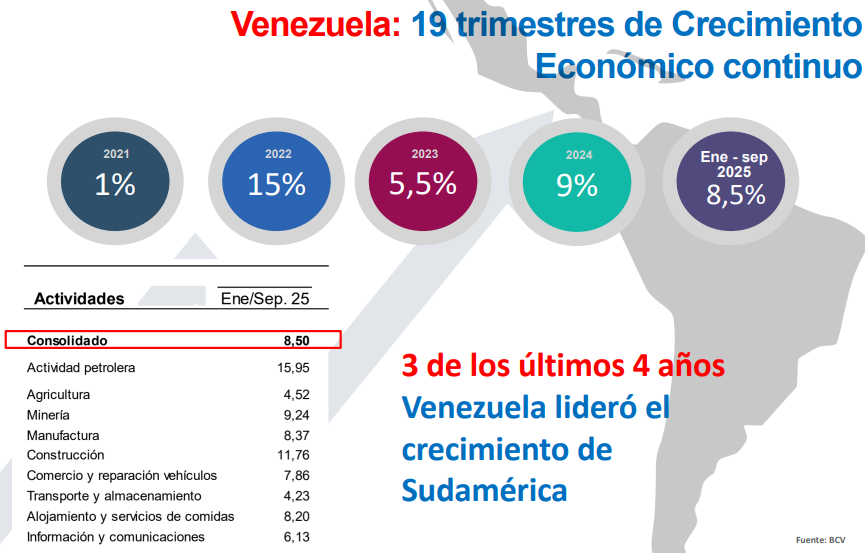
Venezuela’s 2021-2025 GDP growth, with sectorial 2025 desegregated growth. Source: BCV.
She reported to the assembly that over the course of the past year, Venezuela did not import fuel, and that Venezuelan oil workers achieved a production of 1.2 million barrels of oil per day (bpd).
“Thanks to the CPP model, an investment of nearly US$900 million was achieved in the hydrocarbon sector in 2025,” she added.
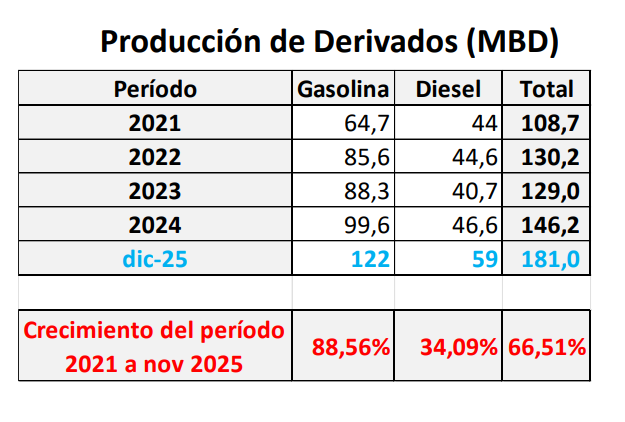
Oil sub-products production comparison between 2021 and 2025 in million of barrels per day.
Rodríguez introduced a draft reform to the hydrocarbons law, in order to incorporate production models from the Anti-Blockade Law. The move is intended to ensure investment flows are incorporated into new or unexploited fields where infrastructure does not yet exist. Additionally, she announced a draft Organic Law for the Expediting of Procedures.
“I have asked the legal teams to implement the anti-blockade model,” she said, “which will allow us to deactivate any existing regulation when a procedure is preventing investment or hindering citizens.”
Achievements in security and public services
Rodríguez highlighted the consolidation of “direct democracy” through the national people’s power model, noting that more than US$280 million was invested in 35,000 communal projects, executed through the autonomy of communes and communal councils.
On the issue of internal security, Rodríguez announced that Venezuela had reached a figure of three homicides per 100,000 inhabitants. She compared this to Ecuador’s rate of 70 homicides per 100,000 and the regional average of 16, emphasizing that it demonstrates “the commitment of the Bolivarian Government to the security of the people.”
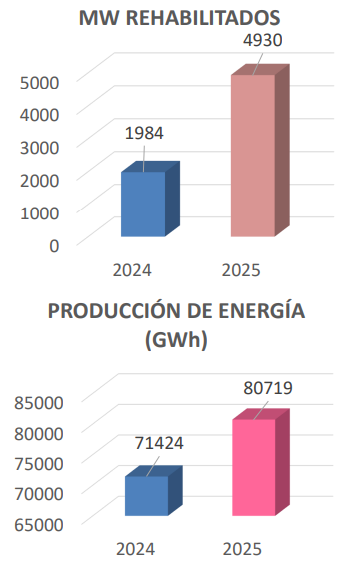
Recovered electricity capacity in MW and overall energy production in Venezuela, compared between 2024 and 2025.
Regarding public services and social metrics:
• Energy: 5,000 megawatts were added to the National Electric System (SEN), more than doubling the 2024 power levels.
• Water: A 110% growth was recorded in water services.
• Infrastructure: Asphalt paving increased by 70%, using materials from Lake Guanoco.
• Health: Maternal and infant mortality rates decreased significantly.
• Employment: The administration recorded growth in formal employment as the economy continues recovery.
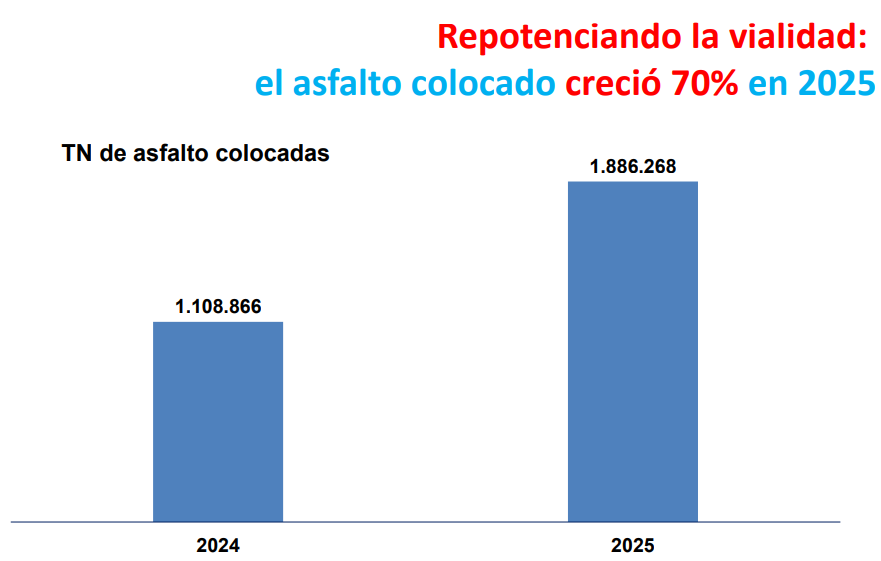
Delivery of asphalt in Venezuela, 2024-2025 comparison.
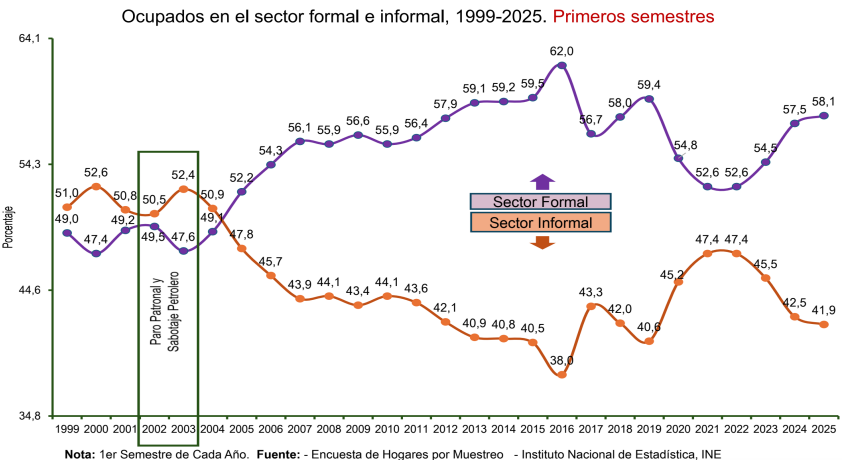
Evolution of formal work vs. informal work in Venezuela over several years.
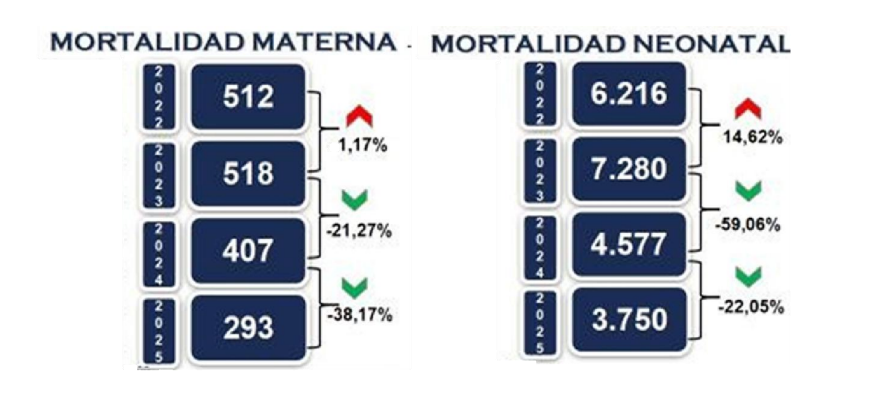
Evolution of maternal and newborn mortality rate in Venezuela between 2022 and 2025.
International relations
“Venezuela has every right to maintain relations with China, Russia, Iran, and Cuba,” Rodríguez reaffirmed, noting that the agenda of energy between Venezuela and the US is not new. “We are not reinventing the wheel; we continue to shape our energy cooperation with the US and other countries.”
Rodríguez also addressed the possibility of traveling to the US in her current capacity. “If one day I have to go to Washington as acting president, I will do it standing, walking, not crawling,” she stated firmly. “I will do it with the tricolor flag. It will be standing, never crawling or dragging myself. That is what holds true to the Venezuelan people standing tall.”
Machado-Trump meeting fiasco
Analysts note that Rodríguez’s speech served as a rebuttal to the low-profile and unproductive meeting between far-right politician María Corina Machado and US ruler Donald Trump on the same day.
White House press secretary Karoline Leavitt stated in a press conference that Trump’s assessment of Machado as a figure to lead a transition in Venezuela has not changed after the meeting. Leavitt also confirmed that Trump evaluated Machado’s profile based on current socio-political realities and believes the 2025 Nobel Peace Prize recipient cannot govern the nation, as she lacks internal support and respect.

Venezuelan far-right politician María Corina Machado exits from the White House’s back door after meeting President Donald Trump in Washington, Thursday, January 15, 2026. Photo: Pablo Martinez Monsivais/AP.
“The president’s assessment is based on the reality on the ground,” Leavitt confirmed. “His opinion has not changed so far.”
This reality clashes with mainstream media reports and statements from some European politicians, claiming Machado remains the primary option for an alleged transition in Venezuela. It also contradicts “creative interpretations” by far-right activists who suggested Trump’s initial assessment only referred to a lack of Machado’s military support.
Machado’s arrival at the White House on Thursday was widely reported as a fiasco of protocol. She was not received by any US officials, entered through a regular entrance, and the visit lacked an official photo with Trump or any formal farewell protocol.
The far-right Venezuelan politician later confirmed that she gifted the Nobel Peace Prize medal to Donald Trump.
Special for Orinoco Tribune by staff
OT/JRE/AU
From Orinoco Tribune – News and opinion pieces about Venezuela and beyond via This RSS Feed.