

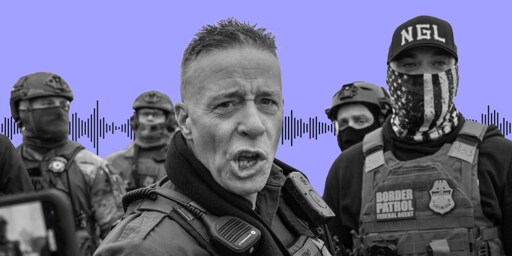
Immigration and Customs Enforcement agent Jonathan Ross fatally shot Renee Good, a 37-year-old mother of three, in Minneapolis last week, unleashing a wave of anti-ICE protests and sentiment throughout Minnesota and the rest of the United States.
On Wednesday evening, federal immigration agents shot and wounded a man in Minneapolis, adding to the tension in the Twin Cities. President Donald Trump threatened to send in troops to crush the unrest.
“What should be very clear to all Americans now is that there is no way to wage war on ‘illegal immigration’ without also waging war on American citizens,” says Adam Serwer, staff writer at The Atlantic.
This week on The Intercept Briefing, host Jessica Washington examines how the Trump administration’s brutal deportation agenda is unfolding in Minnesota, sparking national backlash and renewed demands to abolish ICE; the historical legacy of immigration enforcement in the U.S.; and the administration’s racist vision of reshaping American society.
First, Minnesota Public Radio reporter Jon Collins shares an update on the Trump administration’s siege. “The national audience needs to understand this is not just unrest, this is not just protests. … This is an invasion,” says Collins. “The justification from this administration, the way that they’re portraying what’s happening here in Minnesota — it almost turns on its head how we think about our constitutional rights in this country. Instead of protecting the citizens from the government, what they’re arguing for is protecting law enforcement from any transparency, from any accountability to the people.”
“The biggest organization of terror in this moment is the Department of Homeland Security,” says Rep. Delia Ramirez, who shared exclusively with The Intercept that she is introducing legislation to limit the use of force by DHS agents.
The Illinois congresswoman described the bill as the “bare minimum” to curb DHS’s abuses, calling for Democrats to use the appropriations process to “hold” funding to the agency and ultimately dismantle it.
“Every single Democrat and every single Republican should be able to sign on to this bill,” says Ramirez. “Because it’s basic, bare minimum, and not signing on is indicating that you’re OK with what’s happening on the streets.”
“What we’re seeing today has a long history,” says Adam Goodman, a historian at the University of Illinois Chicago. Federal immigration agencies’ budgets depend “on apprehensions, detentions, and deportations.” That “institutional imperative,” he says, “is going to lead to all kinds of problems, including incredible discretionary authority … and tremendous abuses.”
Serwer points out “the violence that you’re seeing that federal agents are engaging in against observers, against activists, not just against immigrants, is a reflection of [an] ideological worldview. Which is that those of us who do not agree with Donald Trump are not real Americans and are not entitled to the rights that are due us in the Constitution, whether or not we have citizenship.” He adds, “The truth is, a democracy cannot exist when it has an armed uniformed federal agency who believes that its job is to brutalize 50 percent of the country.”
Listen to the full conversation of The Intercept Briefing on Apple Podcasts, Spotify, or wherever you listen.
Transcript
ICE Invades the Twin Cities
Jessica Washington: Welcome to The Intercept Briefing, I’m Jessica Washington.
Since ICE agent Jonathan Ross fatally shot 37-year-old Renee Good last week, the Trump administration has deployed about a 1,000 more immigration agents to the Minneapolis area. That’s on top of the roughly 2,000 federal agents already in the area to conduct the “largest immigration operation ever,” according to Trump administration officials.
Minnesota Sen. Amy Klobuchar: There are like 600 sworn-in officers in Minneapolis, and 550 or so in St. Paul. The ICE agents are literally overwhelming our own police force.
JW: As the city becomes the latest target of the administration, yet again, we see a wave of videos on social media showing heavily armed masked immigration agents tackling, dragging, shoving, and intimidating people.
Sound of tape from ICE arresting Jose Roberto Beto Ramirez: [Whistle sounds] Let them scan your face. … Why did you hit him? No. [Screaming.]
Sound of tape of federal immigration agents tackling Target employee:
Unknown speaker: What’s your name?
Johnny Garcia: Johnny Garcia. Jonathan Aguilar Garcia. … I’m a U.S. citizen.
Sound on tape of ICE carrying a woman from her vehicle: I’m autistic, and I have a brain injury! Put me down! I was just trying to get to the doctor …
Sound on tape from Noah and Judy Levy’s ICE encounter:
Unknown agent: Hello, Judith.
Judy Levy (SOT): Do not threaten me. … God bless you.
Judy Levy: And as more people started showing up and people were honking their horns and making a commotion, they started driving away. So we started following, and they led us to our house.
JW: That last clip is of Noah and Judy Levy, a St. Paul couple who were observing Immigration and Customs Enforcement agents. The Levys were speaking to Minnesota Public Radio reporter Jon Collins. He joins me now to talk about the latest from the Twin Cities.
Jon, welcome to The Intercept Briefing.
Jon Collins: Thanks so much for having me,
Jessica Washington: Jon, we just heard a clip of your interview with a couple from St. Paul, Minnesota, telling you about their encounter with immigration agents on the street the day before Renee Good was killed. Can you tell us more about that interaction?
JC: We had heard many different accounts from observers that they were being intimidated by ICE and other federal agents. And so I tried to track down some of the people who had direct experiences with it, and these are some of the folks who were willing to talk on the record.
They told me they went out. They heard there was a caravan of ICE agents staging in a vacant parking lot near their home. They went out with other neighbors. What typically happens happened — which is that the ICE agents stopped the observers, they surrounded the cars, they started yelling at them, they threatened them with arrest, that sort of thing. But the Levys, in this particular case, after this incident, after they were stopped, kept following. And one of the officers had come up to Judy’s window and scanned her license plate, took pictures of her, of course, and then said, “Hello, Judith.”
So that’s when they first realized that the feds were using some sort of tool to identify them, but they didn’t know the extent of it because as they continued to follow this ICE caravan, the ICE caravan drove onto their street. And they have video showing ICE agents out in front of their house.
[
Related
LexisNexis Is Selling Your Personal Data to ICE So It Can Try to Predict Crimes](https://theintercept.com/2023/06/20/lexisnexis-ice-surveillance-license-plates/)
At that time, they were advised by other observers to go to a safe place. But they were shocked that ICE agents were somehow able to access their private data in order to — what they saw as — intimidate them.
JW: Have you investigated other stories that are similar? Are there other types of surveillance happening in Minneapolis that you’ve encountered?
JC: There’s certainly a lot going on especially since the surge here started, the ICE surge, started in December and that had fewer agents, but they’ve been sending more and more agents here. There’s all sorts of allegations of different tools that ICE agents are using to identify people.
Facial scanners is one, and that’s both for immigrants, that they want to look in their database and see if they’re wanted for any immigration violations — a civil violation, again, not a criminal violation. But also for citizens. So that will be observers, that will be bystanders.
And what people are alleging is that ICE uses this information. And remember, ICE are masked agents, they’re not identified, they don’t typically almost ever have a badge or a number or anything really that holds them accountable — including what agency they’re a part of.
DHS, we know, the Department of Homeland Security, has many different federal agencies under its auspices. Not all of the folks on the street are ICE. And in fact, Border Patrol has showed up in force recently, and they have quite aggressive tactics even compared to ICE. So people have been reporting concerns about federal agents accessing their private information and using all these technologies for weeks now.
And I should say, Homeland Security does not respond to requests for comments. They don’t respond to media questions, and they will not deny or confirm or even acknowledge what tools agents might be using. It’s really a black box, and it causes a lot of concern for privacy advocates.
JW: Yeah, that’s a really good point: The conflation of agents in the street and a lot of confusion and focus on ICE. I was hoping you could give us a little bit of background on why they’re in Minnesota in the first place.
JC: What people are saying is that Minnesota is the home of Gov. Tim Walz. He was the vice presidential candidate who ran against Donald Trump. And people are saying this really fits the pattern that we see across the country of retaliation, using the power of the federal government — in this case, it would be federal agents and immigration enforcement — to retaliate against political enemies.
Minnesota, I should say, is kind of a blue state. It can be relatively close. We don’t have any statewide elected Republican officials, and we haven’t in many years. So in the Midwest, folks will say, we are a pocket of blue surrounded by red. People see some sort of action from the federal government as retaliation for not being loyal enough to the president, essentially.
[
Related
Right-Wing YouTuber Behind Viral Minnesota Fraud Video Has Long Anti-Immigrant History](https://theintercept.com/2025/12/31/nick-shirley-videos-minnesota-somali-day-cares-fraud-claims/)
Then there have been things in the news about fraud that people see being used as a pretext to come to Minnesota to demonize Somali Americans who have been a longtime community here. That is alarming to a lot of people, because Somali Americans — the vast majority are U.S. citizens.
So when ICE agents are driving around town, masked-up, in very small groups, and grabbing Somali Americans off the street, the vast majority of them, the people being hassled, are U.S. citizens. So people think that the pretext of immigration enforcement is just that it’s a pretext. And what they really want to do is enforce some sort of political orthodoxy on the state of Minnesota and on the people here.
JW: I want to get into the reaction from people in Minneapolis and in the Twin Cities in general. Thousands of people have taken to the streets, protesting against the presence of ICE agents after an officer fatally shot Renee Good, a mother of three, who was acting as a neighborhood observer.
Jon, what have you been hearing from residents about how they’re responding to the shooting and to ICE’s, and as you’ve pointed out, larger federal agencies’ presence within the city?
JC: I think one thing a national and international audience needs to understand is what we’re seeing here is not like what happened after George Floyd here and in other places around the country. Of course, there have been vigils after Renee Good was shot and killed by an ICE agent. Of course, there was a vigil of 10,000 people in the neighborhood, and there have been protests. There was 20,000 people a mile from here over the weekend.
But most of what is happening is not what we think of as “protests.” It’s not clashes between protesters and federal agents. What is happening is we have groups of masked armed federal agents, not identifying themselves, roving around the cities in caravans — and then we have neighbors, some activists, but also many normal people.
“Most of what is happening is not what we think of as ‘protests.’ It’s not clashes between protesters and federal agents.”
One person who’s been working with these folks describes it as “normie Target moms.” Essentially these are folks, just normal people who are coming out of their houses when they hear the whistling, which is the signal that folks use to alert the neighborhood that ICE is around. When they hear honking, they’re coming out, they’re trying to use their constitutional rights to observe law enforcement.
Most of the instances where you see someone being pepper-sprayed, someone being tased, ICE agents breaking a window and pulling an observer out of a car — those are not protest situations. That is a response from the community that is trying to, they say, keep their neighbors as safe as possible at a time when we have thousands of these agents in our communities.
I just want to say really quickly that this is not just in the core cities of Minneapolis and St. Paul, the Twin Cities. This is not just in the lefty neighborhoods in Minneapolis and St. Paul. This is happening all over the state. The enforcement is happening all over the state, and then the response is happening all over the state.
When ICE agents conduct some sort of action in a place like St. Cloud, Minnesota, a small town, the neighbors are coming out in the same way that they’re coming out in the core cities of Minneapolis and St. Paul, because these are the folks who work at their coffee shops, they work at their restaurants, they’re co-workers, they’re friends.
So this enforcement action is so broad and unprecedented, and folks across the state are really trying to meet peacefully and observe and use their constitutional rights to express their opposition to what’s being done to this state.
JW: I think for many of us who watched that video of ICE agent Jonathan Ross shooting Renee Good, watched it from multiple different angles. It evokes a lot of fear. And I guess my question is, from what you’re seeing, is the anger and the love for their neighbors — is that outweighing the fear in people right now?
JC: What’s shocking to me is, every time I talk to someone who say they were an observer, they got taken down in 20 below weather kept on the ground, handcuffed, dragged away, brought to detention, all these different circumstances — everyone I talk to says what they see as harassment and intimidation that they experience only makes them more resolved to go out and use their constitutional rights to observe what’s happening and express opposition to it.
JW: I want to talk about some of those violent incidents that you’ve documented. Federal agents in Minneapolis and throughout Minnesota have violently clashed with protesters throughout the week. What can you tell us about these interactions and how they’ve been playing out in the state?
JC: It’s all over the Twin Cities specifically, but all over the state. And typically what’s happened is ICE agents will go around in a caravan. It’s not clear that they have, for the most part, any actual enforcement plan, but they’ll drive around.
“It’s not clear that they have, for the most part, any actual enforcement plan.”
It just happened down the block here. Two people were detained by ICE at a bus stop, and observers show up because typically they’re trailing these officers trying to keep tabs on what they’re doing.
They will let their networks know. They use Signal and other apps to communicate with other folks in the community, and they will start honking. They’ll blow their whistles. And people from all over the city or all over the neighborhood will show up and express their opposition to it. So some people are recording, some people are yelling, but for the most part, people are not impeding law enforcement.
But the clashes that we see are when, typically, ICE decides “OK, people are too close,” or “We want to get out of here.” Or many people have told me stories that they don’t even know why an ICE agent was acting in a certain way. The Minneapolis City Council president was out on a scene the other day, and video captured ICE agents — for no reason — just pushing him as hard as they could. And they pull out pepper spray and randomly use that.
The City Council president told me there’s an officer just running around, putting his Taser to people’s chests or to people’s arms, threatening them. Not for any security reason, not from what we can tell, any reason connected to their job. But because there is no accountability for these ICE agents.
They know they’re not going to be disciplined. They’re clear with a message from the administration — from the top down — that anything they do, including, the shooting of a mother of three in the face, is going to be defended by the administration. So there’s a sense that they’re acting without accountability and that, that is really inspired by a lot of the rhetoric that we hear coming out of this administration.
“Anything they do, including, the shooting of a mother of three in the face, is going to be defended by the administration.”
JW: Where are city and state officials in all of this? What efforts have we seen from local representatives to push back on DHS in their state and in their cities?
JC: So Minneapolis and St. Paul have both had separation ordinances for a while that blocks the city agencies and officials from cooperating with federal immigration enforcement. And that includes the police in both cities.
They have found themselves, in the cities, in a very strange situation because you have essentially all these unaccountable masked, mostly anonymous, federal agents running around town — some who are using excessive force on citizens and on immigrants they’re trying to detain. And the police, for the most part, have steered clear of showing up to those scenes.
The police chief has said, if you see them, call 911, but police so far have not intervened on the side of citizens or protesters. That’s why so many of the observers who are out there say, “It’s our responsibility to put our bodies on the line to go out there, because the state’s not going to come out and protect us. The local law enforcement that we pay is not gonna come out and protect us.” So they say, “We need to protect us.”
And I should say much of the infrastructure for this movement of observers and ICE watchers came out of protests after George Floyd was killed in 2020. Many of the neighborhood groups that were formed in places like my neighborhood — the WhatsApp channels, the Signal channels — were ways that our neighbors communicated with one another to set up things like patrols when police were not patrolling our streets, to make sure that arsons did not happen in our neighborhoods.
So these really evolved into ways that people organized the resistance to this current push by the administration here. And people are really of the opinion that the national audience needs to understand this is not just unrest, this is not just protests.
An attorney I talked to just a few minutes ago said, “This is an invasion.” And people need to understand the scale of it: 3,000 law enforcement agents — that’s about 1 for every 1,000 residents.
JW: Before we go, any final thoughts?
JC: The justification from this administration, the way that they’re portraying what’s happening here in Minnesota — it almost turns on its head how we think about our constitutional rights in this country. Instead of protecting the citizens from the government, what they’re arguing for is protecting law enforcement from any transparency, from any accountability to the people.
[
Related
ICE Agents Deserve No Privacy](https://theintercept.com/2025/07/01/masked-ice-agents-victimization-accountability/)
We have ICE agents who they say they’re afraid are being doxed, which is not a legal term, of course. But we have a principle in this country that officials, we should know who officials are. We’re vesting them with authority; we’re vesting them with power. Therefore, the trade-off is we say, OK, we should know who these people are. We should be able to hold them accountable when they abuse these fundamental rights that are happening. But this administration has turned the Constitution on its head.
We see this in Renee Good’s killing too, where they are saying that citizens, instead of being given these constitutional rights as just an assumption, that citizens need to earn their constitutional rights by acting appropriately, by respecting law enforcement, by not yelling at law enforcement.
And that is just the opposite of what our traditions here are in the United States. I want the national audience to understand that that’s what’s happening here. It’s not just clashes between protesters and ICE; it’s an attack on basic rights that we’ve taken for granted.
JW: Thank you so much for that update, Jon.
JC: Thanks for having me.
Rep. Delia Ramirez on Her Efforts to Stop DHS Violence
JW: Wednesday evening protests erupted in Minneapolis after ICE shot a man, hitting him in the leg. President Donald Trump threatened to invoke the insurrection Act and send troops into the city to crush protests.
Next, I speak to Democratic congresswoman of Illinois, Delia Ramirez, who is introducing a bill that will limit the use of force by Department of Homeland Security agents. This is our conversation.
JW: Can you walk me through the bill that you’re introducing and why?
Delia Ramirez: The bill that I’m introducing, Jessica, is called “The DHS Use of Force Oversight Act.” And it’s a bill that actually codifies that the Department of Homeland Security must have a use of force policy that really also focuses on deescalation.
What you and I have been seeing around the country — not just last Wednesday — since the Trump administration took power is this brute, savage attack of our communities and this undermining of rule of law by ICE agents.
[
Related
New Bill Would Put Basic Limits on ICE Use of Force After Minneapolis Killing](https://theintercept.com/2026/01/15/ice-bill-violence-minneapolis/)
Because in reality, there isn’t any real use of force policy that is being followed by this administration. After what happened on Wednesday, so many of us knew that a use of force policy needed to be codified from this body as quickly as possible, which is what this bill does, but it’s not just creating a policy. It also clearly and consistently specifies that there has to be deescalation as the preferred method of engagement.
And I think the second piece of it, Jessica, that I think is so important, is that it also establishes a review committee to ensure that agents are in fact being trained. You and I both know — we have no idea where these agents are coming from. Have they been with the agency for 10 years? Did they get hired last week at one of their little gatherings that they do or via online? They’re not really doing background checks. So this actually establishes a review committee, making sure that agents are in fact being trained and following the techniques that promote public safety over violence and harm.
And then the third part of it: It requires DHS publish a report every six months, including the data of every use of force incident for transparency and accountability. We know that even under the Biden administration in 2023, the GA under-reported many incidents within the administration then. So for us, it’s really important that we’re doing it every six months and that that report is being published for us to be able to see what in fact is happening on the ground.
JW: What does the agency currently say about use of force and what agents are allowed to do and what accountability metrics do exist?
DR: I would say that most of us would argue that there’s no accountability metrics right now. That what ends up happening is, an agent harasses, beats, shoots, and kills an individual — whether it’s Silverio Villegas-Gonzalez in Chicago, or Renee in Minnesota — and then immediately what you’re seeing in terms of use of force policy is whatever Donald Trump puts on Twitter. Or whatever lie DHS is putting on their own social media platforms, which is some BS argument identifying a victim as a domestic terrorist and then justifying whatever the agent did.
“What you’re seeing in terms of use of force policy is whatever Donald Trump puts on Twitter.”
We know that there are some protocols, specifically protocols like an agent does not get in front of a moving vehicle. An agent is not supposed to shoot at a moving vehicle, especially if it knows the person driving does not have a weapon. There’s a lot of that. But when you actually talk about how they’re supposed to engage, there’s not really a use of force policy being enforced.
We know that in 2023, under [Alejandro] Mayorkas, the administration itself had begun discretionary accounts to establish some use of force policy. But also we know that when we leave it to the administration, this administration, whether it is the president’s administration or the Department of Homeland Security under Kristi Noe — whatever’s internal changes immediately as needed for them. Which is exactly why for us, we need to codify what that actually looks like by Congress, and then we have to have the systems in place to ensure that they’re following protocol and then getting the reports when in fact they’re violating it, so that we can ultimately hold them accountable.
JW: You know the abolish ICE movement has started to pick up some steam, is it enough to restrain ICE from using excessive force, or is more needed?
DR: Look, this bill here, “The DHS use of Force Oversight Act” bill, in my opinion, is the bare minimum. It’s basically stating that like every other law enforcement entity, there must be a use of force policy that is not just in the books but trained, implemented, and used for accountability in the future. The bill itself has a number of details, right? Use only the amount of force that is objectively reasonable. We can argue back and forth what that means. It clearly and consistently specifies that deescalation is preferred, and they should really move and create the tactics for deescalation. It requires law enforcement officers to complete initial required training, which we know agents are not doing now. Prohibition of chokeholds, and the list goes on with this policy.
“This is not controversial. This is what every other enforcement agency is using.”
So when I say that to you, what I mean is, this is not controversial. This is what every other enforcement agency is using, and ICE or CBP, since they’re entering our cities, should not be excluded from it. And I mean that every single Democrat and every single Republican should be able to sign on to this bill because it’s basic — bare minimum. And not signing on is indicating that you’re OK with what’s happening on the streets.
Now let’s separate from a very specific policy reform that I’m looking at through this bill. I still think that we need to hold the administration accountable. I still think that members of Congress need to use the appropriation process right now to ensure that not one more dollar goes to this agency without significant concrete policies.
[
Related
Federal Agents at Protests Renew Calls to Dismantle Homeland Security](https://theintercept.com/2020/07/30/dismantle-homeland-security/)
You know that for me, ultimately, what I want to see is defund ICE. Ultimately, what I really want is to start dismantling the Department of Homeland Security. It has not been around that long. It’s been 20 something years that they’ve been around. It was formed after 9/11, and ICE enforcement was happening under other purviews, and so was other entities like the Coast Guard. And then TSA, of course, as we know, was created after that as well.
This agency was designed, created intentionally in this particular way so that it gives them the massive latitude necessary to do whatever they want in the name of protecting us from domestic terrorism. Which is why strategically you hear Kristi Noem, the president, Tricia [McLaughlin], the assistant secretary, all calling victims — victims attacked and harmed by ICE — domestic terrorists. Because as long as they can call them domestic terrorists, they think that they can have impunity, qualified immunity, and kill and then lie about it.
So what that means is, I want to use the appropriation process to hold money from DHS. I want to see real reforms long-term. I want to work on dismantling DHS. We need to impeach Kristi Noem, and then we need to hold her accountable as well.
“This agency was designed … so that it gives them the massive latitude necessary to do whatever they want in the name of protecting us from domestic terrorism.”
JW: Why do you think that your Democratic colleagues are so resistant — in many ways — to tackling this issue in a broader way? We’ve obviously seen resistance to abolish ICE, to defunding DHS. What do you think that resistance is based in?
DR: Jessica, I think sometimes the resistance is based on fear, and this moment shows us that our constituents are demanding moral courage and moral clarity. If our responsibility is to represent our constituents, — whether it’s in Chicago, in New Orleans, in Louisville, Kentucky or if it’s in Portland, Oregon, and the list goes on — it’s to represent them, to fight for every single resource they need to thrive, and to protect them and uphold the Constitution.
Department of Homeland Security has demonstrated lawlessness. They’re operating unaccountable. They’re violating the Constitution. And they are creating chaos and fear and potential death in every single city that they walk into.
“The biggest organization of terror in this moment is the Department of Homeland Security.”
And so my colleagues have struggled with the fear, of what does that mean? Does this mean open borders? What does this mean? Are constituents going to vote me out because I’m being critical of an agency that was created after 9/11? Am I not demonstrating that I’m defending them from terrorism? Well, the biggest organization of terror in this moment is the Department of Homeland Security.
We are not where we were in 2018. The movement is not where it was in 2018. Thirty-five people have died under the Department of Homeland Security since Donald Trump became president again last year. A U.S. citizen was shot in the face three times, and they’re threatening to kill all over the country and then lie about it.
[
Related
Kat Abughazaleh on the Right to Protest](https://theintercept.com/2025/11/01/briefing-podcast-kat-abughazaleh-indictment-protest/)
When 46 percent of consistent polls of U.S. citizens are talking about abolishing — not even defund, abolishing — it really forces members of Congress to ask themselves, “What are we doing about this agency that is lawless and creating fear and killing people around the country in the name of protecting us from the threats to the homeland?” And so I really think that this is a moment of real moral reckoning for my colleagues, whether they’re Democrats or Republicans.
This agency isn’t operating FEMA the way it needs to. It’s not providing the resource and supports the Coast Guard needs in the way it needs to. It’s actually taking their money and moving them to ICE enforcement. They’re sending these ICE agents untrained, sending them to create the kind of havoc, the kind of chaos into cities that people are worried and fearful of leaving their home for.
And at the same time, they’re giving all these contracts to Donald Trump’s campaign donors so that they can become filthy rich at the expense of imprisoning and letting human beings die in prison.
So, yes, things may have felt different, and maybe they were in some ways, but some of us knew that this agency — in its inception — was created to do what it’s doing now. It is the biggest threat to the homeland, and we need to dismantle it immediately.
JW: Those were all of my questions, but is there anything that I didn’t ask you that you wanted to say?
DR: You heard me talk a lot about the Department of Homeland Security, how it was created. I think more and more of us are going to start talking about what this means. Of course, we need to fund TSA; of course we need to fund the Coast Guard. FEMA needs resources. And we’ve seen what happens when negligent leaders like Kristi Noem are at the helm of DHS.
[
Related
The Questionable Case of Kristi Noem’s $50 Million Luxury Jet](https://theintercept.com/2025/05/20/kristi-noem-coast-guard-50-million-gulfstream-luxury-jet/)
There are ways to fund these important programs, but they can’t be funded under an agency that steals the money from these programs and puts them to put these criminals on the street, these thugs on the street to kill our constituents and American citizens. So where there’s a will, we create the solutions, but we have to have the will to do that.
[Break]
Journalist Adam Serwer and Historian Adam Goodman on How Trump Is Unleashing His Partisan Militia on Immigrants and His Ideological Enemies
Rep. Alexandria Ocasio-Cortez: The cuts to your health care are what’s paying for this.
JW: That’s Rep. Alexandria Ocasio-Cortez speaking to reporters earlier this week.
AOC: So understand how these dots connect. You get screwed over to pay a bunch of thugs in the street that are shooting mothers in the face.
**JW:**Back in 2018, the then-House candidate won the New York City Democratic primary on a progressive platform that included calling for abolishing ICE. In response to Trump’s first term policies — such as family separation — the movement gained modest momentum among Democrats. But it was largely seen as too risky and too radical to completely eliminate the agency.
Now though the calls to abolish ICE are back — perhaps stronger than ever as the Trump administration’s violent immigration raids terrorize communities across the country.
Could backlash to Trump’s deportation agenda actually lead to real change? Joining me now to break it all down are two guests.
Adam Goodman is the author of “The Deportation Machine: America’s Long History of Expelling Immigrants.” He’s a historian at the University of Illinois Chicago.
Welcome to the show, Adam Goodman.
Adam Goodman: Thank you, Jessica.
JW: Also joining us is the author of “The Cruelty is the Point” and staff writer at the Atlantic, Adam Serwer.
Welcome to the show Adam Serwer.
Adam Serwer: Thank you so much for having me.
JW: According to polling from The Economist and YouGov, more Americans support abolishing ICE than keeping it. Adam Goodman, I want to start with you. What do you make of this shift?
AG: One of the things that’s really interesting about public opinion polling on immigration is that it’s held pretty consistent over time of U.S. citizens and people in the country being in favor of immigrants. It was a relatively recent shift in the lead up to the 2024 election against immigrants and against ongoing immigration, in part because of the campaign that Donald Trump launched to scapegoat immigrants — use them for his own political gain. And what we’ve seen since Trump has come into office in the past year is that public opinion polling has shifted again, and response to the cruelty and response to the really draconian actions that the administration has taken against not only immigrants, but also citizens and permanent residents and many others.
JW: Adam Serwer, I want to turn to you. Does this type of polling change the political calculus for Democrats when it comes to either reining in or abolishing ICE altogether?
AS: [Sighs.] That question is difficult to answer because you’d have to ask the Democratic Party, but the reality is that this is a paramilitary armed force that is essentially a partisan militia that is being deployed as an armed force, that is at war with the parts of the country that did not support Donald Trump as much as he deems necessary.
So we talk about ICE in the context of immigration, but I think as we’ve seen over the past few weeks, ever since these deployments started, this is really a war against the “blue” parts of the country. And I hesitate to describe them that way because that’s really un-nuanced. The fact is, the country does not look like an electoral map in terms of, every community has both types of people in it.
“These people have a definition of American that excludes people who do not agree with them ideologically.”
But fundamentally this is not really about immigration. And it’s not just about immigration in the sense of who is a citizen and who is not. These people have a definition of American that excludes people who do not agree with them ideologically. And so the violence that you’re seeing that federal agents are engaging in against observers, against activists, not just against immigrants, is a reflection of that ideological worldview. Which is that those of us who do not agree with Donald Trump are not real Americans and are not entitled to the rights that are due us in the Constitution, whether or not we have citizenship.
JW: I want to push on this a little bit more. As you’ve said, there’s essentially a war on blue states, and it’s more complicated than that. But why do you think we’re not seeing Democrats push really hard against that, against not just this war on immigrants, but as you pointed out, this war on states where they’re in power?
AS: Not just states, cities. They sent ICE, federal agents to Memphis. I hesitate to say ICE because people say ICE when they both mean ICE and the Border Patrol. These are essentially people who are used to the subjects that they’re dealing with treating them as non-persons. So it’s not really a surprise that they’re also treating citizens as non-persons because we have given them license to treat immigrants, essentially as non-persons with no rights they need to respect. And so now that they’re treating Americans who are perceived as liberal that way.
“Most Americans have been alive longer than ICE has existed.”
I think Democrats are apprehensive because the backlash against the 2020 Black rights protest was so profound in the “anti-woke” backlash, which I believe was really driven by anti-integration sentiment in white-collar workplaces — in particular, in the public-facing jobs like the media.
They are concerned with the agenda-setting power of the American right and the reactionary elements within the media industry to define the terms of debate. So if they go against ICE, which has not existed for very long — most Americans have been alive longer than ICE has existed — they’re concerned that they’re going to be dealing with another “abolish the police” backlash. But the truth is, a democracy cannot exist when it has an armed uniformed federal agency who believes that its job is to brutalize 50 percent of the country.
“They are concerned with the agenda-setting power of the American right and the reactionary elements within the media industry to define the terms of debate. ”
AG: What we’re seeing now is also a result of the Democrats’ inaction and actually decision to avoid immigration, in part as a result of the polling. To go back to your first question, the polling that the Biden administration followed and that other administrations before Biden on the Democratic side followed, was that immigration was a toxic issue, it wasn’t going to help them come election time. And kind of they ignored it — hoped it would go away. The Trump campaign and the administration has capitalized on that since.
But I think there’s actually an opportunity here for Democrats to stake out some new ground. I mean, if there was ever a chance for Democrats to stake out new ground, it was 2016 and then again 2024, to distinguish themselves from the Trump administration. They did that to an extent on the campaign trail. But after assuming power, Joe Biden kept at arm’s length when it came to immigration. And that was a missed opportunity, I think, for all kinds of reasons — political, certainly, but also moral and ethical.
One thing I’ll just add, a brief anecdote, is that I had a chance to speak with a group of about 20 congressional Democrats in 2020. And this was the height of the protest for Black Lives Matter after the killing of George Floyd and the Abolish ICE, abolish the police movement.
[
Related
Ruth Wilson Gilmore Makes the Case for Abolition](https://theintercept.com/2020/06/10/ruth-wilson-gilmore-makes-the-case-for-abolition/)
And I mentioned just the word “abolition” or “abolish,” and was quickly shut down by the group. And I think that’s actually both understandable on the one hand from an elected official who sees that there’s no political possibility there, but a real miscalculation and that we’ve seen how far things have moved to the restriction side of the ledger.
We’ve seen what’s politically possible now. And how what was seen as extremist in the past is now a centrist opinion when it comes to immigration. So if we’re ever going to move back in the direction of a more humane immigration policy in this country, I think that we need more radical ideas on the table — regardless of whether or not they come to fruition.
AS: Yeah, I think it’s important to remember the immigration situation when Joe Biden took office was that there was a surge in migration at the border because of the post-Covid economic recovery, which in the United States was the strongest in the Western world. And so you had a big demand for labor, and you had a lot of people who, for other geopolitical reasons, wanted to come here and work.
That created an anti-immigrant sentiment that, along with, what they call thermostatic public opinion, that provided an opportunity for the Trump administration. I’m not a campaign adviser, I can’t give political advice in that sense. But I think what should be very clear to all Americans now is that there is no way to wage war on “illegal immigration” without also waging war on American citizens.
“There is no way to wage war on ‘illegal immigration’ without also waging war on American citizens.”
And they understood that from the beginning. And that’s precisely why they wanted this war in the first place, because they wanted to reshape the country in a very narrow right-wing image of what an American is — which is a white Christian conservative, with a few token minorities who will provide an alibi for the racial nature of their redefinition of American citizenship.
[
Related
Trump’s Cult of Power Cancels Free Speech](https://theintercept.com/2025/09/19/briefing-podcast-charlie-kirk-trump-right/)
But the truth is that they consider anyone who is ideologically opposed to them an enemy, and that that person can be subject to violence — political violence at the hands of armed agents of the state. And you could see that in the way that they’re talking about Renee Good in the aftermath of her shooting by a federal agent saying, she was an agitator, or she was an activist, or she was protesting.
“Their mandate is to terrorize communities that they see as insufficiently pro-Trump.”
What that means is if you express the wrong ideological views or you act on the wrong political views, the state has a right to execute you. Now that is not freedom