


Darren Thompson
Special to ICT
PHOENIX — From the Colorado River agreement to border security, Arizona tribal leaders joined the state legislature, Gov. Katie Hobbs and other officials to discuss a wide range of issues, recognize Indigenous contributions to the state, and strengthen the government-to-government relationships on Wednesday.
The discussions and celebration were part of the 31st Indian Nations and Tribes Legislative Day, and organized by the Governor’s Office on Tribal Relations. The annual event is held on the first Wednesday of the first week of the state’s legislative session in January.
Gov. Hobbs delivered the State of the State with tribal leaders from 22 tribes at the Inter-Tribal Association of Arizona’s annual legislative breakfast at the Heard Museum in the morning before the legislation day event at the state capitol.
“This historic moment reflects our shared commitment to partnership, respect, and building a stronger future together,” Gov. Hobbs said.
After the closed meeting at the Heard Museum, a joint protocol session convened at the Arizona State Capitol, where both Chairman Timothy Williams of the Fort Mojave Tribe and Chairman Verlon Jose of the Tohono O’odham Nation delivered the tribal nations address.
“Like our ancestors before us, we have had to stand strong to protect tribal sovereignty and to preserve our languages, and traditions, our ceremonies and our way of life,” said Fort Mojave Tribal Chairman Timothy Williams in his address. “And while we have had to endure many hardships and challenges and maintaining control of our lands, our water resources, our sacred sites, and our status as sovereign nations. We know that it is through political forums like this, that we can continue the effort to work together or the advancement of the entire state of Arizona.”

Tribal leaders from each of Arizona’s 22 federally recognized tribes convened at the Arizona State Capitol on January 14, 2026, in Phoenix for the 31st annual Indian Nations and Tribes Legislative Day. Credit: Darren Thompson/Special to ICT
The Fort Mojave Tribe is located in eastern Arizona, along the Colorado River, and has land in California, Nevada and Arizona, where the tribe has senior water rights in each state. Climate change and population growth has contributed to significant drought, Williams said, and protecting the river is vital to many tribal nations.
“As tribal leaders, we have had the ultimate responsibility of providing for the welfare of our tribal members,” Williams added. “That responsibility begins with water. As tribes, we have our own laws, traditions, and responsibilities that guide how we manage and respect our natural resources. The Colorado River, not only, not only a source of water for our people, it is a lifeline for many tribes.”
A permanent Colorado River water agreement is currently being negotiated among several states and tribes who rely on the river and is expected to be finalized by the end of the year.
On Jan. 9, the Bureau of Reclamation published draft operational guidelines and environmental reviews for public comment. The agreement aims to establish new rules to replace expiring ones, as states disagree on mandatory cuts of water usage, balancing existing agreements (like the 2023 Lower Basin conservation deal) with long-term climate realities.
A final deal is expected by the end-of-2026 deadline, or the federal government may impose management, but states prefer a cooperative solution.
The formal public review and comment period begins on Jan. 16 after publication in the Federal Register Notice and ends on March 2.
Tohono O’odham Nation Chairman Verlon Jose spoke of communities working together especially when it comes to homeland security and the contributions of Indian gaming to the state economy.
“It’s okay to have differences. This place right here is a sacred place. I believe that we are stronger together. We collaborate when we build bridges and not walls,” he said.

Youth bird dancers from the Quechan Indian Tribe presented traditional dance on the plaza of the Arizona State Capitol on January 14, 2026, in Phoenix for the 31st annual Indian Nations and Tribes Legislative Day. Credit: Darren Thompson/Special to ICT
He continued: “Every emergency room and more have benefited from tribal gaming … Thousands of Arizonans have jobs created directly and indirectly by tribal gaming operations. And at the same time, gaming dollars that provided tribes with resources that simply would have not been available otherwise.”
Since the Arizona Tribal-State Gaming Compact was introduced in 2003, tribal casinos have contributed more than $2.3 billion to the Arizona Benefits Fund, which supports education, emergency services, wildlife conservation, and tourism.
Last year, tribal gaming contributed more than $43 million to the state, and more than $28 million was earmarked for education. Tribal gaming also provides more than 15,000 direct jobs, and tribal casinos are often the largest employer in many counties throughout the state, especially in rural communities.
The Tohono O’odham Nation has the second largest Indian reservation in the state and has more than 37,000 enrolled tribal members with 3,000 living in Mexico, Jose said. The tribe’s southern exterior boundary spans 84 miles along the United States and Mexico border and the tribe spends more than $3 million on border security each year.
“Our people are the first line of defense,” Jose said. “Those things that come — the migrants and drugs — they’re not coming to the Tohono O’odham Nation, they’re coming for the sounding cities and towns of America. If we want to get a hand on a drug epidemic in America — it’s not in other countries — America needs to kick our drug habit, right here at home.”
The event brought hundreds of tribal advocates to the Arizona State Capitol, and the session was filled to capacity in the House of Representatives chamber room. Floor privileges were reserved to tribal leaders to join their representative during the session, and others were seated on the observation level.

Priya Simpson, Miss White Mountain Apache Tribe Queen, is the first military veteran to serve as the tribe’s pageant queen. Credit: Darren Thompson/Special to ICT
The session opened with a posting of colors, led by Tohono O’odham women veterans, the pledge of allegiance led by Miss Indian Arizona Sialik King of the Salt River Pima-removedpa Indian Community and opening remarks by Speaker of the House Steve Montenegro and President of the Senate Warren Petersen.
Gov. Katie Hobbs appointed Dr. Laura Tohe, a Navajo Nation citizen from Fort Defiance, Arizona, as the state’s new poet laureate on Wednesday. Dr. Tohe is the state’s second poet laureate and also the state’s first Indigenous poet laureate.
She read a few poems to the audience and said, “I look forward to sharing and supporting poetry in rural communities that inspire the power of poetry and celebrates our human experience with language, voice, and reflection.”
After the session, a lunch was served by Emerson’s Fry Bread on the capitol plaza with music provided by Shawn Martinez, also known as DJ Tribal Touch and an official NIKE N7 DJ, and Gertie who is a Tohono O’odham waila musician and the T.O. Boyz from the Tohono O’odham Nation.
Hundreds of people visited, danced, and celebrated community.
“It was an amazing day with all our relatives today!” Martinez, Navajo, told ICT. “Great weather, great food, great music and great vibe from start to finish!”
“The day is a history in the making, honestly,” said Priya Simpson, Miss White Mountain Apache Tribe Queen. “It is beautiful to see that our leadership at the legislative level, both at the House and that the Senate, are caring about our Native American communities and our people today.”
The 22-year-old continued: “Not only do that is that they recognize that change needs to happen, and through that change, they’re reaching out to tribal leaders, tribal politics, even us royalty as public figures.” Simpson is the tribe’s first veteran to hold the title.
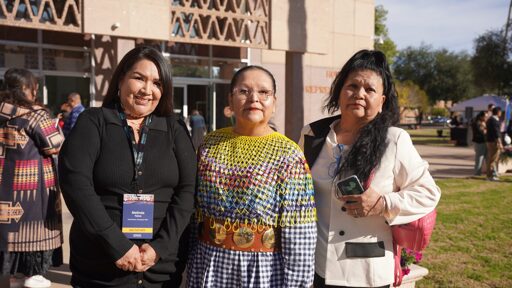
Havasupai Tribal Chairwoman Melinda Yavia said the event was “eye-opening” as a newcomer. She was elected to chair of the tribe in December 2025.
“This was a very teachable moment to me, to see the power and influence we have as tribal nations,” she told ICT. “To hear from our great tribal leaders, to know what steps that we can take to empower our people, is a tremendous blessing.”
The post ‘Stronger together’: Building bridges between Arizona and tribes appeared first on ICT.
From ICT via This RSS Feed.