


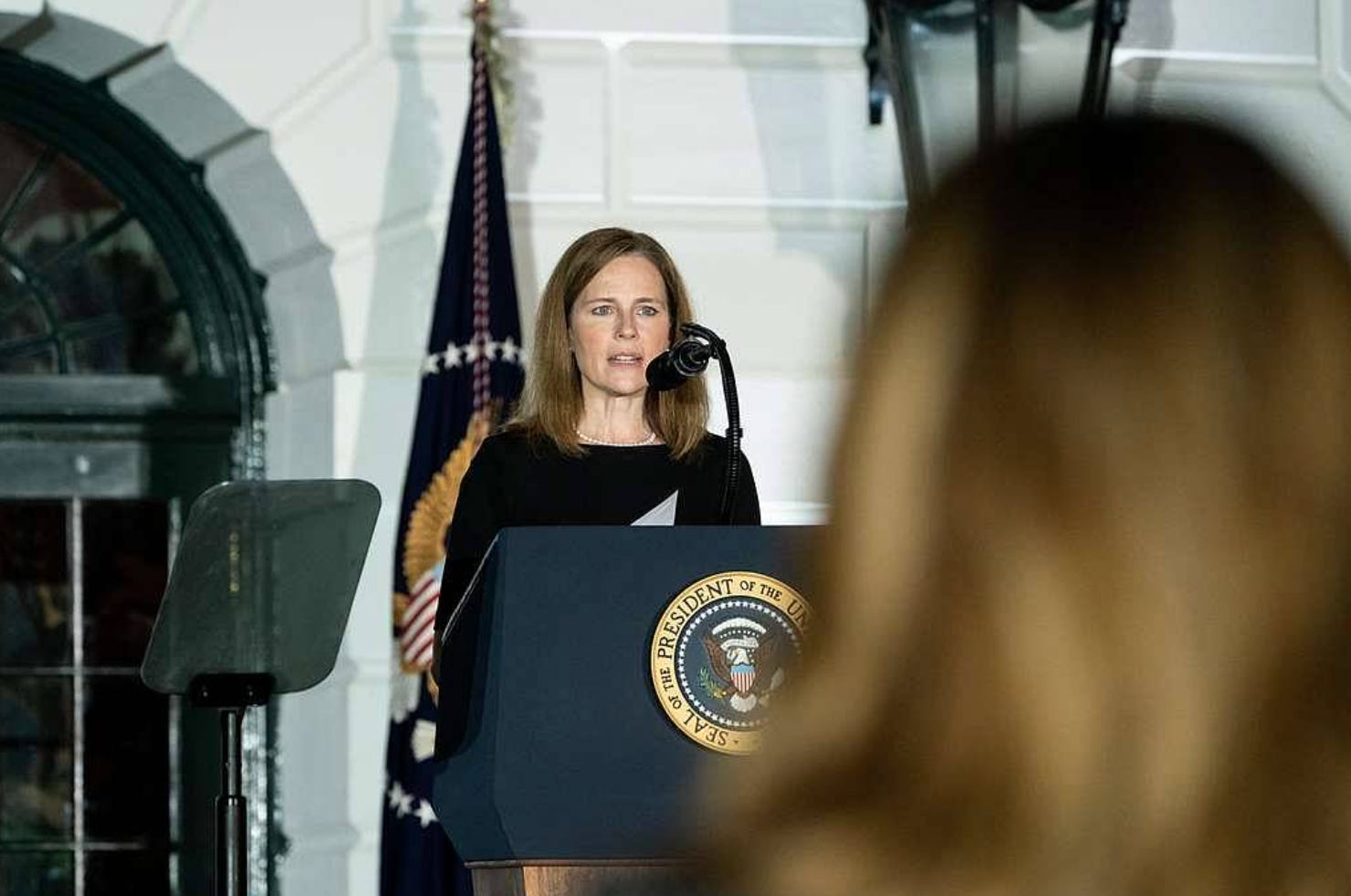
Wikimedia Commons
Erin In The Morning is a reader-supported publication. To receive new posts and support my work, consider becoming a subscriber.
Some transphobes might be on the cusp of understanding what the trans community has been saying for decades now: anti-trans extremism hurts everyone, transgender and cisgender people alike.
Realistically speaking, it’s doubtful these human rights concerns will be enough to tip the scales in favor of progress for the trans community at SCOTUS. We are staring down the barrel of Supreme Court decisions in Little v. Hecox and West Virginia v. BPJ, both of which follow young trans women who had the audacity to want to play sports with the other girls at school.
The decisions could potentially shape how Americans of any sex or gender are treated across all aspects of life—not just trans people, and not just in sports.
“Even Barrett was a bit alarmed about what a broad decision here could do for women,” Alejandra Caraballo, a Harvard Law instructor and civil rights activist, told Erin in the Morning. “It could result in segregation of women in a host of other areas of public life under the rationale that biologically, men are different and they need to be separated.” Underlying this is the assumption there is a universal scientific or legal definition enshrining two binary sexes, which there is not.
Justice Amy Coney Barrett, who was appointed by President Donald Trump in 2020, previously penned one of the most conservative anti-trans documents in SCOTUS history in an even further right-wing concurring opinion for Skrmetti. In thiscase, however, she seems to at the very least acknowledge that anti-trans policies mandating sex segregation inevitably harm cis women, too.
“Your whole position in this case depends on there being inherent differences,” the Justice told the anti-gender rights camp. “I’d be a little bit concerned about what the ramifications of that might be.”
What if, for example, a state produced evidence that women outperform men in math—that women’s good grades put men at a disadvantage academically? Would women need to be culled from advanced math; would there be a required men’s-only remedial option? “Seems to me like there would be some risk on your understanding that that would be okay,” Barrett remarked.
And as far as competitions go, liberal Justice Elena Kagan added: “How about chess club?”
West Virginia Solicitor General Michael Williams, arguing in favor of the state in BPJ, said this would “fail” to require sex segregation “because there’s an actual lack of evidence of meaningful physiological differences that are reflected in the existence of the express regulations in the athletics context.” (Note: There has nonetheless been a successful push to ban trans women from many gendered chess tournaments, as Erin in the Morning has extensively reported on since 2023.)
Beyond that, despite the snipers atop the roof of the Supreme Court on Tuesday, who oversaw protestors and counterprotestors alike, the tenor inside of SCOTUS was more cordial—on its face. Lawyers exchanged pleasantries. Justices asked them questions about “your friends on the other side.” At least one of the trans youths who fascists have scapegoated to tear apart the country sat quietly as her humanity was interrogated in front of the world.
“A lot of people want to read hope into the justices’ generally more conciliatory demeanor on Tuesday but I fear we cannot afford that luxury right now,” Khadijah M. Silver, Director of Gender Justice and Health Equity at Lawyers for Good Government, told Erin in the Morning.
“We must prepare for a world where whatever decision, however narrow on its face, is read expansively by judges that have been placed in their roles explicitly to erase our legal right to exist,” they said. “This has never been a strict constitutional or statutory inquiry but instead a political one.”
Some expert spectators latched on to milquetoast comments by the likes of Justice Brett Kavanaugh, who told the lawyers representing a trans athlete: “I think one of the themes of your argument has been the more people learn, the more they’ll agree with you.”
But this is arguably an off-hand comment at best, and a condescension at worst—a post-Skrmetti affirmation that the court does not see trans people as a distinct class worth protecting. During questioning, many Justices refused to recognize the long and storied history of legal discrimination against the trans community in the United States. Conservative Justices suggested that, because most anti-trans laws do not actually use the word “transgender,” that they can’t possibly be a symptom of discrimination against trans people.
We’ve seen the fallout of this mental-legal gymnastics before; as Justice Sonia Sotomayor wrote in her dissenting opinion on Skrmetti, this line of thinking was used to justify racial segregation by arguing that, while different races were separated, they all were separated equally.
“[N]early every discriminatory law is susceptible to a similarly race- or sex-neutral characterization,” Sotomayor had said of Loving v. Virginia, which challenged a state antimiscegenation law. “A prohibition on interracial marriage, for example, allows no person to marry someone outside of her race, while allowing persons of any race to marry within their races.”
In today’s legal battle over trans rights, this manifests as trans erasure. The more the government can plausibly deny the existence of trans and intersex people—robbing them of legal recognition—the more it emboldens lawmakers to discriminate. The logic rests on the idea that you can’t violate the constitutional rights of a group if that group does not exist.
On Tuesday, Justices further grappled with the combined and contradictory legacies of the 2025 Skrmetti case, which upheld Tennessee’s law preventing trans youth from accessing many kinds of gender-affirming care, and the 2020 Bostock decision, which established employee anti-discrimination protections for LGBTQ people.
Republican-appointed swing Justice Neil Gorsuch was the primary author of the Bostock decision. He argued then that trans people were constitutionally entitled to protections from discrimination on the basis of sex. This time around, Gorsuch sparred with attorneys over what “sex” even means.
But, as University of California - Berkeley School of Law Dean Erwin Chemerinsky notes in his analysis on SCOTUSBlog: “Over the last year, the court has failed to follow the logic of Bostock in upholding discrimination against transgender individuals.”
Indeed, the more these cases play out in front of the court, the more the contradictions of anti-trans extremism seem to crumble.
“My sense is that this court is going to sidestep the constitutional questions entirely—they didn’t seem even remotely eager to grapple with the basic reality that trans people are protected under the Fourteenth Amendment’s Equal Protection Clause,” said Tekla Taylor, a Public Education Specialist at Advocates for Trans Equality.
“It wouldn’t shock me if they ultimately say that states can discriminate against trans girls under Title IX, which completely glosses over the fact that the feminists who fought for Title IX did so to expand opportunity and dismantle sexist stereotypes—not reinforce them.”
Taylor further emphasized how laws are already chipping away at trans, intersex and women’s rights. “It was extremely disappointing,” they said, “though not remotely surprising, to hear Chief Justice Roberts try to wave away the Court’s own ruling in Bostock in order to pretend these laws don’t plainly discriminate against young trans people and deprive them of the same opportunities everyone else has.”
From Erin In The Morning via This RSS Feed.