

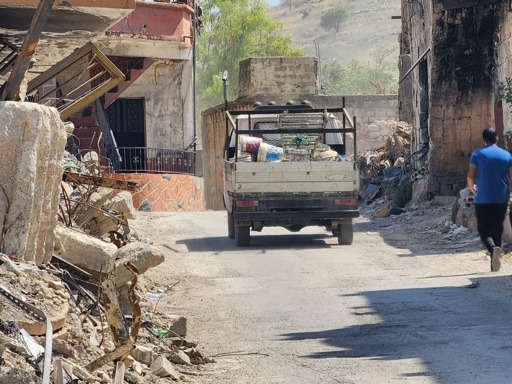

As Lebanon’s government tentatively pursues peace talks with Israel. Following US orders, calls to disarm Hezbollah have grown louder, even though the Lebanese Armed Forces remain underfunded and outgunned. For many residents of south Lebanon, the prospect of a disarmed resistance group revives a darker memory: the Sabra and Shatila refugee camp massacre of 1982. It took place when right-wing militias enabled by the Israeli occupation slaughtered Palestinian and Lebanese civilians.
Lebanon and Israel almost signed a peace deal
Following the Israeli invasion of 1982, Lebanon embarked on what was portrayed as its most serious attempt at achieving a comprehensive peace with Israel. In May 1983, under U.S. sponsorship, Beirut and Tel Aviv signed the “May 17 Agreement,” which promised — at least on paper — to end the state of war between the two countries. The deal outlined Israel’s withdrawal according to an attached timetable, the creation of security arrangements, a buffer zone, a mutual commitment to prevent the use of either countries’ territory for “hostile activity,” the formation of a joint liaison committee, and even future talks on the movement of goods and people.
Yet despite the grand language, the agreement never gained legitimacy inside Lebanon. The majority of Lebanese citizens opposed it. On March 5, 1984, it was officially scrapped. Its collapse stemmed primarily from Syria’s absolute rejection: President Hafez al-Assad and Foreign Minister Abdul Halim Khaddam viewed the accord as a direct threat to Syrian security and an infringement on Lebanon’s sovereignty and strategic autonomy. Facing Syrian pressure — and fearing the political consequences — President Amin Gemayel ultimately backed down and revoked the agreement.
Sabra and Shatila

Sabra and Shatila’s shadow is still cast across Beirut and the South. Between 16–18 September 1982, around 400 members of the right-wing Lebanese Phalange militia operating inside Beirut’s Sabra neighbourhood and the adjacent Shatila camp killed almost 3000 unarmed civilians. The massacre was carried out after Israeli forces’ secured presence all around the area. What’s noteworthy is that the massacre took place after the Palestinian resistance factions all agreed to disarm. The disarmament was agreed to after guarantees from the US, France, and Italy (who had troops stationed close by) that all civilians would be safe and protected.

For many Lebanese southerners today, disarming a major resistance group — without ironclad guarantees — feels like risking the same scenario all over again.
That fear resurfaced sharply this year when the Lebanese state announced plans to disarm Palestinian factions inside the refugee camps, starting with Sabra and Shatila. The decision immediately alarmed residents.
Speaking to The Canary, Amal Akar, a 55-year-old shop owner in Shatila, said:
I was shot in the eye during the massacre. The horrors I saw cannot be described,
We carried white flags that night, but the militias slaughtered us anyway, as Israeli forces blocked the exits. The Lebanese state was responsible then, and it is still weak today.
The South of Lebanon

Her anxiety is echoed in the South, where people view current calls to disarm Hezbollah through the same lens of vulnerability. “The state is throwing itself into Israel’s arms,” said 50-year-old Hasan Awada from Aitaroun. For him and many others, the Sabra and Shatila massacre is not a historical memory, but a historical warning about how quickly civilians can be abandoned when power dynamics shift. In their view, today’s Lebanese state appears more willing to appease US and Israeli demands than to uphold sovereignty — or defend border communities.
Across southern villages, families speak of a “vacuum of protection” that could leave them facing the same fate as the Palestinian refugees in 1982. When militias and occupying forces exploited a moment of political collapse and security breakdown to massacre civilians. Today, with peace negotiations advancing and talk of disarmament growing louder, many in the south fear that without concrete guarantees, international oversight, and a capable national army, they too could be caught between an emboldened enemy and a weakened state — once again paying the price of decisions made far from their homes.
Awada insists that disarming any group confronting Israel, while the army remains weak, would “give Israel free rein in the region, and it will commit more massacres.” He recalls how the national resistance — leftists, Arab nationalists, Islamic groups, and later Hezbollah — filled the vacuum created by the state’s failures.
He asks:
How can we trust this state or Israel? When Israel is occupying our lands, committing genocide in Gaza, and preventing civilians from living normally in border towns? Believing peace with Israel is possible is like believing milk is black.
What peace?
In the end, any talk of a “historic peace” falls apart when Israel shows no genuine interest in peace. It continues to violate Lebanese sovereignty, expand its military footprint, and strike inside Lebanon even as negotiations are underway in what is referred to as the “mechanism”
There have been around 2,850 violations, 331 people killed and 669 airstrikes recorded, according to the Lebanese Ministry of Health. A deal built on such a foundation is not a peace agreement but an illusion.
Lebanon cannot gamble its people’s safety on promises Israel undermines daily. Disarming a local force while the national army remains weak — under the assumption that Israel will suddenly respect borders and civilian life. It is political negligence. True peace cannot be enforced through foreign pressure or wishful thinking, especially when the “guarantor” is the same power arming Israel, granting it complete impunity, and sending it ‘side letters’.
Lebanon’s leaders must recognise that entering such an agreement is not a step toward stability. Rather, it is a step toward surrendering the security and dignity that Lebanese, especially in the south, have already paid for too many times in blood.
Featured image provided via author
From Canary via This RSS Feed.